Gallery of fluid motion: Evocative images and animations bring the science of fluid dynamics to life
Nov 17, 2011
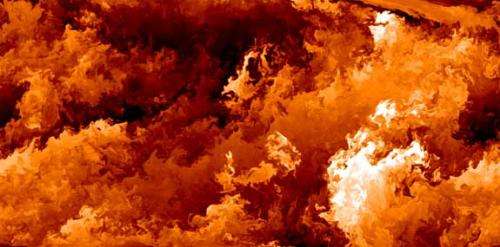
Direct numerical simulation of stratified turbulence. Lighter colors correspond to denser fluid. Image: Georgios Matheou and Daniel Chung

The beauty of science often is contained in elegant formulas or compelling data. For the study of fluid dynamics, fortunately, that beauty also is manifest in enticing images and animations of interesting phenomena. These images and animations also provide important scientific insights into the complex flow of materials under a wide variety of conditions.

Every year, the American Physical Society's (APS) Division of (DFD) hosts posters and videos that show stunning , graphics, and animations from either computational or experimental studies of flow phenomena. The most outstanding entries are selected by a panel of for artistic content and honored for their originality and ability to convey information. To further highlight this important work and to draw attention to the breadth and impact of fluid dynamics research, a subset of these images and videos has been made available for viewing prior to the judging process.

This preview gallery is part of the APS/DFD Virtual Press Room, which highlights research to be presented at the 64th APS Division of Fluid Dynamics Annual Meeting, held from November 20-22, 2011, in Baltimore, Md. These images were selected for their evocative qualities, artistic merit, and ability to represent complex physics concepts in an approachable manner.

Images include simulations of roiling colors in a turbulent environment, the bouncing of balls in puddles, the darting tongue of a , and the careful trapping of a single red blood cell. Animations include the complex freezing of a droplet of water, the flight of a water-lily beetle, and the elegant motion of two entangled water jets.

Explore further: Physicists suggest possible existence of other kinds of dark matter

More information: The complete galleries can be viewed here:

www.aps.org/units/dfd/pressroom/gallery/index.cfm
www.aps.org/units/dfd/pressroom/videos/index.cfm

Provided by American Institute of Physics

not rated yet
add to favorites email to friend print save as pdf

Related Stories

Mathematicians promise animation revolution

Mar 30, 2005

CSIRO mathematicians are combining art and science to solve one of the last big challenges in animation – fluids. They are aiming to develop techniques for fluid animations that are so realistic audiences wil ...

Robotic clam digs in mudflats

Nov 22, 2009

To design a lightweight anchor that can dig itself in to hold small underwater submersibles, Anette (Peko) Hosoi of MIT borrowed techniques from one of nature's best diggers -- the razor clam.

Photos show how a specific fluid defies normal activity

Nov 30, 2010

An illustration showing a scientific phenomenon that defies common intuition has garnered Sunghwan (Sunny) Jung, assistant professor of engineering science and mechanics at Virginia Tech, and his doctoral ...

Butterfly proboscis to sip cells

Nov 22, 2009

A butterfly's proboscis looks like a straw -- long, slender, and used for sipping -- but it works more like a paper towel, according to Konstantin Kornev of Clemson University. He hopes to borrow the tricks of this piece ...

Generating electricity from air flow

Nov 22, 2009

A group of researchers at the City College of New York is developing a new way to generate power for planes and automobiles based on materials known as piezoelectrics, which convert the kinetic energy of motion into electricity. ...

Measuring and modeling blood flow in malaria

Nov 23, 2009

When people have malaria, they are infected with Plasmodium parasites, which enter the body from the saliva of a mosquito, infect cells in the liver, and then spread to red blood cells. Inside the blood cells, the parasites ...

Recommended for you

Engineers pioneer flat spray-on optical lens

May 23, 2013

A University of British Columbia engineer and a team of U.S. researchers have made a breakthrough utilizing spray-on technology that could revolutionize the way optical lenses are made and used.

How do cold ions slide

May 23, 2013

Things not always run smoothly. It may happen, actually, that when an object slides on another, the advancement may occur through a 'stop and go' series in the characteristic manner which scientists call ...

User comments : 0

More news stories

A quantum simulator for magnetic materials

Physicists understand perfectly well why a fridge magnet sticks to certain metallic surfaces. But there are more exotic forms of magnetism whose properties remain unclear, despite decades of intense research. ...

Spheres can form squares

Everybody who has tried to stack oranges in a box knows that a regular packing of spheres in a flat layer naturally leads to a hexagonal pattern, where each sphere is surrounded by six neighbours in a honeycomb-like ...

ACOG: Hormone therapy not recommended to prevent CHD

(HealthDay)—Menopausal hormone therapy should not be used for prevention of coronary heart disease, according to a Committee Opinion from the American College of Obstetricians and Gynecologists (ACOG) published ...