Fukushima radiation 'mostly fell in sea': study
Nov 17, 2011
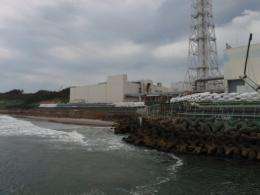
File photo of white sandbags placed around TEPCO's Fukushima nuclear power plant. Most of the radioactive fallout from the disaster at the Fukushima nuclear plant dropped into the ocean and began circling the planet, Japanese researchers said Thursday.

Most of the radioactive fallout from the disaster at the Fukushima nuclear plant dropped into the ocean and began circling the planet, Japanese researchers said Thursday.

Up to 80 percent of the released by the Fukushima Daiichi power plant landed in the Pacific and made its way into other oceans around the world, scientists at the Meteorological Research Institute said.

"The rest has fallen on land" in and around Fukushima, said Hiroshi Takahashi, a researcher at the institute in Ibaraki, northeast of Tokyo.

"The results mean the ocean was more contaminated than land, although recent data have shown that ocean pollution resulting from the accident was well below levels affecting humans," Takahashi said.

Researchers say the radioactive materials, including caesium-137, an isotope with a half-life of more than 30 years, were widely dispersed when they entered the oceans and each particle would measure less than one micrometer -- one seventh the size of a human .

Using , they calculate the material was first blown northeast over eastern Russia and Alaska, before falling into the Pacific and reaching the western coast of the mainland United States around March 17, Takahashi said.

The materials were believed to have completed their first around-the-globe trip by March 24, he said, adding that the results would be presented to an academic meeting in Nagoya, central Japan.

Several previous studies, including one produced in France last month, have concluded the fallout had been hugely diluted by and, except for near-shore species, posed no discernible threat.

Japan has been on alert for the impact of radiation since an earthquake and resulting tsunami struck the northeast of the country on March 11, crippling the Fukushima Daiichi .

Its cooling systems were knocked offline and reactors were sent into meltdown, resulting in the leaking of radiation into the air, oceans and food chain.

Explore further: Slovenian flyer lands in France on return trip from Arctic

add to favorites email to friend print save as pdf

Related Stories

Some land in Japan too radioactive to farm: study

Nov 15, 2011

Farmland in parts of Japan is no longer safe because of high levels of radiation in the soil, scientists have warned, as the country struggles to recover from the Fukushima atomic disaster.

Japan finds radiation traces in whales

Jun 15, 2011

Japanese whale hunters have found traces of radioactive caesium in two of the ocean giants recently harpooned off its shores in the Pacific Ocean, a fisheries agency official said Wednesday.

Mountains limited spread of fallout from Fukushima

Nov 14, 2011

A map of radioactive contamination across Japan from the Fukushima power plant disaster confirms high levels in eastern and northeastern areas but finds much lower levels in the western part of the country, thanks to mountain ...

Areva to set up treatment system at Japan plant

Apr 19, 2011

French nuclear group Areva said Tuesday it will set up a system to treat radioactive water from a quake-hit Japanese power plant to allow power supplies and cooling systems to be repaired.

Fukushima nuke pollution in sea 'was world's worst'

Oct 27, 2011

France's nuclear monitor said on Thursday that the amount of caesium 137 that leaked into the Pacific from the Fukushima disaster was the greatest single nuclear contamination of the sea ever seen.

Recommended for you

Century-old science helps confirm global warming

17 hours ago

(Phys.org) —Ocean measurements taken more than 135 years ago during the scientific expedition of HMS Challenger have provided further confirmation of human-produced global warming over the past century.

Be prepared for weather extremes

19 hours ago

Unsettled weather is an Iowa mainstay, and so is Inside's annual reminder of the university's severe weather safety and preparedness guidelines—for storms, extreme heat, flooding and more.

User comments : 0

More news stories

A hidden population of exotic neutron stars

(Phys.org) —Magnetars – the dense remains of dead stars that erupt sporadically with bursts of high-energy radiation - are some of the most extreme objects known in the Universe. A major campaign using ...

Hubble reveals the ring nebula's true shape

(Phys.org) —The Ring Nebula's distinctive shape makes it a popular illustration for astronomy books. But new observations by NASA's Hubble Space Telescope of the glowing gas shroud around an old, dying, ...

NASA head views progress on asteroid lasso mission

Surrounded by engineers, NASA chief Charles Bolden inspected a prototype spacecraft engine that could power an audacious mission to lasso an asteroid and tow it closer to Earth for astronauts to explore.

Controlling mood through the motions of mitochondria

(Medical Xpress)—Regulating the distribution of power in neurons is done by a system that makes the national electric grid look simple by comparison. Each neuron has several thousand mitochondria confined ...

A quantum simulator for magnetic materials

Physicists understand perfectly well why a fridge magnet sticks to certain metallic surfaces. But there are more exotic forms of magnetism whose properties remain unclear, despite decades of intense research. ...