Blossom end rot: Transport protein identified
Nov 23, 2011
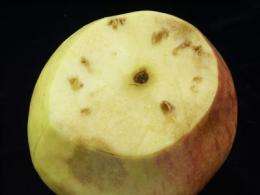
This is a spotty apple due to poor calcium distribution. Credit: Picture: Agroscope

Poor calcium distribution in agricultural crops causes substantial loss of income every year. Now a Korean-Swiss research team under the co-leadership of plant physiologists at the University of Zurich identified a protein that regulates calcium transport in the plant root and up to the shoot. For plant breeding, the specific transport protein provides a first step toward correcting deficiency symptoms in food plants.

Blossom end rot on tomatoes and cucumbers, bitter-pit in apples – these unpleasant blemishes on fruits and vegetables not only compromises the flavor but also causes significant harvest losses every year. The characteristic blotches and spotting can be traced back to insufficient calcium uptake or faulty calcium transport within the plant. Consequently, the damage can occur even if the soil provides sufficient calcium.

A team under the leadership of scientists from the University of Zurich and Pohang University of Science and Technology, Korea, has for the first time identified a protein which is responsible for the calcium transport from the root to the shoot. "Without this , plants exhibit stunted growth," explains Enrico Martinoia, Professor for Molecular Plant Physiology at the University of Zurich.
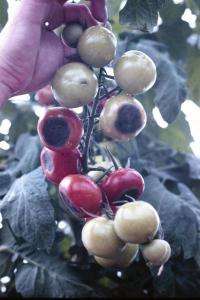
This shows blossom end rot on tomatoes. Credit: Picture: Agroscope

Calcium provides stable cell walls for plants and transmits signals within the cells. Calcium concentration varies within the plant depending on area, which requires complex regulation and transport mechanisms. How and from which tissue calcium ions are taken up by the roots and transported to the shoot of the plant was largely unknown before. In order to settle these questions, the scientists examined the cultivated plant Brassica Juncea, commonly known as brown or Indian mustard, and the model plant Arabidopsis thaliana, or thale cress. The researchers identified a specific transport protein which advances calcium ions from the root into the shoot.

In their article recently published in the Proceedings of the National Academy of Sciences, they also show that the calcium uptake occurs via the root epidermis and not through the endoderm as earlier presumed. The identification of the transport protein for is a first step in eliminating the formidable deficiency symptoms in food plants.

Explore further: Researchers conduct first genomic survey of human skin fungal diversity

More information: Wong-Yong Song, Kwan-Sam Choi, De Angeli Alexis, Enrico Martinoia and Youngsook Lee. Brassica juncea plant cadmium resistance 1 protein (PCR1) facilitates the radial transport of calcium in the root. PNAS. October 14, 2011. doi: 10.1073/pnas.1104905108

add to favorites email to friend print save as pdf

Related Stories

How plants manage calcium may reduce effects of acid rain

Mar 09, 2007

A new understanding of how plants manage their internal calcium levels could lead to modifying plants to avoid damage from acid rain. The pollutant disrupts calcium balance in plants by leaching significant amounts of the ...

How roots find a route

Feb 28, 2008

Scientists at the John Innes Centre in Norwich have discovered how roots find their way past obstacles to grow through soil. The discovery, described in the forthcoming edition of Science, also explains how ...

Unraveling plant reactions to injury

May 27, 2011

Better understanding of plant defense systems, and the potential to generate stress-tolerant plants and even new malaria drugs, may all stem from the documentation of a molecular mechanism that plays a significant ...

Getting to the root of nutrient sensing

Jun 14, 2010

New research published by Cell Press in the June 15th issue of the journal Developmental Cell, reveals how plants modify their root architecture based on nutrient availability in the soil.

Recommended for you

Fast new, one-step genetic engineering technology

19 hours ago

A new, streamlined approach to genetic engineering drastically reduces the time and effort needed to insert new genes into bacteria, the workhorses of biotechnology, scientists are reporting. Published in ...

100K Pathogen Genome Project maps first genomes

20 hours ago

(Phys.org) —Striking a blow at foodborne diseases, the 100K Pathogen Genome Project at the University of California, Davis, today announced that it has sequenced the genomes of its first 10 infectious microorganisms, including ...

New DNA cattle test beefs up dairy and meat quality

20 hours ago

(Phys.org) —A genomics technique developed at Cornell to improve corn can now be used to improve the quality of milk and meat, according to research published online May 17 in the journal PLOS ONE.

Strawberry fields forever and fungus-free

20 hours ago

(Phys.org) —Strawberries are one of the most economically important berry crops in the world, and a high value export crop for the Australian horticultural industry.For the first time, researchers at The ...

User comments : 1

Adjust slider to filter visible comments by rank

Display comments: newest first

Pirouette
not rated yet Nov 23, 2011
Very good news for farming producers.

More news stories

Theorists weigh in on where to hunt dark matter

(Phys.org) —Now that it looks like the hunt for the Higgs boson is over, particles of dark matter are at the top of the physics "Most Wanted" list. Dozens of experiments have been searching for them, but ...