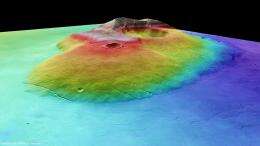
Battered Tharsis Tholus volcano on Mars
November 9, 2011

Battered Tharsis Tholus volcano on Mars

Enlarge

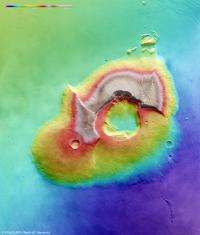
Tharsis Tholis towers 8 km above the surrounding terrain. Its base stretches 155 x 125 km and what marks it out as unusual is its battered condition. The main feature of Tharsis Tholus is the caldera at its centre. It has an almost circular outline, about 32 x 34 km, and is ringed by faults where the caldera floor has subsided by as much as 2.7 km. The image was created using a Digital Terrain Model (DTM) obtained data taken by the High Resolution Stereo Camera on ESA’s Mars Express spacecraft during four orbits of Mars: 0997, 1019, 1041, 1052 between 28 October and 13 November 2004. Elevation data from the DTM is colour coded: purple indicates the lowest lying regions and beige the highest. The scale is in metres. Credits: ESA/DLR/FU Berlin (G. Neukum)

(PhysOrg.com) -- The latest image released from Mars Express reveals a large extinct volcano that has been battered and deformed over the aeons.

By Earthly standards, Tharsis Tholus is a giant, towering 8 km above the surrounding terrain, with a base stretching over 155 x 125 km. Yet on Mars, it is just an average-sized volcano. What marks it out as unusual is its battered condition.

Shown here in images taken by the HRSC high-resolution stereo camera on ESA's Mars Express spacecraft, the volcanic edifice has been marked by dramatic events.

At least two large sections have collapsed around its eastern and western flanks during its four-billion-year history and these are now visible as scarps up to several kilometres high.

The main feature of Tharsis Tholus is, however, the caldera in its center.
Battered Tharsis Tholus volcano on Mars
Enlarge

Tharsis Tholis towers 8 km above the surrounding terrain with a base that stretches 155 x 125 km and a central caldera measuring 32 x 34 km. The image was created using a Digital Terrain Model (DTM) obtained from the High Resolution Stereo Camera on ESA’s Mars Express spacecraft. Elevation data from the DTM is colour coded: purple indicates the lowest lying regions and beige the highest. The scale is in metres. In these images, the relief has been exaggerated by a factor of three. Credits: ESA/DLR/FU Berlin (G. Neukum)

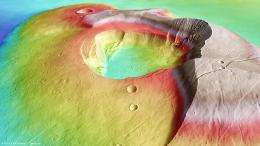
It has an almost circular outline, about 32 x 34 km, and is ringed by faults that have allowed the caldera floor to subside by as much as 2.7 km.  

It is thought that the volcano emptied its magma chamber during eruptions and, as the lava ran out onto the surface, the chamber roof was no longer able to support its own weight.

So, the collapsed, forming the large caldera.

Battered Tharsis Tholus volcano on Mars
Enlarge

Tharsis Tholis towers 8 km above the surrounding terrain with a base that stretches 155 x 125 km and a central caldera measuring 32 x 34 km. The image was created using a Digital Terrain Model (DTM) obtained from the High Resolution Stereo Camera on ESA’s Mars Express spacecraft. Elevation data from the DTM is colour coded: purple indicates the lowest lying regions and beige the highest. The scale is in metres. In these images, the relief has been exaggerated by a factor of three. Credits: ESA/DLR/FU Berlin (G. Neukum)

November is a busy month for Mars exploration: Russia and NASA both plan launches this month.

Russia's Phobos–Soil (formerly known as Phobos–Grunt) is designed to land on Phobos, the larger of Mars' two moons, to collect samples, and return them to Earth in 2014. It also carries the first Chinese spacecraft to Mars, Yinghuo-1.

HRSC digital elevation models of Phobos were used by Russian scientists to assess the mission's potential landing sites and ESA is also providing telecommunications support for both Phobos–Soil and Yinghuo-1.

In return, the European scientific community will have access to data obtained by both spacecraft.

NASA's mission is the Mars Science Laboratory, a large rover known as Curiosity, with experiments designed to detect organic molecules – past or present – on the Red Planet.

Also worth noting is the simulated mission, Mars500, which ended on Friday when the hatch was opened for the first time since June 2010. For 520 days, the international crew had been working in a simulated in Moscow.

Provided by European Space Agency search and more info website

3.7 /5 (3 votes)  

Rank 3.7 /5 (3 votes)
Relevant PhysicsForums posts
  • Distance of planets from stars and revolution
    created3 hours ago
  • revamping general concept and cosmological principle
    createdMay 25, 2012
  • Transiting Exoplanet Light Curve
    createdMay 25, 2012
  • Math behind Theoretical Physics
    createdMay 24, 2012
  • Do we know whats at the center of galaxies yet?
    createdMay 23, 2012
  • Structure of the Milky Way?
    createdMay 20, 2012
  • More from Physics Forums - General Astronomy

More news stories

Land and sea species differ in climate change response: study

(Phys.org) -- Marine and terrestrial species will likely differ in their responses to climate warming, new research by Simon Fraser University and Australia’s University of Tasmania has found.

Space & Earth / Environment

created 55 minutes ago | popularity not rated yet | comments 1 | with audio podcast

Yale study concludes public apathy over climate change unrelated to science literacy

Are members of the public divided about climate change because they don't understand the science behind it? If Americans knew more basic science and were more proficient in technical reasoning, would public consensus match ...

Space & Earth / Environment

created 2 hours ago | popularity 4 / 5 (1) | comments 10 | with audio podcast

10 million years needed to recover from mass extinction

It took some 10 million years for Earth to recover from the greatest mass extinction of all time, latest research has revealed.

Space & Earth / Earth Sciences

created 2 hours ago | popularity not rated yet | comments 1 | with audio podcast

Sophisticated simulations predict future warming

The chances of our planet being hit by a global warming of 3 degrees Celsius by 2050 is as likely as it being hit by an increase of 1.4 degrees, new research shows. Presented in the journal Nature Geoscience, the British study ...

Space & Earth / Earth Sciences

created May 22, 2012 | popularity 4.4 / 5 (9) | comments 51

Aliens don't want to eat us, says former SETI director

Alien life probably isn’t interested in having us for dinner, enslaving us or laying eggs in our bellies, according to a recent statement by former SETI director Jill Tarter.

Space & Earth / Space Exploration

created May 25, 2012 | popularity 4.4 / 5 (14) | comments 39


Almost half of new vets seek disability

(AP) -- America's newest veterans are filing for disability benefits at a historic rate, claiming to be the most medically and mentally troubled generation of former troops the nation has ever seen.

'Unzipped' carbon nanotubes could help energize fuel cells, batteries

Multi-walled carbon nanotubes riddled with defects and impurities on the outside could replace some of the expensive platinum catalysts used in fuel cells and metal-air batteries, according to scientists at ...

T cells 'hunt' parasites like animal predators seek prey, study shows

By pairing an intimate knowledge of immune-system function with a deep understanding of statistical physics, a cross-disciplinary team at the University of Pennsylvania has arrived at a surprising finding: T cells use a movement ...

Computer model used to pinpoint prime materials for efficient carbon capture

When power plants begin capturing their carbon emissions to reduce greenhouse gases – and to most in the electric power industry, it's a question of when, not if – it will be an expensive undertaking.

Change in developmental timing was crucial in the evolutionary shift from dinosaurs to birds: study

At first glance, it's hard to see how a common house sparrow and a Tyrannosaurus Rex might have anything in common. After all, one is a bird that weighs less than an ounce, and the other is a dinosaur that ...

Nvidia trumpets Tegra 3 phone design wins for 2012

(Phys.org) -- Nvidia’s competitive war paint has a name, Tegra 3. On the heels of Nvidia announcements about lowering costs of its Tegra 3 processors and Nvidia-enabled tablets running Android Ice Cream ...