AUVs: From idea to implementation
Since the 1970s, when early autonomous underwater vehicles (AUVs) were developed at MIT, Institute scientists have tackled various barriers to robots that can travel autonomously in the deep ocean. This four-part series examines current MIT efforts to refine AUVs’ artificial intelligence, navigation, stability and tenacity.
As the search for oil and natural-gas resources moves into deeper and deeper water, companies are facing increasing costs. Building and installing a single offshore drilling platform now costs more than a billion dollars, so companies are using their platforms as efficiently as possible. Advances in technology have enabled them to service several oil fields from a single platform, and much of the infrastructure for well operations has moved to the seafloor, which may be as much as 4,000 meters — almost 2.5 miles — below the surface. As a result, inspecting, servicing and repairing underwater equipment has become an ever-greater challenge.
Many companies accomplish those tasks using remotely operated vehicles (ROVs), robots that are operated by a person aboard a surface vessel. Because radio signals do not propagate through seawater, the ROVs are connected to the vessel by cables that carry data as well as power. But as the distance between a platform and its wells has increased, the cables, or “tethers,” have become longer and heavier. To support that weight, the vessels needed to launch and recover them have become larger and more expensive. Running an ROV and its ship now costs around $250,000 per day.
For the past two decades, MIT researchers have been working on a different approach, motivated by the notion that “small is good” — the operating premise of Chryssostomos Chryssostomidis, director of the MIT Sea Grant College Program, the Doherty Professor of Ocean Science and Engineering and professor of mechanical and ocean engineering.
“In the late 1980s, I suggested a revolutionary concept: an underwater vehicle that has no tether and travels in the deep ocean without input from an operator,” Chryssostomidis says.
Chryssostomidis’ proposed AUV would be fully functional, but small enough so that deploying it wouldn’t require a huge ship. Getting rid of the tether would make it far more maneuverable and flexible. It could get into small spaces — for example, after an accident — without worrying about the tether dragging along and getting tangled.
The goal, therefore, was to make an AUV that the offshore industry could use to service its deepwater operations — and that researchers could use to explore and monitor the deep ocean. To that end, in 1989 Chryssostomidis founded the Autonomous Underwater Vehicles Laboratory within the MIT Sea Grant College Program, and he and his colleagues began developing a series of AUVs.
A first challenge was how to navigate without knowing details of the deep-sea landscape. Early efforts were helped by insights from Rodney Brooks, now the Panasonic Professor of Robotics emeritus. Brooks’ idea was that the AUV — as with other robots — didn’t need to know anything about its environment. It only needed to know when it was approaching an obstacle and should go right, left, up or down to avoid a collision. “So he enabled me to start developing AUVs without having to address that problem,” Chryssostomidis says.
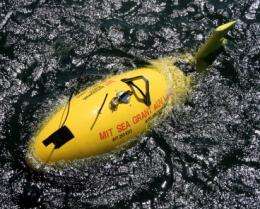
Since then, the lab has developed and demonstrated a series of AUVs, all of them small, relatively inexpensive and artificially intelligent. Of particular note was the early “Odyssey” series of vehicles, which had a torpedo shape with a streamlined horizontal axis designed for efficient cruising. For a decade, Odyssey II vehicles have run successful surveying missions, demonstrating rapid long-distance travel and good battery life due to their hydrodynamic efficiency.
But while surveys are important, they are not enough. “The next frontier is going to be intervention,” Chryssostomidis says. An AUV will examine, say, the footing of an oil platform or another piece of subsea equipment and then perform a task. An Odyssey II vehicle isn’t suited to such close study. Like a shark, it must keep swimming forward in order to maintain its maneuvering capability. As a result, it can prepare a detailed image of an object only by repeatedly circling over it, taking a photo at each pass.
Performing close-up inspections, service and repairs would be better accomplished by an AUV that could stop and hover in one place. Members of the AUV laboratory and their collaborators therefore designed a hovering AUV, which has a full six degrees of freedom while standing still and is extremely maneuverable. However, its lack of a streamlined axis doesn’t allow for efficient cruising, and its small thrusters and battery don’t provide enough force to withstand any but the smallest of currents.
Enter the Odyssey IV, a hybrid cruising/hovering vehicle that gains advantages from both vehicle designs. This two-meter-long craft has a smooth, teardrop profile derived from the streamlined body of the Odyssey II, and four commercial off-the-shelf thrusters: one in the bow, one in the stern, and two mounted on arms that protrude from the sides of the vehicle and can be rotated about its lateral axis. A custom-designed battery consisting of 648 lithium-ion cells provides the vehicle with the power necessary to fight currents and the longevity to dive to full ocean depth. The vehicle’s conservative size and weight make it deployable from small, less-expensive boats, but it still has room inside for a substantial payload.
In sea trials, the Odyssey IV has demonstrated that it can both move quickly and hover in place. It can travel through the deep ocean — 6,000 meters below the surface — at a rate of 1.4 meters per second when going straight ahead. Having located its objective, the Odyssey IV can hold its position to within centimeters of the desired location. If a current pushes it in one direction, its controller activates the appropriate thruster and brings it back into position. It can thus hover as a helicopter does, making detailed inspections of particular subsea structures or the natural landscape. It can also pick up samples and other cargo from the deep sea and bring them back to the surface for inspection and analysis.
Remaining challenges include developing better power-storage and communications capabilities so that the vehicles can stay underwater longer and send back more information to operators on shore. Chryssostomidis notes that his team has made great strides in both areas. The Odyssey IV has enough power that it can operate for a day or more without refueling, and an onshore operator can receive still frames of what the AUV is “seeing” with only a few seconds’ delay (due to the time it takes for sound to travel through water). The researchers continue to improve the efficiency with which video is transmitted underwater, largely due to new techniques of data compression developed by Milica Stojanovic, a visiting scientist at MIT Sea Grant and associate professor at Northeastern University.
What’s the future? To illustrate, Chryssostomidis refers to the blowout preventer: the device that’s at the heart of underwater operations and that dominated news reports about the April 2010 Deepwater Horizon accident. For now, he is sure he will be allowed to send an AUV within five meters of a blowout preventer and observe. If all goes well, he predicts that in a few years he’ll be allowed to have an AUV touch that critical piece of equipment. In a few decades, the AUV may perform a real repair. And one day, Chryssostomidis says, an AUV will be able to do tasks without a human in the loop. It will head underwater, locate a problem, make a judgment, formulate a plan and perform a repair — all on its own.
This story is republished courtesy of MIT News (web.mit.edu/newsoffice/), a popular site that covers news about MIT research, innovation and teaching.
More information: Next: Advanced mathematical techniques enable AUVs to survey large, complex, cluttered seascapes.
Provided by Massachusetts Institute of Technology


