As Assange awaits ruling, WikiLeaks faces its fate
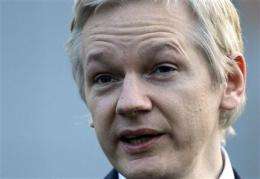
(AP) -- As Julian Assange awaits a judge's extradition verdict, it could be WikiLeaks' very future that's at stake.
Its finances under pressure and some of its biggest revelations already public, WikiLeaks may not have the strength to survive if Britain's High Court judge decides Wednesday in favor of a Swedish request to extradite Assange to face trial over rape allegations, some experts argue.
Tim Maurer, who has studied the group and its membership, said he wasn't sure whether its remaining staff had the tech savvy to run the site if its founder is absent.
"I don't think that WikiLeaks will exist without Assange," said Maurer, a research associate at the Harvard University's Belfer Center for Science and International Affairs.
Legal analysts were predicting a ruling in favor of extradition.
"Very, very few people defeat a European Arrest Warrant," said Julian Knowles, an extradition lawyer at London's Matrix Chambers who has been following the case. "The courts in England generally lean in favor of extradition."
Assange may have the right to challenge an unfavorable verdict in Britain's Supreme Court. But Knowles said that if he were denied leave to appeal, it could be only days before he were sent to Scandinavia to face allegations of sex crimes.
That result could be devastating for WikiLeaks.
For much of the past year Assange has been running the website from a supporter's country manor in eastern England, where the terms of his bail have confined him to virtual house arrest.
The 40-year-old Australian says he has 20 staff members, but it's unclear who might take over were he jailed. A few years ago two of his closest aides, Joseph Farrell and Sarah Harrison, were working as journalistic interns. WikiLeaks' spokesman, Icelandic journalist Kristinn Hrafnsson, is rarely reachable.
Even if Assange eventually wins his battle to the stay in the U.K., his fight will be far from over.
A U.S. grand jury is still weighing whether to indict him on espionage charges, WikiLeaks is straining under the weight of an American financial embargo which he says has starved it of nearly all its revenue, and some media organizations that previously worked closely with the website have since turned their backs to the online secret-spiller.
Perhaps most important is the question of whether Assange can still produce explosive leaks with his suspected chief source, Army intelligence analyst Bradley Manning, in detention.
Purported chat logs between Manning and the man who turned him in, Adrian Lamo, list the State Department cables, the Iraq war logs, and a sheaf of Guantanamo documents among the highlights of the material handed to WikiLeaks.
Except for an Afghanistan air strike video - which has allegedly been destroyed - all the material has since been published.
WikiLeaks' only other publicly announced disclosure since then, the purported hand-over of CDs packed with tax evasion secrets by Swiss banker Rudolf Elmer, turned into a big dud when Elmer's lawyers later claimed that the discs were blank.
Even if the spectacular revelations return - and Assange insists he's still sitting on hundreds of secrets - WikiLeaks may have trouble finding an outlet to publish them.
The WikiLeaks chief said last week that he'd struck deals with some 90 media and human rights groups. But he has long had a prickly relationship with the mainstream press, which he variously describes as corrupt, complicit with powerful governments, or - in a recent speech to demonstrators in London - "war criminals."
Many journalists return Assange's disdain.
"I don't think we'd ever work with him again," said Guardian Editor Alan Rusbridger, whose newspaper played a key role in last year's WikiLeaks disclosures.
Assange's conflicts with the Guardian (and The New York Times) are long-running, but reservations about WikiLeaks extend beyond the English-language press.
Concerns became especially acute after WikiLeaks published 250,000 diplomatic cables to the Web in their raw, uncensored form - a move many feared would lead to the persecution of sensitive diplomatic sources.
The circumstances of the release are disputed, but Javier Moreno, the director of Spain's El Pais newspaper, said it had breached his paper's agreement with the online secret-spiller.
"It is now too complicated to work with Julian Assange and WikiLeaks," Moreno told The Associated Press in September.
Other problems are looming. WikiLeaks is starved for cash, something Assange says is the result of the decision by MasterCard Inc., Visa, and other financial companies to block donations to his site late last year. Assange warned last week that his site could shut as soon as January if funding didn't pick up. Lawyers for his payment processor have lodged a complaint in Brussels.
Back in the United States, the grand jury investigation into Assange's activities continues, with government lawyers trawling through the Internet records of WikiLeaks' volunteers and supporters looking for evidence of criminal activity under U.S. laws.
While there are strong levels of support for the site internationally, Assange has received little sympathy on Capitol Hill, where Democrats and Republicans have both urged U.S. Attorney General Eric Holder to prosecute him for espionage.
"No one in political power defends WikiLeaks," said Steven Aftergood, director of the Project on Government Secrecy at the Federation of American Scientists.
Efforts to imitate WikiLeaks have stumbled, with The Wall Street Journal's SafeHouse program and the New York Times' own secure document submission system experiencing growing pains, according to a recent account carried in Forbes magazine. OpenLeaks, produced by Assange's collaborator-turned-rival, Daniel Domscheit Berg, has yet to go live.
Governments have also become more wary of the threat of WikiLeaks-style releases.
In early October, the White House announced a series of measures to guard U.S. government computer networks and classified material against leaks - including the creation of a special committee to coordinate information sharing and to ensure confidentiality.
But Dave Winer, a visiting scholar at New York University's Arthur L. Carter Journalism Institute, said that the spirit of WikiLeaks would live on whatever happened to the group - or to Assange.
"The technology that made WikiLeaks possible is not going away," he said.
©2011 The Associated Press. All rights reserved. This material may not be published, broadcast, rewritten or redistributed.


