Women making slow, sure strides in science, math
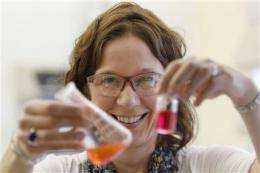
For many of the women, the chemistry lab was a home away from home - a sorority for nerds, of sorts, that hints at the slow but steady shift in technical fields that have been traditionally filled with men.
Rebecca Allred has fond memories of that lab at the College of William and Mary in Virginia. She and her peers spent hours there. They worked into the night for their professor, Elizabeth Harbron, because they wanted to, blowing off steam by dancing to the soundtrack of "Mamma Mia" or taking a break on Fridays to play Putt-Putt golf together.
Harbron was not only their mentor, but often a confidante. They shared their frustrations. They celebrated their successes. Several published their findings with Harbron's guidance, a rarity for undergraduates.
"That lab was a refuge between classes. I loved being there," says Allred, now a second-year doctoral student in the Yale University chemistry department and one of a new generation of young women who are helping change the face of the so-called STEM fields - science, technology, engineering and math.
Though she was happy to help blaze the path for them, Harbron says she didn't set out to create an all-women's lab. It happened naturally. Students like Allred sought her out because they liked her informal, lively teaching style.
"I don't want to become a female ghetto of over-achieving white girls," Harbron jokes, referring to the general makeup of her lab these days. Then she asks more seriously: "But am I just perpetuating the model that's gotten us where we are?"
In other words, she wonders, has she inadvertently created the female version of the "old boys' network"?
Whatever the answer, it's hard to argue with her results: her lab has become a place where these young women gained confidence to match their abilities, she says.
Many, like Allred, have gone on to graduate programs.
That's a big deal in the STEM fields, which have been slower than other disciplines to integrate women at the highest levels.
With two-thirds of all undergraduate degrees and 60 percent of master's degrees now going to women, many believe it's only a matter of time before that trend influences the upper echelons of the STEM fields.
Already, statistics from the Council of Graduate Schools show that women, overall, earned slightly more than half of the doctorates handed out in all disciplines in the United States in 2009 and 2010. When it comes to the STEM fields, women have been most successful in medicine and biology - and least successful in engineering, math and computer science.
But experts hope that, too, will change. A recent report from the American Association of University Women notes that, 30 years ago, the ratio of seventh- and eighth-grade boys who scored more than 700 on the SAT math exam, compared with girls, was 13 to 1. Now it's 3 to 1.
"You gotta fill up the pipeline and support these good people and, after a while, things get straightened out," says Thomas Pollard, dean of Yale's Graduate School of Arts and Sciences, which includes Allred's program.
Some would argue that that pipeline is still too leaky in the STEM fields.
"In an ideal world you'd expect that it'd catch up, but it doesn't quite catch up because we're still losing women at every level," says Ted Greenwood, a former director with the Alfred P. Sloan Foundation, which funds several STEM programs that target women and minorities.
That said, he and others note that women are still making more progress than minorities, particularly black men.
And even in fields like chemistry, engineering and math, the percentages of women who received doctorates still has steadily increased over the last decade, according to the Council of Graduate Schools report.
Rebecca Allred's path to a doctoral program provides a glimpse of how it's happening - and how crucial access and support can be.
---
It began, she says, with her first role model - her mother, Janet Mikulas.
Mikulas, who got her engineering degree in the 1970s from Virginia Tech, can hardly imagine what it would be like to have so many women peers, as her daughter did at William and Mary.
"You know," Mikulas remembers her mother whispering to her after she announced her major to her parents, "Dad always said you should be an engineer."
She was stunned. Why didn't she know this? Why hadn't her father told her?
Her mother explained, as best she could, that he had felt it was wrong to encourage her to enter a male-dominated field, that he thought he was supposed to encourage her to be a mother and a secretary.
"He did it with the very best of intentions. He taught me a million things all his life. I was his best buddy," Mikulas said. "But he couldn't quite tell me what he really thought."
Mikulas and her husband, also an engineer, vowed that it would be different for their daughters. "We decided that we'd let them be what they wanted to be," she says.
Some would say there was no way Allred - known as Rebecca Mikulas before she married her college sweetheart in 2009 - could have failed. She had educational opportunities that many do not, including a private school in rural Virginia where classes were small and where she was given the chance to study at her own pace. She also had the smarts, skipping kindergarten and second grade and taking college classes by the time she was in middle school.
She finished her high school requirements by age 16 but then decided to take more math and science courses at a public high school, where she also excelled at volleyball, basketball and track.
Her parents always worked to integrate math and science into everyday life on their family farm and during dinnertime conversations.
But she also had teachers who encouraged and challenged her - another key, experts say, in keeping girls engaged.
Her mother remembers how Rebecca's high school chemistry teacher put off retiring for a year so she could have Rebecca as a student in her advanced-placement class. The teacher was certain she'd be her first student to receive the top score of 5 on the AP chemistry test. And Rebecca did.
She was considering colleges, including Harvard, around the time when Harvard's then-president, Lawrence Summers, made controversial comments questioning women's aptitude for top-level science and math. He later stepped down.
Unfazed, 17-year-old Rebecca went to William and Mary on a track scholarship. There, she took a chemistry class with Harbron - and applied for a spot in Harbron's lab.
She quickly realized she'd found her next mentor.
"She was so animated and funny - and into what she was doing," Allred says of her professor. "I wanted to be a part of it."
When she first joined Harbron's lab, she was the only woman student.
"I had to learn my boy social dynamics," Allred says, laughing and noting that, at that point, many of her interactions at her Mormon church and in sports were with other women.
You wouldn't think that would matter much. But Harbron and other professors say there's an interesting dynamic they often see in coed labs. Women tend to hang back, they say, and let men take the lead role.
"They're so afraid of being wrong. I don't think guys have that fear," Harbron says. "If they're admitting they don't know something, then they are admitting a vulnerability.
"But what they don't realize is that other people don't know either."
Christina Davis, another student who was in Harbron's lab when Allred was there, remembers feeling stressed out by her need to be perfect, to have all the answers. She balked, at first, when Harbron refused to tell her what result she should expect in an experiment.
But Davis says she soon learned to love exploring the unknown in experiments, so much so that she, too, eventually decided to pursue a doctorate in chemistry instead of going to medical school.
"I stopped following the plan I had written when I was 7 and opened myself up to new possibilities," says Davis, who's now in the PhD program at the University of Texas and currently studying in South Korea.
Increasingly, some institutions are finding value in more formal all-women's programs in the STEM fields.
The all-women's Smith College in Massachusetts, for instance, bucked its liberal arts tradition and started an engineering program 10 years ago - a decision other all-women's schools are following.
Some students come to Smith knowing they want to be engineers. Others are drawn into the program by an introductory class called "Engineering for Everyone."
Another interesting result: Most of the students in the Smith program have ended up choosing mechanical or electrical engineering - specialties within that field that women have tended to avoid.
The program is also growing, averaging 20 students a year until this year, when that number doubled, says Donna Riley, an associate professor of engineering at Smith who helped found the program.
"Our teachers are stretched," Riley says of the uptick. "But it's a good problem to have."
Meanwhile, other institutions are targeting younger students, since research has shown that girls tend to lose interest in science and math in middle school. That research also has shown that income plays a greater role than gender when it comes to students who make it to the highest levels of the STEM fields.
That's why Pamela Clute, a math lecturer who is also assistant vice provost for academic partnerships at the University of California, Riverside, developed summer and after-school math programs for middle school girls - many of them from low-income neighborhoods.
She calls her program and its participants GEMS - Girls Excelling in Mathematics with Success.
The curriculum, she says, incorporates topics that the teen girls tell her they're interested in. They might be asked to solve math problems that incorporate questions about fashion and cell phones, for instance. They also are allowed to work in groups.
"If you say, algebra, people tend to vomit," Clute quips. But if you can show them how it applies to real life, she says, that attitude changes.
An interest in science and math was never an issue for Allred. When she was in middle school, she was asking questions at the dinner table that always seemed to spark an answer related to either topic.
Once, noticing that ice cubes get smaller in the freezer over time, she asked, "Where do ice cubes go?" her mother recalled. "And we would have a conversation around the dinner table about sublimation."
Then she'd go to school and tell her teacher about how a solid like an ice cube can turn to gas - "but never in a braggart way."
"She absorbed everything and liked to share it," her mom says. "And that feeling of success would motivate her to study more."
---
That motivation carried her to Yale, where she is now balancing parenthood with her studies. She and her husband Jacob Allred had a daughter, Anna, this past spring.
Allred hinted at their plan when she interviewed with various doctoral programs.
"Why would you have kids when you're going to school?" was the response she got from an official at one of the schools she considered. Only two schools she visited mentioned policies for parental leave, for any student.
Yale was one of them.
"I think it's being driven by doing the right thing as opposed to being used as a recruiting tool," says Pollard, the dean who oversees Allred's program and others at Yale. "But we all know that if you have good practices, you attract good students."
Pollard also concedes that he is particularly sensitive to parental issues because his own daughter, a junior professor at another institution, just had twins.
Among other things, he hopes the university will improve its day care options.
And he says the university just completed a report that examines how various departments can make sure their students - female or male - finish their programs.
Once again, Allred says she feels that crucial support, from her advisor and also her fellow students. Her husband also has agreed to stay home with Anna until Allred gets her doctorate, maybe by the time Anna is in kindergarten.
She jokes that she'll then take on the title of "Dr. Mom," certain that she will be able to add her name to the list of women with PhDs in the STEM fields that is growing - slowly but surely.
"I'm not sure where this is going to take me," Allred says. "I'm just so grateful that I'm here at a time when I can do this."
©2011 The Associated Press. All rights reserved. This material may not be published, broadcast, rewritten or redistributed.


