Sympathy for the devils
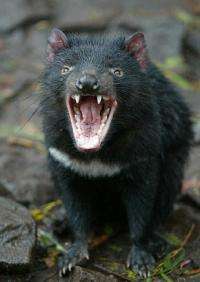
Better than sympathy, now there's hope for the devil -- the Tasmanian devil, that is.
The carnivorous little creature has suffered one of the most precipitous population declines ever documented. In 15 years, the devil -- once just as common in Tasmania as raccoons currently are across North America -- has become an endangered species. The threat to the devil is unprecedented; not loss of habitat, not hunting pressure, but a disease. And not just any disease, but an infectious tumor.
"Devil facial tumor disease has been a devastating, ongoing problem," said Menna Jones professor of zoology at the University of Tasmania in Australia. "We've had no good news since the first we learned of the existence of this disease."
No good news, that is, until now. As the disease has spread to the northwest corner of the island state of Tasmania, it has encountered a new population of devils. And the disease itself has changed. The result, as Jones' recent paper, published online by Conservation Biology, reports, is that the disease has stalled out in the west. Fewer devils are developing tumors and the ones that do are living longer.
The disease kills every devil it infects, and it has spread inexorably, from devil to devil, from the northeast throughout the island of Tasmania. In affected locations, only one of 10 devils remains. There is evidence that the lone remaining devil moved in only after all the others died. Efforts to stop the disease, by removing infectious individuals or by vaccination, have all failed. The last hope has been to isolate healthy devils in reserves as an insurance population, with plans to reintroduce them after the disease has burned itself out.
Researchers consider this to be a very serious "epizootic" -- the animal equivalent of an epidemic. The impact goes beyond the potential extinction of an iconic animal. The Tasmanian devil is a top predator. They keep invasive feral cats and foxes in check. Cats and foxes are largely responsible for the extinction of over 20 species of mammals in mainland Australia. In Tasmania, some of those affected species still exist in the wild, like the Eastern Quoll, the Pademelon, and the Bettong. But without the devils around, the last of these species would likely fall to cats and foxes.
This has seemed inevitable, until now.
"The population (in western Tasmania) is declining, but slowly, slower than it did in the east. And the devils are living with the tumor much longer -- it used to be that devils in the east with tumors would die within 3-6 months. In the west some are living with the tumors for 18 months," said Jones.
The disease produces an unusual tumor, which spreads as live cells between devils. When the devils squabble over carrion or as a prelude to mating, they pass the cells along. The devils do not mount an immune response to the tumors, at least in part because the disease and the animal share nearly identical cell marker genes. In the eastern regions, the population of devils had no immunological defense against the tumor, not even when a vaccine was crafted to create one.
When researchers examined devils from the west, they found two significant differences. Two exposed but uninfected devils had produced antibodies to the tumor -- something no devil had ever done before. And they found that the marker genes in the genome of the western devils were not the same.
The tumor had changed, too. The tumors infecting devils in the western area are tetraploid -- meaning they have duplicated chromosomes and four sets of each gene instead of two. These tetraploid tumors grow more slowly than the original tumors.
Whether the explanation for the improved outcomes is that western devils are resistant or the tetraploid quality of the tumor, the results are the first encouraging news the devils have had.
Jones considers these new findings to give them a "management lever." Whether it is the tumor or devil that is different, either one could be used to help squelch the disease as it spreads to other parts of the island. They could translocate resistant devils or even translocate the less virulent tumors to other sites -- a kind of assisted natural selection strategy that has never been tried before.
Jones remains cautiously optimistic, seeing the current findings as a glimmer of hope that the devils aren't doomed to extinction in the wild. Fellow Tasmanian scientist Elizabeth Murchison, who studies the disease affecting the devils as well as transmissible canine venereal tumors at the Wellcome Trust Sanger Institute in the U.K., agrees with Jones.
While Murchison finds the news exciting, she is also a bit cautious. Whether it is the devil that is resisting, or the tumor that is weakening, things can change.
"We shouldn't be too over-the-top hopeful, we shouldn't breath too huge a sigh of relief," said Murchison. "The disease is evolving, and tumors tend to evolve much more quickly than their hosts."
More information: Paper online: onlinelibrary.wiley.com/doi/10 … 011.01747.x/abstract
Source: Inside Science News Service


