New species of Albino trapdoor adds to biodiversity jigsaw
Oct 31, 2011 by Chris Thomas, ScienceNetwork
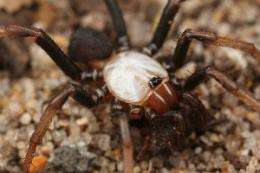
While the new spider is yet to be officially named, Dr Harvey says it adds a small piece to the overall giant biodiversity jigsaw puzzle. Credit: Volker Framenau

A new species of spider has been found near Northam -- just by chance.

The spider has been identified by the WA Museum as a new of trap door spider from the Idiopidae family.

Nicknamed the albino trapdoor spider, it was spotted by Grass Valley resident John Cornish on his back veranda in July.

The white-headed, black and brown-legged spider about the size of a 50-cent piece was captured in a jar and handed to the Northam office of the Department of Environment and Conservation.

Wheatbelt National Resource Management spider expert Mick Davis realised it was potentially a new species.

Senior curator of arachnology Dr. Mark Harvey says subtle differences on the pedipalp and front leg of the male indicated it was a new type of spider.

“The pedipalp is used to transfer sperm to the female during mating and the front legs are used to lift her body up,” Dr. Harvey says.

“Comparing the sizes of the processes and the number of small spines on these structures with other species of white-headed trap-door spiders shows sufficient differences to conclude it is a new species.”

Dr. Harvey says new spider species were often discovered in WA but many areas remain poorly surveyed in relation to invertebrates—especially highly seasonal and cryptic species such as trap-door spiders.

“It’s likely this species has a very small natural range that has been affected by land clearing,” he says. “It may simply be hanging on in small remnant vegetation patches.

“The spiders make burrows in the soil that have tight-fitting trap-door lids. These lids are often difficult to see and the spiders can remain undetected without careful observations.

“Once the males mature, they leave their burrows and wander in search of females.

While the new spider is yet to be officially named, Dr. Harvey says it adds a small piece to the overall giant biodiversity jigsaw puzzle.

“We know of hundreds of new species but have insufficient time to prepare scientific descriptions,” he says.

“Full descriptions take a long time to prepare and publish and we have a very long back-log of new species waiting in the queue.”

Dr. Harvey says the discovery does not change any scientific thinking on spiders, but adds, “It is cool to see such a strangely colored .”

Explore further: Navy dolphins discover rare old torpedo off Calif. coast near Coronado

Provided by ScienceNetwork Western Australia

4.7 /5 (3 votes)
add to favorites email to friend print save as pdf

Related Stories

Male wolf spiders cannibalize females

Apr 13, 2011

(PhysOrg.com) -- While most people are familiar with the fact that many species of female spiders eat their male counterparts, new research findings published in the Biological Journal of the Linnean Society show h ...

Male black widows look for well-fed mates

Jul 07, 2011

(PhysOrg.com) -- According to a new study published in Animal Behaviour, a male black widow spider is able to identify a female spider that has eaten well by simply taking a few steps on the web she spins. ...

Largest spider fossil found in China

Apr 21, 2011

(PhysOrg.com) -- According to Paul Selden, the director of the Paleontological Institute at the University of Kansas, he and his team members have discovered the largest spider fossil. The fossil was discovered ...

Recommended for you

Scientists take a new look at an ancient crop

16 hours ago

Though the price makes you wince, you might just buy that bottle of your favorite olive oil anyway. Perhaps it's exactly what you want for the salad dressing you're making tonight and for your special stir-fry ...

Bittersweet: Bait-averse cockroaches shudder at sugar

May 23, 2013

Sugar isn't always sweet to German cockroaches, especially to the ones that avoid roach baits. In a study published May 24 in the journal Science, North Carolina State University entomologists show the ne ...

White tiger mystery solved

May 23, 2013

White tigers today are only seen in zoos, but they belong in nature, say researchers reporting new evidence about what makes those tigers white. Their spectacular white coats are produced by a single change ...

User comments : 0

More news stories

EU bans three pesticides harmful to bees

The European Commission said Friday that it will ban for two years beginning in December pesticides blamed for killing the bees that pollinate food and fruit crops.

Galaxies fed by funnels of fuel

(Phys.org) —Computer simulations of galaxies growing over billions of years have revealed a likely scenario for how they feed: a cosmic version of swirly straws.

Google eyes emerging markets networks

Google has become deeply involved in a series of projects to build and operate wireless networks in emerging markets including sub-Saharan Africa and Southeast Asia, a report said Friday.