Special relativity may answer faster-than-light neutrino mystery
October 17, 2011 by Tammy Plotner, Universe Today
The relativistic motion of clocks on board GPS satellites exactly accounts for the superluminal effect, says physicist. Credit: axirv
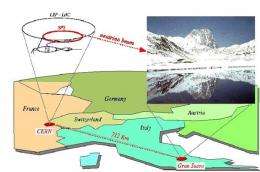
Oh, yeah. Moving faster than the speed of light has been the hot topic in the news and OPERA has been the key player. In case you didnt know, the experiment unleashed some particles at CERN, close to Geneva. It wasnt the production that caused the buzz, it was the revelation they arrived at the Gran Sasso Laboratory in Italy around 60 nanoseconds sooner than they should have. Sooner than the speed of light allows!
Since the announcement, the physics world has been on fire, producing more than 80 papers each with their own opinion. While some tried to explain the effect, others discredited it. The overpowering concensus was the OPERA team simply must have forgotten one critical element. On October 14, 2011, Ronald van Elburg at the University of Groningen in the Netherlands put forth his own statement one that provides a persuasive point that he may have found the error in the calculations.
To get a clearer picture, the distance the neutrinos traveled is straightforward. They began in CERN and were measured via global positioning systems. However, the Gran Sasso Laboratory is located beneath the Earth under a kilometre-high mountain. Regardless, the OPERA team took this into account and provided an accurate distance measurement of 730 km to within tolerances of 20 cm. The neutrino flight time is then measured by using clocks at the opposing ends, with the team knowing exactly when the particles left and when they landed.
But were the clocks perfectly synchronized?
Keeping time is again the domain of the GPS satellites which each broadcasting a highly accurate time signal from orbit some 20,000km overhead. But is it possible the team overlooked the amount of time it took for the satellite signals to return to Earth? In his statement, van Elburg says there is one effect that the OPERA team seems to have overlooked: the relativistic motion of the GPS clocks.
Sure, radio waves travel at the speed of light, so what difference does the satellite position make? The truth is, it doesnt... but the time of flight does. Here we have a scenario where one clock is on the ground while the other is orbiting. If they are moving relative to one another, this calculation needs to be included in the findings. The orbiting probes are positioned from West to East in a plane inclined at 55 degrees to the equator almost directly in line with the neutrino flight path. This means the clock on the GPS is seeing the neutrino source and detector as changing.
From the perspective of the clock, the detector is moving towards the source and consequently the distance travelled by the particles as observed from the clock is shorter, says van Elburg.
According to the news source, he means shorter than the distance measured in the reference frame on the ground and the OPERA team overlooks this because it thinks of the clocks as on the ground not in orbit. Van Elburg calculates that it should cause the neutrinos to arrive 32 nanoseconds early. But this must be doubled because the same error occurs at each end of the experiment. So the total correction is 64 nanoseconds, almost exactly what the OPERA team observes.
Is this the final answer for traveling faster than the speed of light? No. Its just another possible answer to explain a new riddle... and a confirmation of a new revelation.
More information: Time-of-flight between a Source and a Detector observed from a Satellite, arXiv:1110.2685v2 [physics.gen-ph] http://arxiv.org/abs/1110.2685
Abstract
The Michelson-Morley experiment shows that the experimental outcome of an interference experiment does not depend on the constant velocity of the setup with respect to an inertial frame of reference. From this one can conclude the existence of an invariant velocity of light. However it does not follow from their experiment that a time-of-flight is reference frame independent. In fact the theory of special relativity predicts that the distance between the production location of a particle and the detection location will be changed in all reference frames which have a velocity component parallel to the baseline separating source and detector in a foton time-of-flight experiment. For the OPERA experiment we find that the associated correction is in the order of 32 ns. Because, judging from the information provided, the correction needs to be applied twice in the OPERA experiment the total correction to the final results is in the order of 64 ns. Thus bringing the apparent velocities of neutrino's back to a value not significantly different from the speed of light. We end this short letter by suggesting an analysis of the experimental data which would illustrate the effects described.
Source: Universe Today
-
From lemons to lemonade: Reaction uses carbon dioxide to make carbon-based semiconductor,
32 comments
-
Thioridazine kills cancer stem cells in human while avoiding toxic side-effects of conventional cancer treatments,
3 comments
-
SpaceX private rocket blasts off for space station (Update),
42 comments
-
Climate scientists say they have solved riddle of rising sea,
31 comments
-
SpaceX capsule has 'new car' smell, astronauts say (Update),
3 comments
-
Water flow question
3 hours ago
-
[Drift velocity] Factors affecting velocity
6 hours ago
-
does cold gasoline have less energy
7 hours ago
-
distribution of molecules throughout the atmosphere
9 hours ago
-
The Global Positioning System !
10 hours ago
-
A Question relating Power
11 hours ago
- More from Physics Forums - General Physics
More news stories
Is a classical electrodynamics law incompatible with special relativity?
(Phys.org) -- The laws of classical electromagnetism that were developed in the 19th century are the same laws that scientists use today. They include Maxwell’s four equations along with the Lorentz la ...
Landmark calculation clears the way to answering how matter is formed
(Phys.org) -- An international collaboration of scientists, including Thomas Blum, associate professor of physics, is reporting in landmark detail the decay process of a subatomic particle called a kaon ...
May 25, 2012 |
4.3 / 5 (22) |
51
|
Lying in wait for WIMPs: Researchers seek to dramatically increase sensitivity of Large Underground Xenon detector
Although it's invisible, dark matter accounts for at least 80 percent of the matter in the universe. No one knows what it is, but most scientists would bet on weakly interacting massive particles, or WIMPs.
May 23, 2012 |
4 / 5 (7) |
15
|
Hawaii lab turns laser-powered bubbles into microrobots
(Phys.org) -- A team of scientists from the University of Hawaii are working on microrobots created from bubbles of air in a saline solution. The bubbles take on their title of robots as a laser ...
Sound increases the efficiency of boiling
Scientists at the Georgia Institute of Technology achieved a 17-percent increase in boiling efficiency by using an acoustic field to enhance heat transfer. The acoustic field does this by efficiently removing vapor bubbles ...
May 24, 2012 |
5 / 5 (2) |
2
'Unzipped' carbon nanotubes could help energize fuel cells, batteries
Multi-walled carbon nanotubes riddled with defects and impurities on the outside could replace some of the expensive platinum catalysts used in fuel cells and metal-air batteries, according to scientists at ...
T cells 'hunt' parasites like animal predators seek prey, study shows
By pairing an intimate knowledge of immune-system function with a deep understanding of statistical physics, a cross-disciplinary team at the University of Pennsylvania has arrived at a surprising finding: T cells use a movement ...
Computer model used to pinpoint prime materials for efficient carbon capture
When power plants begin capturing their carbon emissions to reduce greenhouse gases and to most in the electric power industry, it's a question of when, not if it will be an expensive undertaking.
Change in developmental timing was crucial in the evolutionary shift from dinosaurs to birds: study
At first glance, it's hard to see how a common house sparrow and a Tyrannosaurus Rex might have anything in common. After all, one is a bird that weighs less than an ounce, and the other is a dinosaur that ...
Yale study concludes public apathy over climate change unrelated to science literacy
Are members of the public divided about climate change because they don't understand the science behind it? If Americans knew more basic science and were more proficient in technical reasoning, would public consensus match ...
Same gene that stunts infants' growth also makes them grow too big: research
UCLA geneticists have identified the mutation responsible for IMAGe* syndrome, a rare disorder that stunts infants' growth. The twist? The mutation occurs on the same gene that causes Beckwith-Wiedemann syndrome, which makes ...
Oct 17, 2011
Rank: not rated yet
The rebuttal paper assumes the measuring clocks were on the satellites, but they were on the earth. Both labs synchronized using the satellite. Now, while the sync might have been flawed, it has been stated for years that such a sync can produce accuracy to about 1ns.
I am guessing the problem might be that the instrument delay times during the sync calibration were different than during the experiment. This could account for faster or slower neutrino times. This might also be possible since the system GPS sync was updated in 2008 and perhaps not all design time constraint assumptions have been retested (including maybe software upgrades if any). I think a different delay path could be used for syncing and then for testing.
However, the values of the Lorentz transform from the rebuttal did come really close to the 60ns.
Also, iirc, the neutrino data was taken over multiple years. The PDF of the transit times might be skewed from subset errors?
Oct 17, 2011
Rank: 5 / 5 (1)
I'm sure that some time during the years and millions spent checking these results, someone would have got two clocks synchronised at the mid point, and moved them to each end of the experiment.
What am I missing?
Oct 17, 2011
Rank: 1.3 / 5 (4)
As one of indicia, that the OPERA results cannot be ignored so easily, can serve the fact, these experiments fits well previous results.
http://www.scienc...ini2.jpg
Oct 17, 2011
Rank: not rated yet
It could also be that the neutrinos are faster and the problem is much less basic than we realise.
Fact is people aren't ready to give up on >c speeds so we'll continue to scruntinize this problem until we're blue in the face.
Oct 17, 2011
Rank: 1.2 / 5 (5)
The exception of neutrinos consist of the fact, they're very weak and subtle solitons, so that accidental fluctuations of underwater can occasionally wipe out the effect of surface deformation. Under such a situation, the neutrino propagates like underwater sound wave exclusively, i.e. much higher speed, than the surface ripples. During these rare moments the spreading of neutrino is literally detached from water surface, so it can propagate higher speed. This situation is the more probable, the higher speed the neutrino is - whereas low energy neutrinos would propagate in normal subluminal speed.
Oct 17, 2011
Rank: 1 / 5 (4)
This model is slightly complicated with fact, the space-time is not completely flat due the presence of CMBR fluctuations, so that the low energy neutrinos can still propagate with subluminal speed, until their energy is not higher, than the energy of CMBR photons. And the photons can spread with slightly superluminal speed, until their energy (i.e. frequency) is not higher, than the energy/frequency of CMBR photons.
Oct 17, 2011
Rank: not rated yet
Oct 17, 2011
Rank: 5 / 5 (1)
Why do you have to account for the delta in realitivistic distance between ground and sat references to each other? The GPS system already transmits a slower timing signal to account for time difference between sat and ground.
Oct 19, 2011
Rank: not rated yet
I don't think they read the same publication I read. The M-M experiment showed a variable velocity of light dependent on altitude. The results were published in Science in 1905 with great detail on the experimental setup and the analysis of the collected data.
Oct 19, 2011
Rank: not rated yet
http://www.aether...vity.gif
In general, the perspective based on breaking of symmetries enables to understand their connections deeper, whereas the perspective based on symmetries enables you to describe these connections more exact. It's tic-for-tac situation, which people should consider even when discussing another aspects of reality, including the politics, biology and social sciences. The more exact theories are less predicative and vice-versa.
Oct 19, 2011
Rank: not rated yet
My stance is, for chargeless neutrinos the analogy with charged particles cannot be applied - on the contrary, these neutrinos are moving with superluminal speed in brief moments of their life just because they're losing their charge during this (while changing into sterile Majorana neutrinos in this way). No charge - no radiation into outside.
Oct 19, 2011
Rank: 1 / 5 (1)
Oct 19, 2011
Rank: not rated yet
Oct 19, 2011
Rank: not rated yet
Oct 20, 2011
Rank: not rated yet
Oct 22, 2011
Rank: not rated yet
http://en.wikiped...ter_wave
Oct 23, 2011
Rank: not rated yet