Scientists film hagfish anti-shark slime weapon
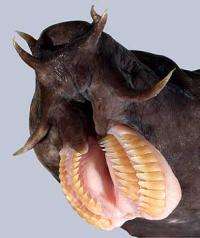
A hagfish showing its teeth.
(PhysOrg.com) -- The hagfish found in New Zealands deepest waters is grotesque enough, thanks to its scary protruding teeth straight from a horror film. Now, scientists have witnessed the full power of its other gruesome feature a built-in slime weapon to deter predators such as sharks, making it one of the planets ultimate survivors.
Researchers from Massey University and Te Papa have just released graphic underwater footage showing for the first time how the primitive hagfish also known as the snot-eel defends itself by emitting a choking, gill-clogging slime that might be the envy of any surfer under attack from a shark.
This video is not supported by your browser at this time.
The footage, part of a study of New Zealands deep-sea animal diversity, is from special cameras that captured images of various fish attacking hagfish off Three Kings and Great Barrier Islands as they feed on bait attached to the camera. As soon as it is attacked, the hagfish releases a gooey mucus-like substance from its battery of slime glands and up to 200 slime pores, causing predators to gag before hastily retreating.Our video footage in New Zealand waters has proven that hagfish secrete slime at an incredibly fast speed when under attack by predators such as large sharks or bony fishes, says Te Papas Dr Vincent Zintzen, lead scientist of the project.
A paper on the findings just published online in Scientific Reports (Nature Publishing Group) titled Hagfish predatory behaviour and slime defence mechanism describes the effectiveness of the copious slime in choking would-be predators without apparently poisoning or killing them. This in turn allows the hagfish to carry on feeding or to make an escape, clearly a success as an evolutionary strategy.
Other new findings include the discovery that the hagfish is not only an ocean scavenger but is also a predator with a twist. Footage reveals its bizarre method of burrowing into sand in pursuit of a red bandfish by knotting its tail for additional leverage as it grabs its hidden prey before unknotting and emerging from the sand.
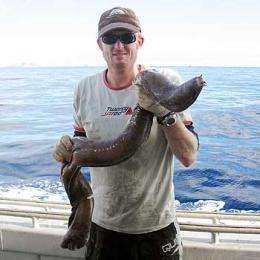
Te Papa researcher Carl Struthers with a hagfish.
Professor Marti Anderson, a marine biologist and statistician at Masseys New Zealand Institute for Advanced Study at Albany, co-authored the study. She says the footage provides clear evidence of how the unique slime defence mechanism works and also how hagfish exhibit different adaptive feeding strategies.
Taken together, the findings help to explain why the hagfish, a very primitive fish, has endured successfully for around 300 million years, she says. Anatomically modern humans have been around for just 200,000 years by comparison.
We know so very little about the deep sea. Simply dropping cameras into the water at a range of depths in a systematic design not only gives us good quantitative data to model diversity and behaviour, it also has a high probability of finding something new, says Professor Anderson. Using underwater video cameras, we can actually see fish in their own environment, which is far more informative than what can be learned from the often bedraggled specimens brought to the surface in research trawls.
Dr Clive Roberts, co-author and curator of fishes at Te Papa, says the ecological role of the hagfish may be far more diverse than previously considered. Hagfish, which are quite abundant in the deep sea, were previously observed feeding on carcasses of dead whales, fishes and invertebrates. Our video footage now clearly shows that hagfish are also hunters able to prey on live fishes.
Since 2009, the scientists have deployed cameras at depths ranging from 50 to 1500 metres around New Zealand. So far, over 1000 hours of footage has been collected off the Kermadec Islands, Three Kings Islands, Great Barrier Island, White Island and Kaikoura, with surveys to extend in 2012 to the sea off the Otago Peninsula and down as far as the Auckland Islands.
More information: The open-access article, which includes underwater videos, available through the following link: http://www.nature. … p/index.html
Provided by
Massey University
-
From lemons to lemonade: Reaction uses carbon dioxide to make carbon-based semiconductor,
32 comments
-
Thioridazine kills cancer stem cells in human while avoiding toxic side-effects of conventional cancer treatments,
3 comments
-
SpaceX private rocket blasts off for space station (Update),
42 comments
-
Climate scientists say they have solved riddle of rising sea,
31 comments
-
SpaceX capsule has 'new car' smell, astronauts say (Update),
4 comments
-
What would stain as translucent on light-coloured fabric?
22 hours ago
-
How do I identify different bacteria on culture plates?
May 26, 2012
-
Why Do Dogs do Strange things...
May 25, 2012
-
What does exophillic and endophillic mean in terms of mosquito and their control?
May 24, 2012
-
Semen stains glows under black lights (uv light)?
May 23, 2012
-
Question on Human Chromosome 2
May 23, 2012
- More from Physics Forums - Biology
More news stories
Manufacturing genes to attack flu virus
An international research team has manufactured a new protein that can combat deadly flu epidemics.
2 hours ago |
not rated yet |
0
|
Scientist: Evolution debate will soon be history
(AP) -- Richard Leakey predicts skepticism over evolution will soon be history. Not that the avowed atheist has any doubts himself.
21 hours ago |
3.5 / 5 (20) |
81
More plant species responding to global warming than previously thought
(Phys.org) -- Far more wild plant species may be responding to global warming than previous large-scale estimates have suggested.
May 22, 2012 |
4.6 / 5 (14) |
18
|
Thousands of shellfish found dead in Peru
Thousands of crustaceans were found dead off the coast of Lima following the mystery mass death of dolphins and pelicans, the Peruvian Navy said Friday.
May 26, 2012 |
4.8 / 5 (5) |
7
For monogamous sparrows, it doesn't pay to stray (but they do it anyway)
It's quite common for a female song sparrow to stray from her breeding partner and mate with the male next door, but a new study shows that sleeping around can be costly.
May 22, 2012 |
5 / 5 (2) |
8
|
Land and sea species differ in climate change response: study
(Phys.org) -- Marine and terrestrial species will likely differ in their responses to climate warming, new research by Simon Fraser University and Australia’s University of Tasmania has found.
Almost half of new vets seek disability
(AP) -- America's newest veterans are filing for disability benefits at a historic rate, claiming to be the most medically and mentally troubled generation of former troops the nation has ever seen.
'Unzipped' carbon nanotubes could help energize fuel cells, batteries
Multi-walled carbon nanotubes riddled with defects and impurities on the outside could replace some of the expensive platinum catalysts used in fuel cells and metal-air batteries, according to scientists at ...
T cells 'hunt' parasites like animal predators seek prey, study shows
By pairing an intimate knowledge of immune-system function with a deep understanding of statistical physics, a cross-disciplinary team at the University of Pennsylvania has arrived at a surprising finding: T cells use a movement ...
Computer model used to pinpoint prime materials for efficient carbon capture
When power plants begin capturing their carbon emissions to reduce greenhouse gases and to most in the electric power industry, it's a question of when, not if it will be an expensive undertaking.
Change in developmental timing was crucial in the evolutionary shift from dinosaurs to birds: study
At first glance, it's hard to see how a common house sparrow and a Tyrannosaurus Rex might have anything in common. After all, one is a bird that weighs less than an ounce, and the other is a dinosaur that ...

Oct 28, 2011
Rank: not rated yet
Oct 28, 2011
Rank: not rated yet
Oct 28, 2011
Rank: not rated yet
the predation was pretty surprising but still not as cool looking as seeing fish ten times the mass of the hagfish choking on its slime.
Oct 29, 2011
Rank: not rated yet
And/or open to a synthetic process of manufacture? Why not fill all underwater porous neoprene foam apparel with the slime? Or waist band filled or impregnated swimsuits for bathers and swimmers. This does not prevent the bite. Just a lethal outcome of a predatory act.
And finally, what prevents self-choking?
Kudos to the researchers and research.
Extreme potential for further research and exploitative benefits coming from future research.
Oct 29, 2011
Rank: not rated yet
Yeah, "sharks must swim or drown" is an old canard long disproven.
Oct 29, 2011
Rank: not rated yet