Saturn's geyser moon Enceladus shows off for Cassini
Oct 04, 2011
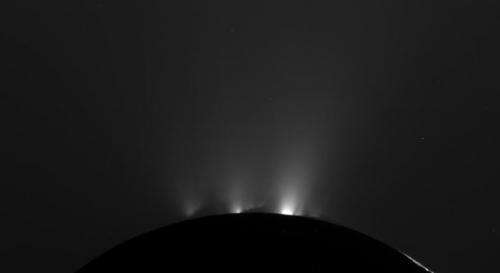
Cassini sees jets of water vapor and ice from Enceladus. Image credit: NASA/JPL-Caltech/Space Science Institute

(PhysOrg.com) -- NASA's Cassini spacecraft successfully completed its Oct. 1 flyby of Saturn's moon Enceladus and its jets of water vapor and ice. At its closest approach, the spacecraft flew approximately 62 miles (100 kilometers) above the moon's surface. The close approach was designed to give some of Cassini's instruments, including the ion and neutral mass spectrometer, the chance to "taste" the jets themselves.

At a higher vantage point during the encounter, Cassini's high-resolution camera captured pictures of the jets emanating from the moon's south polar region. The latest raw images of Enceladus are online.

The images of the surface include previously seen leading-hemisphere terrain. However, during this encounter, multi-spectral imaging of these terrains extended farther into the ultraviolet region of the electromagnetic spectrum than had previously been achieved at this resolution. By looking at the surface at , scientists can better detect the difference between surface materials and shadows than they can at , where icy materials are highly reflective and shadows are washed out. With both ultraviolet and visible images of the same terrain available to them, scientists will better understand how the surface coverage of icy particles coming from the vents and plumes changes with terrain type and age.

Cassini's next pass of this fascinating moon will be Oct. 19, when the spacecraft flies by at an altitude of approximately 765 miles (1231 kilometers).

The Cassini-Huygens mission is a cooperative project of NASA, the European Space Agency and the Italian Space Agency. The Jet Propulsion Laboratory, a division of the California Institute of Technology in Pasadena, manages the mission for NASA's Science Mission Directorate, Washington. The and its two onboard cameras were designed, developed and assembled at JPL. The imaging operations center is based at the in Boulder, Colo. The Ion and Neutral Mass Spectrometer science team is based at the Southwest Research Institute, San Antonio, Texas.

Explore further: Slooh Space Camera to broadcast live feed of recent lunar impact site

add to favorites email to friend print save as pdf

Related Stories

Divine dione captured by Cassini

Sep 08, 2010

Cruising past Saturn's moon Dione this past weekend, NASA's Cassini spacecraft got its best look yet at the north polar region of this small, icy moon and returned stark raw images of the fractured, cratered ...

Cassini presents Saturn moon quintet

Sep 19, 2011

(PhysOrg.com) -- With the artistry of a magazine cover shoot, NASA's Cassini spacecraft captured this portrait of five of Saturn's moons poised along the planet's rings.

Cassini's Photo Album From a Season of Icy Moons

Dec 07, 2005

Wrapping up a phenomenally successful year of observing Saturn's icy moons, the Cassini mission is releasing a flood of new views of the moons Enceladus, Dione, Rhea, Hyperion and Iapetus.

Cassini completes Rhea flyby

Jan 14, 2011

(PhysOrg.com) -- NASA's Cassini spacecraft has successfully completed its closest flyby of Saturn's moon Rhea, returning raw images of the icy moon's surface.

Recommended for you

Proba-V opens its eyes

22 hours ago

(Phys.org) —Earth watcher Proba-V is in good health following its launch last week. The Vegetation imager has been switched on and the first image has been captured over western France.

User comments : 1

Adjust slider to filter visible comments by rank

Display comments: newest first

NickFun
not rated yet Oct 05, 2011
Could anyone explain how the water on Enceladus is constantly replenished as it has supposedly been spewing water for many millions of years. A moon the size of Arizona would have spent its supply relatively quickly without replenishement!

More news stories

Making quantum encryption practical

One of the many promising applications of quantum mechanics in the information sciences is quantum key distribution (QKD), in which the counterintuitive behavior of quantum particles guarantees that no one can eavesdrop on ...

Evaluating a new way to open clogged arteries

Over the past few decades, scientists have developed many devices that can reopen clogged arteries, including angioplasty balloons and metallic stents. While generally effective, each of these treatments ...