HP says it will keep personal computer unit
Hewlett-Packard Co. has decided against spinning off or selling its PC division - a plan first brought to light in August by the technology conglomerate's now former CEO.
HP said Thursday that it reached its decision after evaluating the impact to the company of jettisoning the business unit, which is the world's biggest manufacturer of desktop and notebook computers for consumers and businesses.
The unit supplies a third of HP's revenue, and PCs are an area where the company is a market leader. But it is HP's least profitable division, and its disposal was meant to be part of former CEO Leo Apotheker's plan to transform the Silicon Valley stalwart into a twin of East Coast rival IBM Corp.: a company focused on businesses, rather than both businesses and consumers.
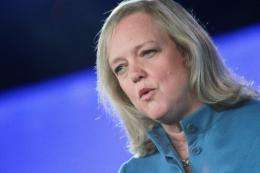
In an interview, HP's new CEO Meg Whitman said the company determined that, given the lost revenue and cost, removing business "makes no sense."
"I have a lot of confidence we've made the right decision and now we're going to go back to work and go execute," she said.
Deciding what to do with the unit has been one of the biggest challenges for Whitman, a former head of online marketplace operator eBay Inc. who joined Palo Alto-based HP in September after Apotheker was fired.
In August, Apotheker said the PC business would go up for sale in a badly blundered announcement that hastened his demise. At that time, HP also said it would exit the tablet computer and smartphone business and buy business software maker Autonomy Corp. for about $10 billion.
Carving out the PC business would have been a tricky kind of surgery, given its enormity. Steve Diamond, an associate professor at Santa Clara University School of Law, told The Associated Press last month that "tearing apart a business unit of that size is like taking out organs."
"It's very painful. It's like dividing Siamese twins. It's very, very difficult to do and you don't know how it's going to come out," he said.
HP appears to have reached a similar conclusion.
The company said that its evaluation of the business unit revealed a deep integration across key operations, such as its supply chain and procurement. Ultimately, the review found that the cost of recreating these operations in a single company outweighed any benefits of separating the PC unit.
Some analysts cheered HP's decision as the right move, adding they were happy that Whitman made the announcement so rapidly. She had previously said the company would make a determination about the business by the end of the year.
"The fact that Meg pushed this decision very quickly is absolutely cleaning up the mistakes of the past," said Gartner analyst Mark Fabbi.
Whitman said she wanted to reach a decision on the business as fast as possible because it had "created a lot of uncertainty in the marketplace."
Forrester Research analyst Frank Gillett said HP never should have considered removing its PC unit, and the move to keep it seems like the right decision given market conditions.
"Hopefully it's the beginning of showing they've got the process and people in place to work these things through," he said. "But it is puzzling that it was hard for them to figure out."
Gillett said he thinks HP may now be able to thin out its PC family - similar to what Steve Jobs did at Apple in order to resuscitate the company in the `90s - and focus on just a few devices with attractive features.
"It's something they have the potential to do that few others do," Gillett said.
Analysts said they don't see any long-term consequences for HP now that it has made its decision. But there's still a big question mark: How will HP compete in the rapidly growing mobile device market?
As part of its PC business spinoff announcement, HP also said it would stop making tablet computers and smartphones by October - effectively killing flailing smartphone pioneer Palm Inc., which HP bought in 2010 for $1.8 billion.
With Palm, HP got the intuitive WebOS software, which ran on several smartphones. In July, HP released a tablet called the TouchPad that also ran WebOS. But the devices never caught on with consumers, many of whom were more enticed by Apple Inc.'s iPhone and iPad and smartphones running Google Inc.'s Android software. HP still hasn't said what, precisely, it plans to do with WebOS.
Todd Bradley, the head of HP's PC unit, said it's "fair to say Apple got a great jump-start in the tablet space" and now HP is trying to figure out its own best approach. Right now, HP is focused on building a tablet that uses Microsoft Corp.'s upcoming Windows 8 software, he said.
He added that consumers shouldn't be keeping an eye out for a TouchPad 2, but that the company will "clearly look at what's the right path forward for WebOS."
HP shares rose 14 cents to $27.23 in after-hours trading. In regular trading on Thursday, the stock added $1.34, or 5.2 percent, to close at $27.09.
©2011 The Associated Press. All rights reserved. This material may not be published, broadcast, rewritten or redistributed.


