Recycling thermal cash register receipts contaminates paper products with BPA
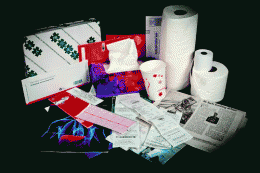
a substance that may have harmful health effects -- occurs in 94 percent of thermal cash register receipts, scientists are reporting. The recycling of those receipts, they add, is a source of BPA contamination of paper napkins, toilet paper, food packaging and other paper products. The report, which could have special implications for cashiers and other people who routinely handle thermal paper receipts, appears in Environmental Science & Technology.
Kurunthachalam Kannan and Chunyang Liao explain that manufacturers produce more than 8 billion pounds of BPA worldwide every year. Research links BPA with a variety of harmful health effects. BPA has been used in plastic water bottles, the lining of food cans and a variety of other products. But how much do non-food sources contribute to humans' daily BPA exposure? BPA coats the surfaces of thermal receipts, where it acts as a developer for the printing dye. To see whether this source of BPA was a concern, the researchers analyzed hundreds of samples of thermal cash register receipts and 14 other types of paper products from the U.S., Japan, Korea and Vietnam.
They found BPA on 94 percent of the receipts. The only receipts with that were BPA-free were those from Japan, which phased out this use of BPA in 2001. BPA was in most of the other types of paper products, with tickets, newspapers and flyers having the highest concentrations. But these levels still paled in comparison to BPA on receipts, which the study said are responsible for more than 98 percent of consumer exposure to BPA from paper. The researchers estimate that receipts contribute about 33.5 tons of BPA to the environment every year in the U.S. and Canada. They note that handling of paper products can contribute up to 2 percent of the total daily BPA exposures in the general population, and that fraction can be much higher in occupationally exposed individuals.
More information: Widespread Occurrence of Bisphenol A in Paper and Paper Products: Implications for Human Exposure, Environ. Sci. Technol., Article ASAP. DOI: 10.1021/es202507f
Abstract
Bisphenol A (BPA) is used in a variety of consumer products, including some paper products, particularly thermal receipt papers, for which it is used as a color developer. Nevertheless, little is known about the magnitude of BPA contamination or human exposure to BPA as a result of contact with paper and paper products. In this study, concentrations of BPA were determined in 15 types of paper products (n = 202), including thermal receipts, flyers, magazines, tickets, mailing envelopes, newspapers, food contact papers, food cartons, airplane boarding passes, luggage tags, printing papers, business cards, napkins, paper towels, and toilet paper, collected from several cities in the USA. Thermal receipt papers also were collected from Japan, Korea, and Vietnam. BPA was found in 94% of thermal receipt papers (n = 103) at concentrations ranging from below the limit of quantitation (LOQ, 1 ng/g) to 13.9 mg/g (geometric mean: 0.211 mg/g). The majority (81%) of other paper products (n = 99) contained BPA at concentrations ranging from below the LOQ to 14.4 μg/g (geometric mean: 0.016 μg/g). Whereas thermal receipt papers contained the highest concentrations of BPA (milligram-per-gram), some paper products, including napkins and toilet paper, made from recycled papers contained microgram-per-gram concentrations of BPA. Contamination during the paper recycling process is a source of BPA in paper products. Daily intake (DI) of BPA through dermal absorption was estimated based on the measured BPA concentrations and handling frequency of paper products. The daily intake of BPA (calculated from median concentrations) through dermal absorption from handling of papers was 17.5 and 1300 ng/day for the general population and occupationally exposed individuals, respectively; these values are minor compared with exposure through diet. Among paper products, thermal receipt papers contributed to the majority (>98%) of the exposures.
Provided by American Chemical Society


