Quantum physics is the focus of Nobel buzz
October 4, 2011 By LOUISE NORDSTROM , Associated Press

Quantum physics is the focus of Nobel buzz (AP)

Enlarge

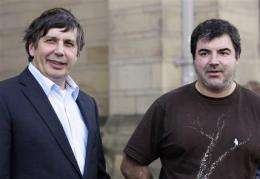
This is a Tuesday, Oct. 5, 2010 file photo of Professor Andre Geim, left, and Dr Konstantin Novoselov are seen outside Manchester University, Manchester, England. The scientists won the 2010 Nobel Prize for Physics. (AP Photo/Jon Super, File)

Three physicists whose research on entangled particles plays a key role in attempts to develop super-fast quantum computers could be in the running for the 2011 Nobel Prize in physics on Tuesday.

Although the award committee doesn't give any clues about candidates for the 10 million kronor ($1.5 million) award, Alain Aspect of France, John Clauser of the United States and Anton Zeilinger of Austria are the hottest names in the speculation this year.

For example, the trio is the top bet of leading Nobel-guesser Karin Bojs, the science editor of the Swedish newspaper Dagens Nyheter.

The physicists' work on entangled quantum states shows that particles can be connected even across long distances so that a change in one of them impacts the other. Scientists believe that can be used in the development of quantum computers, many times faster than the computers used today.

Last year, Aspect, Clauser and Zeilinger won the Wolf Prize in Israel, which sometimes is a precursor to the Nobel.

Other contenders could include Israel's Yakir Aharonov and Britain's Michael Berry for work on the Aharonov-Bohm Effect and the related Berry Phase, also within .

Developed by Aharonov and the late David Bohm in 1959, the theory explains the actions of parts of atoms around a magnetic field, allowing an electron effectively to split around the magnetic field and rejoin later.

The physics prize is the second Nobel Prize to be announced this year.

The medicine prize, announced Monday, went to American Bruce Beutler and French scientist Jules Hoffmann who shared it with Canadian-born Ralph Steinman for their discoveries about the immune system. Their research has opened up new avenues for the treatment and prevention of infectious illnesses and cancer.

Steinman died of pancreatic cancer three days before the announcement. The said it was unaware that then had already died when it awarded the prize to him. The committee is only supposed to consider living scientists, but after an emergency meeting Monday, the Nobel Foundation said the decision on the to Steinman will remain unchanged.

The prestigious Nobel Prizes were established in the will of Swedish industrialist Alfred Nobel, and have been handed out since 1901.

Last year's physics award went to Russian-born scientists Andre Geim and Konstantin Novoselov for groundbreaking experiments with graphene, the strongest and thinnest material known to mankind.

The prizes are handed out every year on Dec. 10, on the anniversary of Nobel's death in 1896.

©2011 The Associated Press. All rights reserved. This material may not be published, broadcast, rewritten or redistributed.

3.7 /5 (3 votes)  

Rank 3.7 /5 (3 votes)
Relevant PhysicsForums posts
  • Calculating Saturation Vapor Pressure?
    created2 hours ago
  • Question about high electric charge.
    created7 hours ago
  • eyeglasses with smallest chromatic abberation
    created10 hours ago
  • Linear momentum converted to angular momentum?!
    created10 hours ago
  • Physics laboratory project - bumpers/crash tests
    created11 hours ago
  • How to open a winebottle with a shoe
    created11 hours ago
  • More from Physics Forums - Classical Physics

More news stories

Is a classical electrodynamics law incompatible with special relativity?

(Phys.org) -- The laws of classical electromagnetism that were developed in the 19th century are the same laws that scientists use today. They include Maxwell’s four equations along with the Lorentz la ...

Physics / General Physics

created May 24, 2012 | popularity 4.7 / 5 (17) | comments 43 | with audio podcast feature

Landmark calculation clears the way to answering how matter is formed

(Phys.org) -- An international collaboration of scientists, including Thomas Blum, associate professor of physics, is reporting in landmark detail the decay process of a subatomic particle called a kaon – ...

Physics / General Physics

created May 25, 2012 | popularity 4.3 / 5 (22) | comments 51 | with audio podcast

Lying in wait for WIMPs: Researchers seek to dramatically increase sensitivity of Large Underground Xenon detector

Although it's invisible, dark matter accounts for at least 80 percent of the matter in the universe. No one knows what it is, but most scientists would bet on weakly interacting massive particles, or WIMPs.

Physics / General Physics

created May 23, 2012 | popularity 4 / 5 (7) | comments 16 | with audio podcast

Hawaii lab turns laser-powered bubbles into microrobots

(Phys.org) -- A team of scientists from the University of Hawaii are working on microrobots created from bubbles of air in a saline solution. The bubbles take on their title of “robots” as a laser ...

Physics / General Physics

created May 23, 2012 | popularity 5 / 5 (4) | comments 2 | with audio podcast weblog

Sound increases the efficiency of boiling

Scientists at the Georgia Institute of Technology achieved a 17-percent increase in boiling efficiency by using an acoustic field to enhance heat transfer. The acoustic field does this by efficiently removing vapor bubbles ...

Physics / Soft Matter

created May 24, 2012 | popularity 5 / 5 (2) | comments 2


Land and sea species differ in climate change response: study

(Phys.org) -- Marine and terrestrial species will likely differ in their responses to climate warming, new research by Simon Fraser University and Australia’s University of Tasmania has found.

Almost half of new vets seek disability

(AP) -- America's newest veterans are filing for disability benefits at a historic rate, claiming to be the most medically and mentally troubled generation of former troops the nation has ever seen.

'Unzipped' carbon nanotubes could help energize fuel cells, batteries

Multi-walled carbon nanotubes riddled with defects and impurities on the outside could replace some of the expensive platinum catalysts used in fuel cells and metal-air batteries, according to scientists at ...

T cells 'hunt' parasites like animal predators seek prey, study shows

By pairing an intimate knowledge of immune-system function with a deep understanding of statistical physics, a cross-disciplinary team at the University of Pennsylvania has arrived at a surprising finding: T cells use a movement ...

Computer model used to pinpoint prime materials for efficient carbon capture

When power plants begin capturing their carbon emissions to reduce greenhouse gases – and to most in the electric power industry, it's a question of when, not if – it will be an expensive undertaking.

Change in developmental timing was crucial in the evolutionary shift from dinosaurs to birds: study

At first glance, it's hard to see how a common house sparrow and a Tyrannosaurus Rex might have anything in common. After all, one is a bird that weighs less than an ounce, and the other is a dinosaur that ...