Researchers identify mysterious life forms in the extreme deep sea (w/ video)
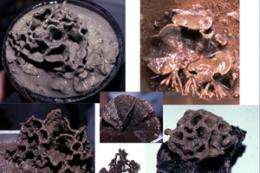
Close-ups of xenophyophores obtained on previous expeditions. Photo credit: Lisa Levin (all except upper right, credit David Checkley)
(PhysOrg.com) -- A summer research expedition organized by scientists at Scripps Institution of Oceanography at UC San Diego has led to the identification of gigantic amoebas at one of the deepest locations on Earth.
During a July 2011 voyage to the Pacific Ocean's Mariana Trench, the deepest region on the planet, Scripps researchers and National Geographic engineers deployed untethered free-falling/ascending landers equipped with digital video and lights to search the largely unexplored region. The team documented the deepest known existence of xenophyophores, single-celled animals exclusively found in deep-sea environments. Xenophyophores are noteworthy for their size, with individual cells often exceeding 10 centimeters (4 inches), their extreme abundance on the seafloor and their role as hosts for a variety of organisms.
The researchers spotted the life forms at depths up to 10,641 meters (6.6 miles) within the Sirena Deep of the Mariana Trench. The previous depth record for xenophyophores was approximately 7,500 meters (4.7 miles) in the New Hebrides Trench, although sightings in the deepest portion of the Mariana Trench have been reported. Scientists say xenophyophores are the largest individual cells in existence. Recent studies indicate that by trapping particles from the water, xenophyophores can concentrate high levels of lead, uranium and mercury and are thus likely highly resistant to large doses of heavy metals. They also are well suited to a life of darkness, low temperature and high pressure in the deep sea.
This video is not supported by your browser at this time.
"The research of Scripps Professor Lisa Levin (deep-sea biologist) has demonstrated that these organisms play host to diverse multicellular organisms," said Doug Bartlett, the Scripps marine microbiologist who organized the Mariana Trench expedition. "Thus the identification of these gigantic cells in one of the deepest marine environments on the planet opens up a whole new habitat for further study of biodiversity, biotechnological potential and extreme environment adaptation."
The xenophyophores are just the tip of the iceberg when it comes to considerations of the nature and diversity of life at extreme depths. For example, according to Dhugal Lindsay (Japan Agency for Marine-Earth Science and Technology, or JAMSTEC), the Dropcam movie also depicts the deepest jellyfish observed to date.
The instruments used to spot the mysterious animals were "Dropcams" developed and used by National Geographic Society Remote Imaging engineers Eric Berkenpas and Graham Wilhelm, participants in the July voyage.
"The 'Dropcams' are versatile autonomous underwater cameras containing an HD camera and lighting inside of a glass bubble," said Berkenpas. "They were created by National Geographic engineers to allow scientists and filmmakers to capture high-quality footage from any depth in the ocean. The devices were baited and used 'camera-traps' to capture imagery of approaching marine life."
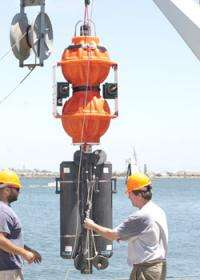
Scripps ocean engineer Kevin Hardy (right) and marine technician Josh Manger prepare to test Hardy's deep-sea lander at Scripps' Nimitz Marine Facility.
Dropcams utilize a thick-wall glass sphere capable of withstanding more than eight tons per-square-inch pressure at extreme depth."Seafloor animals are lured to the camera with bait, a technique first developed by Scripps Professor John Isaacs in the 1960s," said Kevin Hardy, a Scripps ocean engineer and cruise participant. Hardy advanced the ultra-deep glass sphere design used on 'Dropcams' more than a decade ago. "Scripps researchers hope to one day capture and return novel living animals to the laboratory for study in high pressure aquariums that replicate the trench environment."
Also during the expedition, Scripps researchers successfully tested an advanced seafloor Deep Ocean Vehicle (DOV) design, using similar spheres to recover microbes and test other advanced system components.
The xenophyophore sightings were positively identified by Scripps' Levin, director of the Scripps Center for Marine Biodiversity and Conservation, and confirmed by Andrew Gooday of the UK National Oceanography Center.
"As one of very few taxa found exclusively in the deep sea, the xenophyophores are emblematic of what the deep sea offers. They are fascinating giants that are highly adapted to extreme conditions but at the same time are very fragile and poorly studied," said Levin. "These and many other structurally important organisms in the deep sea need our stewardship as human activities move to deeper waters."
Provided by
University of California - San Diego
-
From lemons to lemonade: Reaction uses carbon dioxide to make carbon-based semiconductor,
32 comments
-
Thioridazine kills cancer stem cells in human while avoiding toxic side-effects of conventional cancer treatments,
3 comments
-
SpaceX private rocket blasts off for space station (Update),
42 comments
-
Climate scientists say they have solved riddle of rising sea,
31 comments
-
SpaceX capsule has 'new car' smell, astronauts say (Update),
3 comments
-
Hypothetical desert earth
16 hours ago
-
More human population = greater mass?
May 25, 2012
-
Conversion from aircraft bearing to normal degrees
May 23, 2012
-
Interpretation/Analysis of the Lab results(HEPA filter)
May 22, 2012
-
Has anyone here attended the The Urbino Summer School in Paleoclimatology?
May 22, 2012
-
Earthquakes: Mag 6 N. Italy and Mag 5.6 W. Bulgaria
May 21, 2012
- More from Physics Forums - Earth
More news stories
Yale study concludes public apathy over climate change unrelated to science literacy
Are members of the public divided about climate change because they don't understand the science behind it? If Americans knew more basic science and were more proficient in technical reasoning, would public consensus match ...
1 hour ago |
not rated yet |
8
|
10 million years needed to recover from mass extinction
It took some 10 million years for Earth to recover from the greatest mass extinction of all time, latest research has revealed.
Space & Earth / Earth Sciences
1 hour ago |
not rated yet |
1
|
Sophisticated simulations predict future warming
The chances of our planet being hit by a global warming of 3 degrees Celsius by 2050 is as likely as it being hit by an increase of 1.4 degrees, new research shows. Presented in the journal Nature Geoscience, the British study ...
Space & Earth / Earth Sciences
May 22, 2012 |
4.4 / 5 (9) |
51
Aliens don't want to eat us, says former SETI director
Alien life probably isnt interested in having us for dinner, enslaving us or laying eggs in our bellies, according to a recent statement by former SETI director Jill Tarter.
Space & Earth / Space Exploration
May 25, 2012 |
4.4 / 5 (14) |
39
Kyoto Protocol architect 'frustrated' by climate dialogue
UN climate talks are going nowhere, as politicians dither or bicker while the pace of warming dangerously speeds up, one of the architects of the Kyoto Protocol told AFP.
May 23, 2012 |
3.7 / 5 (7) |
39
'Unzipped' carbon nanotubes could help energize fuel cells, batteries
Multi-walled carbon nanotubes riddled with defects and impurities on the outside could replace some of the expensive platinum catalysts used in fuel cells and metal-air batteries, according to scientists at ...
T cells 'hunt' parasites like animal predators seek prey, study shows
By pairing an intimate knowledge of immune-system function with a deep understanding of statistical physics, a cross-disciplinary team at the University of Pennsylvania has arrived at a surprising finding: T cells use a movement ...
Computer model used to pinpoint prime materials for efficient carbon capture
When power plants begin capturing their carbon emissions to reduce greenhouse gases and to most in the electric power industry, it's a question of when, not if it will be an expensive undertaking.
Change in developmental timing was crucial in the evolutionary shift from dinosaurs to birds: study
At first glance, it's hard to see how a common house sparrow and a Tyrannosaurus Rex might have anything in common. After all, one is a bird that weighs less than an ounce, and the other is a dinosaur that ...
Same gene that stunts infants' growth also makes them grow too big: research
UCLA geneticists have identified the mutation responsible for IMAGe* syndrome, a rare disorder that stunts infants' growth. The twist? The mutation occurs on the same gene that causes Beckwith-Wiedemann syndrome, which makes ...
Scientists develop ultra-sensitive test that detects diseases in their earliest stages
Scientists have developed an ultra-sensitive test that should enable them to detect signs of a disease in its earliest stages, in research published today in the journal Nature Materials.

Oct 23, 2011
Rank: 3.7 / 5 (6)
A one-celled amoeba that's 4 inches long. . . .who knew?
PLUS, they are highly resistant to lead, uranium and mercury. . . .guys, I think we've found a new way to clean up nuclear waste.
Oct 23, 2011
Rank: 5 / 5 (1)
Oct 23, 2011
Rank: 5 / 5 (8)
Oct 23, 2011
Rank: 3.3 / 5 (7)
Does that mean they are larger than ostrich eggs?
Oct 23, 2011
Rank: 5 / 5 (3)
This is actually a great question. All of the research I've done on the subject appears to confirm your hypothesis. Although there is still some debate on the subject, most biologists seem to agree that the ostrich egg is in fact the world's largest single cell.
Oct 23, 2011
Rank: 5 / 5 (2)
Oct 24, 2011
Rank: 5 / 5 (2)
Oct 24, 2011
Rank: 3 / 5 (2)
Oct 24, 2011
Rank: 5 / 5 (1)
Oct 24, 2011
Rank: 5 / 5 (2)
/watch?v=RxUZM-cLtGg