Moon's shadow, like a ship, creates waves
October 5, 2011

Moon

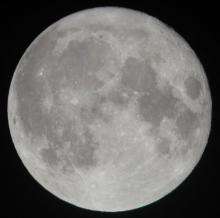
During a solar eclipse, the Moon's passage overhead blocks out the majority of the Sun's light and casts a wide swath of the Earth into darkness. The land under the Moon's shadow receives less incoming energy than the surrounding regions, causing it to cool.

In the early 1970s, researches proposed that this temperature difference could set off slow-moving waves in the . They hypothesized that the waves, moving more slowly than the travelling temperature disparity from which they spawned, would pile up along the leading edge of the Moon's path -- like slow-moving waves breaking on a ship's bow. The dynamic was shown theoretically and in early , but it was not until a on 22 July 2009 that researchers were able to observe the behavior.

Using a dense network of ground-based receivers, Liu et al. tracked the influence of the 2009 eclipse as it passed over Taiwan and Japan. The researchers looked for changes in the total electron content in the ionosphere and find with periods between 3 and 5 minutes traveling around 100 meters per second (328 feet per second) that originated from the leading and trailing edges of the shadow, analogous to bow waves and stern wake common in maritime activity.

They find that there was a 30 minute time difference between the arrival of the bow and stern waves suggesting that, were the Moon's shadow a ship, it would be 1,712 kilometers (1,064 miles) long. The researchers indicate that this would correspond to the part of the Moon's shadow that produced at least an 80 percent obscuration of the Sun's light.

More information: Geophysical Research Letters, doi:10.1029/2011GL048805 , 2011

Provided by American Geophysical Union search and more info website

4.6 /5 (5 votes)  

Filter


Move the slider to adjust rank threshold, so that you can hide some of the comments.


Display comments: newest first

Nanobanano
Oct 05, 2011

Rank: 1 / 5 (3)
This seems to provide some circumstancial support to the notion that "some" of what we call "gravity" may actually be a repulsive force in the form of radiation pressure, as clearly this is a Mass Shadow effect, causing the wave due to a combination of changes most importantly in thermal energy absorbed by the water from radiation, but also a direct change in radiation pressure due to the Moon's "Mass Shadow".

Radiation Pressure from the Sun produces a net "thrust" on the Earth which is roughly equal to the Solar Constant, seeing as how Earth radiates heat away roughly symetrically in all directions as infrared. But the initial EM comes in from the direction of the Sun almost exclusive, ignoring stars for the moment.

So it is natural that the Moon would block an amount of radiation pressure equal to the fraction of the Solar Constant under its shadow (minus any neutrinos or exotic radiation that passes all the way through the moon...)
rawa1
Oct 05, 2011

Rank: not rated yet
what we call "gravity" may actually be a repulsive force in the form of radiation pressure
You're extrapolating the above observation a bit too much, IMO - but this is basically, what the ancient de Duillier-LeSage theory of gravity is about. There are another experiments, which indicate the Moon shadow can affect the gravity at the Earth.
http://en.wikiped...s_effect
I consider them a sort of neutrino flux shielding.
88HUX88
Oct 06, 2011

Rank: not rated yet
Cat Stevens released Moonshadow in 1971, coincidence? I think not! http://www.songfa...p?id=288
Rank 4.6 /5 (5 votes)
Relevant PhysicsForums posts

More news stories

Yale study concludes public apathy over climate change unrelated to science literacy

Are members of the public divided about climate change because they don't understand the science behind it? If Americans knew more basic science and were more proficient in technical reasoning, would public consensus match ...

Space & Earth / Environment

created 1 hour ago | popularity not rated yet | comments 8 | with audio podcast

10 million years needed to recover from mass extinction

It took some 10 million years for Earth to recover from the greatest mass extinction of all time, latest research has revealed.

Space & Earth / Earth Sciences

created 1 hour ago | popularity not rated yet | comments 1 | with audio podcast

Sophisticated simulations predict future warming

The chances of our planet being hit by a global warming of 3 degrees Celsius by 2050 is as likely as it being hit by an increase of 1.4 degrees, new research shows. Presented in the journal Nature Geoscience, the British study ...

Space & Earth / Earth Sciences

created May 22, 2012 | popularity 4.4 / 5 (9) | comments 51

Aliens don't want to eat us, says former SETI director

Alien life probably isn’t interested in having us for dinner, enslaving us or laying eggs in our bellies, according to a recent statement by former SETI director Jill Tarter.

Space & Earth / Space Exploration

created May 25, 2012 | popularity 4.4 / 5 (14) | comments 39

Kyoto Protocol architect 'frustrated' by climate dialogue

UN climate talks are going nowhere, as politicians dither or bicker while the pace of warming dangerously speeds up, one of the architects of the Kyoto Protocol told AFP.

Space & Earth / Environment

created May 23, 2012 | popularity 3.7 / 5 (7) | comments 39


'Unzipped' carbon nanotubes could help energize fuel cells, batteries

Multi-walled carbon nanotubes riddled with defects and impurities on the outside could replace some of the expensive platinum catalysts used in fuel cells and metal-air batteries, according to scientists at ...

T cells 'hunt' parasites like animal predators seek prey, study shows

By pairing an intimate knowledge of immune-system function with a deep understanding of statistical physics, a cross-disciplinary team at the University of Pennsylvania has arrived at a surprising finding: T cells use a movement ...

Computer model used to pinpoint prime materials for efficient carbon capture

When power plants begin capturing their carbon emissions to reduce greenhouse gases – and to most in the electric power industry, it's a question of when, not if – it will be an expensive undertaking.

Change in developmental timing was crucial in the evolutionary shift from dinosaurs to birds: study

At first glance, it's hard to see how a common house sparrow and a Tyrannosaurus Rex might have anything in common. After all, one is a bird that weighs less than an ounce, and the other is a dinosaur that ...

Same gene that stunts infants' growth also makes them grow too big: research

UCLA geneticists have identified the mutation responsible for IMAGe* syndrome, a rare disorder that stunts infants' growth. The twist? The mutation occurs on the same gene that causes Beckwith-Wiedemann syndrome, which makes ...

Scientists develop ultra-sensitive test that detects diseases in their earliest stages

Scientists have developed an ultra-sensitive test that should enable them to detect signs of a disease in its earliest stages, in research published today in the journal Nature Materials.