Mongolian 'kamikaze' wreck found off Japan coast
October 27, 2011

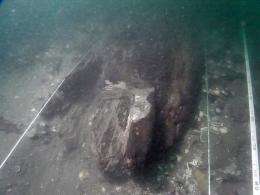
A picture from Ryukyu University professor Yoshifumi Ikeda shows a wreck believed to be an invading Mongolian ship

Enlarge

The 13th century wreck of an invading Mongolian ship that fell victim to a famous typhoon known in Japan as the "kamikaze" or "divine wind" has been found off the country's southern coast.

The 13th century wreck of an invading Mongolian ship that fell victim to a famous typhoon known in Japan as the "kamikaze" or "divine wind" has been found off the country's southern coast.

A long section of the keel of a wooden vessel, thought to have been one of more than 4,000 sent by Kublai Khan to conquer Japan, was discovered beneath the near Nagasaki, the Mainichi Shimbun and other media reported.

The huge invading fleet of 1281 is believed to have been sunk by a powerful typhoon that became known in Japan as the "kamikaze" -- a "divine wind" that protected a chosen nation.

The wreck, which is buried in a metre (three feet) of mud, was found by a team led by Yoshifumi Ikeda, professor of archaeology at the University of the Ryukyus in Okinawa.

The team found a 12-metre section of the keel with several long pieces of wood attached.

Experts estimate the vessel was at least 20 metres long before it sank off the island of Takashima in northern Nagasaki prefecture.
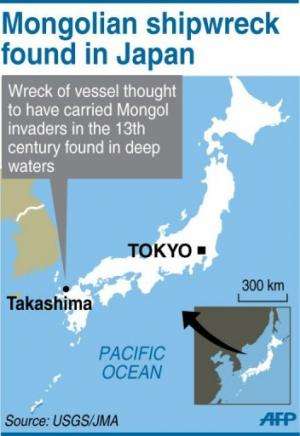
Map of Japan locating Takashima, where archeologists found a shipwreck believed to have carried Mongolian invaders
Enlarge

Map of Japan locating Takashima, where archeologists found a shipwreck believed to have carried Mongolian invaders in the 13th century.

Ikeda said a number of pieces of Chinese pottery dating from the 12th and 13th centuries were also found at the site, helping to pinpoint the age of the boat.

The Mongolian-ruled Yuan dynasty of China, led initially by Genghis Khan's grandson, Kublai, tried to conquer the samurai warriors of on two occasions, in 1274 and 1281.

About 900 were sent in the first attempt. Battles were fought in Kyushu, Japan's main southern island, but the invasion attempt failed.

The much bigger, second fleet of 4,400 ships was largely sunk by the huge typhoon that the Japanese attributed to divine intervention, giving currency to the notion of "kamikaze", a word now largely associated with the suicide pilots of .

Around 4,000 artefacts from the wreck, including the anchor, were previously known about, but researchers hope the discovery of such a large and well-preserved section of the boat will help them to understand more about the invading fleet.

"This discovery was of major importance for our research. We are planning to expand search efforts and find further information that can help us restore the whole ship," Ikeda said.

(c) 2011 AFP


Rank 4 /5 (1 vote)
Relevant PhysicsForums posts

More news stories

Change in developmental timing was crucial in the evolutionary shift from dinosaurs to birds: study

At first glance, it's hard to see how a common house sparrow and a Tyrannosaurus Rex might have anything in common. After all, one is a bird that weighs less than an ounce, and the other is a dinosaur that ...

Other Sciences / Archaeology & Fossils

created 1 hour ago | popularity 5 / 5 (2) | comments 0 | with audio podcast

Social welfare cuts ultimately come with heavy price, researchers say

(Phys.org) -- Slashing government funding for Medicaid, food stamps and other programs that serve the poor – while politically popular with some lawmakers and many conservatives – may do more harm ...

Other Sciences / Social Sciences

created May 24, 2012 | popularity 4.3 / 5 (16) | comments 149

Ancient Bethlehem seal unearthed in Jerusalem

Israeli archaeologists have discovered a 2,700-year-old seal that bears the inscription "Bethlehem," the Israel Antiquities Authority announced Wednesday, in what experts believe to be the oldest artifact ...

Other Sciences / Archaeology & Fossils

created May 23, 2012 | popularity 3.5 / 5 (14) | comments 23

Oldest Jewish archaeological evidence on the Iberian Peninsula

German archaeologists of the Friedrich Schiller University Jena found one of the oldest archaeological evidence so far of Jewish Culture on the Iberian Peninsula at an excavation site in the south of Portugal, ...

Other Sciences / Archaeology & Fossils

created May 25, 2012 | popularity 4.3 / 5 (4) | comments 12

Dollars and sense: Why are some people morally against tax?

As the U.S. presidential election campaigns heat up, the economic debate is dominated by bailouts, austerity and, inevitably, taxation. Now a new study published in Symbolic Interaction asks why tax is such an important issue ...

Other Sciences / Social Sciences

created May 23, 2012 | popularity 3 / 5 (2) | comments 12


Computer model used to pinpoint prime materials for efficient carbon capture

When power plants begin capturing their carbon emissions to reduce greenhouse gases – and to most in the electric power industry, it's a question of when, not if – it will be an expensive undertaking.

'Unzipped' carbon nanotubes could help energize fuel cells, batteries

Multi-walled carbon nanotubes riddled with defects and impurities on the outside could replace some of the expensive platinum catalysts used in fuel cells and metal-air batteries, according to scientists at ...

T cells 'hunt' parasites like animal predators seek prey, study shows

By pairing an intimate knowledge of immune-system function with a deep understanding of statistical physics, a cross-disciplinary team at the University of Pennsylvania has arrived at a surprising finding: T cells use a movement ...

Yale study concludes public apathy over climate change unrelated to science literacy

Are members of the public divided about climate change because they don't understand the science behind it? If Americans knew more basic science and were more proficient in technical reasoning, would public consensus match ...

Same gene that stunts infants' growth also makes them grow too big: research

UCLA geneticists have identified the mutation responsible for IMAGe* syndrome, a rare disorder that stunts infants' growth. The twist? The mutation occurs on the same gene that causes Beckwith-Wiedemann syndrome, which makes ...

Scientists develop ultra-sensitive test that detects diseases in their earliest stages

Scientists have developed an ultra-sensitive test that should enable them to detect signs of a disease in its earliest stages, in research published today in the journal Nature Materials.