Mental time-travel in birds
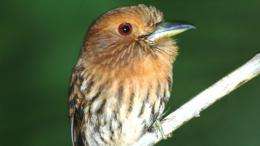
White Whiskered Puff bird Credit: Glenn M Duggan FZS
(PhysOrg.com) -- Certain types of birds may track army ant swarms using sophisticated memory and the ability to plan for the future.
Some tropical birds collect their prey at army ant raids, where massive swarms of ants sweep through the forest and drive out insects. The behaviour of interest is called bivouac checking; it allows these birds to track the cyclical raid activity of army ant colonies.
Army ants have regular alternating periods of high and low raiding activity, and birds visit the ants temporary nest sites (bivouacs) to determine which colonies are raiding on a given day.
The new findings published today in the journal Behavioural Ecology, suggest that bivouac checking allows birds to keep track of multiple army ant colonies, keeping account of which colonies are in periods of high-raiding activity while avoiding colonies with low-raiding activity.
Recent research has discovered that birds check army ant bivouacs at the end of the day, after they have fed at the raid. They may use the information about the army ant nest location the next day to find the ants again, thus accessing a past memory (the nest location) to fulfil a future need (bird will be hungry tomorrow), also known as mental time-travel.
Two of the authors of the study Corina Logan of the University of Cambridge, and Sean ODonnell of the University of Washington, observed bivouac checking behaviour in Monteverde, Costa Rica.
Mental time-travel consists of two elements: the ability to remember past events and the ability to anticipate and plan for future events. It has traditionally been considered a quality unique to humans. However, ever since Nicola Clayton of the University of Cambridge discovered that scrub jays (a species of large-brained crow) can remember the past and plan for the future, there have been a suite of studies showing evidence of this ability in other species as well. We now know that corvids (birds in the crow family), some primates, and possibly rats have all shown the ability to remember the past and plan for the future.
Corina Logan, said: We suspect that future planning could be involved in bivouac-checking bird behaviour because the birds were checking bivouacs when they were not hungry, a behaviour that does not make sense until the next morning upon return to the bivouac when the bird finds the ants raiding again and encounters its next meal a delayed benefit.
Until recently, it has been difficult to find model systems for studying mental time travel in an ecologically relevant way. The fact that we might have happened on a whole new system for exploring these capacities is quite exciting, added Corina Logan.
Provided by
University of Cambridge
-
From lemons to lemonade: Reaction uses carbon dioxide to make carbon-based semiconductor,
32 comments
-
Thioridazine kills cancer stem cells in human while avoiding toxic side-effects of conventional cancer treatments,
3 comments
-
SpaceX private rocket blasts off for space station (Update),
42 comments
-
Climate scientists say they have solved riddle of rising sea,
31 comments
-
SpaceX capsule has 'new car' smell, astronauts say (Update),
3 comments
-
What would stain as translucent on light-coloured fabric?
20 hours ago
-
How do I identify different bacteria on culture plates?
May 26, 2012
-
Why Do Dogs do Strange things...
May 25, 2012
-
What does exophillic and endophillic mean in terms of mosquito and their control?
May 24, 2012
-
Semen stains glows under black lights (uv light)?
May 23, 2012
-
Question on Human Chromosome 2
May 23, 2012
- More from Physics Forums - Biology
More news stories
Manufacturing genes to attack flu virus
An international research team has manufactured a new protein that can combat deadly flu epidemics.
1 hour ago |
not rated yet |
0
|
Scientist: Evolution debate will soon be history
(AP) -- Richard Leakey predicts skepticism over evolution will soon be history. Not that the avowed atheist has any doubts himself.
19 hours ago |
3.3 / 5 (18) |
73
More plant species responding to global warming than previously thought
(Phys.org) -- Far more wild plant species may be responding to global warming than previous large-scale estimates have suggested.
May 22, 2012 |
4.6 / 5 (14) |
18
|
Thousands of shellfish found dead in Peru
Thousands of crustaceans were found dead off the coast of Lima following the mystery mass death of dolphins and pelicans, the Peruvian Navy said Friday.
May 26, 2012 |
4.8 / 5 (4) |
7
For monogamous sparrows, it doesn't pay to stray (but they do it anyway)
It's quite common for a female song sparrow to stray from her breeding partner and mate with the male next door, but a new study shows that sleeping around can be costly.
May 22, 2012 |
5 / 5 (2) |
8
|
Computer model used to pinpoint prime materials for efficient carbon capture
When power plants begin capturing their carbon emissions to reduce greenhouse gases and to most in the electric power industry, it's a question of when, not if it will be an expensive undertaking.
'Unzipped' carbon nanotubes could help energize fuel cells, batteries
Multi-walled carbon nanotubes riddled with defects and impurities on the outside could replace some of the expensive platinum catalysts used in fuel cells and metal-air batteries, according to scientists at ...
T cells 'hunt' parasites like animal predators seek prey, study shows
By pairing an intimate knowledge of immune-system function with a deep understanding of statistical physics, a cross-disciplinary team at the University of Pennsylvania has arrived at a surprising finding: T cells use a movement ...
Yale study concludes public apathy over climate change unrelated to science literacy
Are members of the public divided about climate change because they don't understand the science behind it? If Americans knew more basic science and were more proficient in technical reasoning, would public consensus match ...
Same gene that stunts infants' growth also makes them grow too big: research
UCLA geneticists have identified the mutation responsible for IMAGe* syndrome, a rare disorder that stunts infants' growth. The twist? The mutation occurs on the same gene that causes Beckwith-Wiedemann syndrome, which makes ...
Change in developmental timing was crucial in the evolutionary shift from dinosaurs to birds: study
At first glance, it's hard to see how a common house sparrow and a Tyrannosaurus Rex might have anything in common. After all, one is a bird that weighs less than an ounce, and the other is a dinosaur that ...
Oct 14, 2011
Rank: 1 / 5 (5)
Oct 14, 2011
Rank: 3 / 5 (2)
Oct 14, 2011
Rank: 4.5 / 5 (8)
No to both. The point is not that the birds know where food is normally available. The point is they can predict, based on what the ants do, where food is likely to be available the next day, and that they gather the information at a time when they are not hungry.
It is the same criterion developmental psychologists use to decide whether children are capable of mental time travel. For example, around age 4 a child who is asked "We're going for a walk in the woods this afternoon. What do you want to take with you?" may answer "some juice, in case I get thirsty". That child is not thirsty now, but plans to deal with future thirst. The claim is that the birds do the same, not that they remember where they normally feed. These are two very different things. That's why the article is not stupid.
Oct 14, 2011
Rank: 2 / 5 (6)
Oct 14, 2011
Rank: 5 / 5 (2)
Birds also listen to other bird species and animals for indicators.
Oct 14, 2011
Rank: 2.3 / 5 (7)
Stop invoking "time travel" for dramatic effect please.
Oct 14, 2011
Rank: 4.3 / 5 (6)
It is the term established in the scientific literature. The term was coined to make clear the relationship between episodic memory (remembering specific past events) and mental modelling (imagining possible futures). Studies with human amnesics have shown that the two use much of the same brain regions. The term mental time travel explicitly marks the theoretical and empirical links between thinking about the past and thinking about the future. Is the editor supposed to revise the terminology used in published papers?
Oct 14, 2011
Rank: 1 / 5 (3)
Oct 14, 2011
Rank: 5 / 5 (6)
Mental time travel is what distinguishes what Damasio calls core consciousness, the experience of a self to whom things are happening here and now, and extended consciousness, a self with an experience of past and future. The normal assumption, for lack of reason to think otherwise, is that it works the same in other species. Whether other species have core or extended consciousness, or no subjective experience at all, seems like a pretty fundamental question to me.
If you mean monetary value, like answers to other fundamental questions, such as whether the expansion of the universe accelerates or decelerates, I don't see how this can be turned into money.
Oct 14, 2011
Rank: 1 / 5 (2)
What scientific literature? If you mean psychology journals, then it's a sad reflection on psychology that they can get away with mis-using the term "time-travel" for sensational purposes. As Isaacsname noted, there is a proper scientific term, "Chronesthesia", and psychologists should use it if they want to be taken seriously.
The term time-travel is well understood in physics, science fiction, and popular usage. Chronesthesia is a mental process that has nothing to do with time travel as understood by the vast majority of the population. Very few of us would have bothered to read this article if the editor had used the term Chronothesia instead of Mental Time-Travel, and we feel tricked.
Oct 14, 2011
Rank: 5 / 5 (2)
I don't remember who first used "mental time travel", so I can't even guess at the motives. What is your source?
What makes it more scientific than "mental time travel"?
I have read a good deal of that literature. None of the people using "mental time travel" has been taken less seriously by other researchers in the field for that reason.
The function of adjectives is to modify the meaning of the following noun phrase. I had no trouble understanding that the papers are not discussing time travel as in physics, SF and popular usage. If you want researchers to replace a descriptive phrase by a neologism, go ahead, but you'll have to do it in the journals where that work is published.
Oct 14, 2011
Rank: 1 / 5 (3)
Oct 15, 2011
Rank: 3.5 / 5 (2)
It is quite correct if taken in the manner of it's intent and presentation by any interpretation.
Do not confuse it with physical time travel.
But I must admit, that I also find it in many other species
Don Jose de La Mancha
Oct 15, 2011
Rank: 1 / 5 (1)
Why? Just because you say so?
Prediction is time travel and proof of FTL travel of information.
Not such a stupid article name but rather an ignorant comment from the opinionated and mostly brain dead CHollman.
Oct 16, 2011
Rank: not rated yet
Very timely! Just as the faster-than-light neutrino theory seems to be debunked...we have a new theory of faster-than- light mental time-travel.
Oct 17, 2011
Rank: not rated yet
You can "cloak" physical events. Every one has a problem picturing the time component of light waves being 'bend' around an object with the same result that the object becomes temporal nonexistent (synonymous to invisibility) or becomes invisible with 'bend' time.
That is science manipulating the physical. (Although many adhere to the view time is nonphysical)
http://www.physor...ust.html
Brains can not manipulate this way. Instead brains give the visual physical aspects of objects the 'ability' to be place anywhere in settings already experienced.
The 'mental' picture (absent temporal aspects) can be placed mentally anywhere in settings past experiences dictates. This avoids time mentally.
The mental picture setting most likely to lead to food is the mental picture setting most often reinforced.
Oct 17, 2011
Rank: not rated yet
the ability to place objects remembered anywhere.
And the correct word for the definition is:
'Chron' becomes 'Topos'. Toposesthesia.
And time becomes a thing of the past. lol