Mars500 crew prepare to open the hatch
October 31, 2011

Mars500 crew prepare to open the hatch

Enlarge

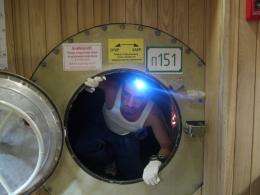
Diego Urbina looking out from the hatch inside Mars500 facility. Credits: ESA

The 520 days of isolation for the Mars500 crew will end on 4 November, when the hatch of their ‘spacecraft’ is opened for the first time since June last year. Scientists eagerly await the final samples as the crew count the hours to liberty.

During the 17-month simulated , the six men have run seemingly countless experiments. They have monitored their brains, scanned their bodies, given all sorts of samples and maintained their habitat.
The scientists are already happy with the quality of the unique material they have and are looking forward to working with all the new information.

Teasing out the scientific results takes a while, but the main question is already answered – or almost: “The answer is yes”, says Patrik Sundblad, the human life sciences specialist at ESA.  

“And the scientists have already highlighted the importance of their investigations for terrestrial medical issues.

“Yes, the crew can survive the inevitable that is for a mission to Mars and back. Psychologically, we can do it.

“They have had their ups and downs, but these were to be expected. In fact, we anticipated many more problems, but the crew has been doing surprisingly well.

“August was the mental low point: it was the most monotonous phase of the mission, their friends and families were on vacation and didn’t send so many messages, and there was also little variation in food.”
Mars500 crew prepare to open the hatch
Enlarge

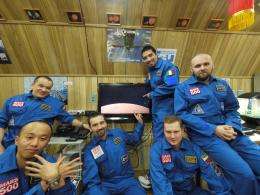
Crew portrait from May 2011. Credits: ESA

The crew’s spirits rose again with the approaching finale of the mission, the normal flow of messages after the holiday period and, especially, the return to real-time communications on 15 September after the artificial delay.

Key word is motivation
 
“The high fidelity of the simulation has been an important factor in the success of the experiment,” notes Patrik.
“Simulating a real mission to Mars as closely as is possible on Earth has been very important for the crew.

“Knowing this mission is really helping to make a real mission to Mars possible has made the challenging long-duration experiment somehow easier for the crew.”

Real Mars-bound astronauts will be faced with additional psychological challenges. They will be in constant danger because they can’t just step from their spacecraft in an emergency.

Travelling so far that Earth becomes just one star among many may create a feeling of detachment, adding to the other stress factors.

Weightlessness and radiation will add to the challenges.

Some factors can be explored through bedrest studies on Earth and crews staying completely isolated in Antarctica during the long, dark winter.

“We are using to some extent the same psychological questionnaires with Mars500 as with over-wintering crews at the Concordia base and bedrest studies,” says Patrik. “Comparing them is extremely interesting.”
Mars500 crew prepare to open the hatch
Enlarge

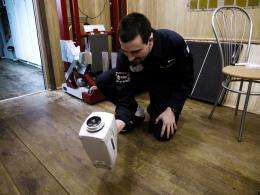
Romain Charles taking an air sample for the European MICHA experiment in Mars500. Credits: ESA

Mars500 was not only about the six men in isolation – it was also about the international cooperation and the whole infrastructure around the mission.

“The crew has worked individually and as team very well, and the cooperation in the outside world has been outstanding,” observes Patrik.

“Russia, China and Europe have maintained the integrity of the unique experiment.

“This is a very important lesson for any future mission to Mars: it is not only about the spacecraft and its , but also about close cooperation on Earth between all the teams and the international space agencies.”

Provided by European Space Agency search and more info website

Filter


Move the slider to adjust rank threshold, so that you can hide some of the comments.


Display comments: newest first

Temple
Oct 31, 2011

Rank: 5 / 5 (1)
Can you imagine the smell when the door is opened?

On a serious note, it would take an amazing amount of dedication to lock yourself in a small habitat with several other people for 520 days on your way to Mars and back, but it's even more incredible to me to do the same for a simulated mission. Great job by those involved, especially the 'terranauts'.
Rank 5 /5 (1 vote)
Related Stories
created Jun 06, 2011 comments 0

One year in isolation

Relevant PhysicsForums posts
  • revamping general concept and cosmological principle
    createdMay 25, 2012
  • Transiting Exoplanet Light Curve
    createdMay 25, 2012
  • Math behind Theoretical Physics
    createdMay 24, 2012
  • Do we know whats at the center of galaxies yet?
    createdMay 23, 2012
  • Structure of the Milky Way?
    createdMay 20, 2012
  • What would it take to terraform Pluto and Charon?
    createdMay 19, 2012
  • More from Physics Forums - General Astronomy

More news stories

Yale study concludes public apathy over climate change unrelated to science literacy

Are members of the public divided about climate change because they don't understand the science behind it? If Americans knew more basic science and were more proficient in technical reasoning, would public consensus match ...

Space & Earth / Environment

created 1 hour ago | popularity not rated yet | comments 4 | with audio podcast

10 million years needed to recover from mass extinction

It took some 10 million years for Earth to recover from the greatest mass extinction of all time, latest research has revealed.

Space & Earth / Earth Sciences

created 1 hour ago | popularity not rated yet | comments 1 | with audio podcast

Sophisticated simulations predict future warming

The chances of our planet being hit by a global warming of 3 degrees Celsius by 2050 is as likely as it being hit by an increase of 1.4 degrees, new research shows. Presented in the journal Nature Geoscience, the British study ...

Space & Earth / Earth Sciences

created May 22, 2012 | popularity 4.4 / 5 (9) | comments 51

Aliens don't want to eat us, says former SETI director

Alien life probably isn’t interested in having us for dinner, enslaving us or laying eggs in our bellies, according to a recent statement by former SETI director Jill Tarter.

Space & Earth / Space Exploration

created May 25, 2012 | popularity 4.4 / 5 (13) | comments 39

Kyoto Protocol architect 'frustrated' by climate dialogue

UN climate talks are going nowhere, as politicians dither or bicker while the pace of warming dangerously speeds up, one of the architects of the Kyoto Protocol told AFP.

Space & Earth / Environment

created May 23, 2012 | popularity 3.7 / 5 (7) | comments 39


Computer model used to pinpoint prime materials for efficient carbon capture

When power plants begin capturing their carbon emissions to reduce greenhouse gases – and to most in the electric power industry, it's a question of when, not if – it will be an expensive undertaking.

'Unzipped' carbon nanotubes could help energize fuel cells, batteries

Multi-walled carbon nanotubes riddled with defects and impurities on the outside could replace some of the expensive platinum catalysts used in fuel cells and metal-air batteries, according to scientists at ...

T cells 'hunt' parasites like animal predators seek prey, study shows

By pairing an intimate knowledge of immune-system function with a deep understanding of statistical physics, a cross-disciplinary team at the University of Pennsylvania has arrived at a surprising finding: T cells use a movement ...

Same gene that stunts infants' growth also makes them grow too big: research

UCLA geneticists have identified the mutation responsible for IMAGe* syndrome, a rare disorder that stunts infants' growth. The twist? The mutation occurs on the same gene that causes Beckwith-Wiedemann syndrome, which makes ...

Change in developmental timing was crucial in the evolutionary shift from dinosaurs to birds: study

At first glance, it's hard to see how a common house sparrow and a Tyrannosaurus Rex might have anything in common. After all, one is a bird that weighs less than an ounce, and the other is a dinosaur that ...

Scientists develop ultra-sensitive test that detects diseases in their earliest stages

Scientists have developed an ultra-sensitive test that should enable them to detect signs of a disease in its earliest stages, in research published today in the journal Nature Materials.