Komodo dragon has 'pussycat' bite but plenty of punch
October 21, 2011 By Bob Beale

Komodo dragon has 'pussycat' bite but plenty of punch

Enlarge

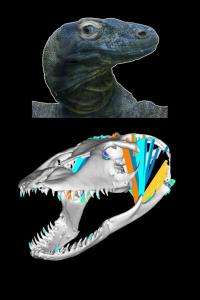
Komodo Dragon and 3-D model of lightweight skull

(PhysOrg.com) -- The world’s largest lizard – the Komodo Dragon – has an astonishingly weak bite, but a new study has revealed that the key to its killing power is a lethal combination of poison, brute strength, razor-sharp teeth and a “can-opener” biting technique.

Growing more than three metres long and weighing up to 100 kg, Komodo Dragons have a deserved reputation as fearsome predators and can kill animals as large as water buffalo - and occasionally humans.

Yet despite its formidable bulk, the giant reptile has a bite less powerful than that of a common house cat, says an international team of scientists - including researchers at Rutgers University (USA) and the University of New South Wales (Australia) - in a study published in the online journal PLoS ONE.

So how exactly does an animal with a pussycat bite kill a buffalo?

The researchers attached slabs of meat to strain gauges for the Dragon to ‘attack’ and showed that by harnessing the considerable strength of its limbs the lizard relies mostly on forces generated by its hefty, muscular body to employ its sharp, serrated teeth to tear away large pieces of flesh.

The findings support earlier 3D-modelling by the Computational Biomechanics Research Group at UNSW, suggesting that the big lizard’s lightweight skull was poorly adapted to resist high forces generated by jaw muscles.

“When considered together with our computer-modelling results these new data show that the Komodo Dragon operates like a giant scaly can opener,” says Dr Stephen Wroe, director of the Group. “By using its body, the animal does away with the need to invest energy in heavy muscle and bone in its head – it’s a very efficient system.”

In 2009, Wroe and other colleagues showed that the Komodo Dragon is truly poisonous, producing toxins that induce shock and promote bleeding after a : “People think of Komodo Dragons as ‘prehistoric’ or ‘primitive’, but the picture emerging is one of a very effective killer,” he says. “Altogether, it’s a pretty sophisticated and lethal piece of kit.”

The may be an extreme case, but the new findings also bolster the argument that forces produced by the neck and limbs may be important for other predators in prosecuting a successful kill, he notes. The team is particularly interested in understanding how carnivorous dinosaurs, many of which also had lightweight skulls, may have applied similar techniques.

More information: The paper is available online here

Provided by University of New South Wales search and more info website

3.8 /5 (4 votes)  

Filter


Move the slider to adjust rank threshold, so that you can hide some of the comments.


Display comments: newest first

Sinister1811
Oct 22, 2011

Rank: 5 / 5 (1)
Research has actually shown that the Komodo Dragon has a venomous bite, rather than a bite full of deadly bacteria.
DavidMcC
Oct 25, 2011

Rank: 5 / 5 (1)
Sinister, that's what the article is saying. Unfortunately, they missed out the point that the main "toxin" is simply an anti-coagulant, like the stuff that vampire bats use to get a good meal.

In other words, it isn't a neurotoxin, like some animals' venom.
Rank 3.8 /5 (4 votes)
Relevant PhysicsForums posts

More news stories

Scientist: Evolution debate will soon be history

(AP) -- Richard Leakey predicts skepticism over evolution will soon be history. Not that the avowed atheist has any doubts himself.

Biology / Evolution

created 22 hours ago | popularity 3.5 / 5 (20) | comments 86

Manufacturing genes to attack flu virus

An international research team has manufactured a new protein that can combat deadly flu epidemics.

Biology / Biotechnology

created 4 hours ago | popularity not rated yet | comments 0 | with audio podcast

More plant species responding to global warming than previously thought

(Phys.org) -- Far more wild plant species may be responding to global warming than previous large-scale estimates have suggested.

Biology / Ecology

created May 22, 2012 | popularity 4.6 / 5 (14) | comments 18 | with audio podcast

Thousands of shellfish found dead in Peru

Thousands of crustaceans were found dead off the coast of Lima following the mystery mass death of dolphins and pelicans, the Peruvian Navy said Friday.

Biology / Ecology

created May 26, 2012 | popularity 4.7 / 5 (6) | comments 7

For monogamous sparrows, it doesn't pay to stray (but they do it anyway)

It's quite common for a female song sparrow to stray from her breeding partner and mate with the male next door, but a new study shows that sleeping around can be costly.

Biology / Plants & Animals

created May 22, 2012 | popularity 5 / 5 (2) | comments 8 | with audio podcast


Land and sea species differ in climate change response: study

(Phys.org) -- Marine and terrestrial species will likely differ in their responses to climate warming, new research by Simon Fraser University and Australia’s University of Tasmania has found.

'Unzipped' carbon nanotubes could help energize fuel cells, batteries

Multi-walled carbon nanotubes riddled with defects and impurities on the outside could replace some of the expensive platinum catalysts used in fuel cells and metal-air batteries, according to scientists at ...

T cells 'hunt' parasites like animal predators seek prey, study shows

By pairing an intimate knowledge of immune-system function with a deep understanding of statistical physics, a cross-disciplinary team at the University of Pennsylvania has arrived at a surprising finding: T cells use a movement ...

Computer model used to pinpoint prime materials for efficient carbon capture

When power plants begin capturing their carbon emissions to reduce greenhouse gases – and to most in the electric power industry, it's a question of when, not if – it will be an expensive undertaking.

Change in developmental timing was crucial in the evolutionary shift from dinosaurs to birds: study

At first glance, it's hard to see how a common house sparrow and a Tyrannosaurus Rex might have anything in common. After all, one is a bird that weighs less than an ounce, and the other is a dinosaur that ...

Nvidia trumpets Tegra 3 phone design wins for 2012

(Phys.org) -- Nvidia’s competitive war paint has a name, Tegra 3. On the heels of Nvidia announcements about lowering costs of its Tegra 3 processors and Nvidia-enabled tablets running Android Ice Cream ...