Mapping immune genes in salmon
October 3, 2011

Mapping immune genes in salmon

Enlarge

Morten F. Lukacs' doctoral research at The Norwegian School of Veterinary Science has identified and mapped a group of immune genes that are the key to warding off infectious agents such as viruses and bacteria in salmon.

The Norwegian fish farming industry is continually growing and the production of Atlantic salmon is one of the country's flagships. One of the problems facing the industry is the threat from viral diseases and parasites, and it is difficult to find effective vaccines against these. But by increasing our knowledge of how salmon defend themselves against bacteria and viruses, we can develop better vaccines and breeding tools.

Salmon have an system designed to combat both bacterial and viral diseases, but we still do not know exactly how it works. One group of genes, called MHC, which can be found in everything from sharks to humans, is known to affect the development of diseases, such as diabetes in humans and in chickens. Earlier studies have also shown that in salmon, these genes affect the ability of the fish to withstand . In order to discover whether these effects are due to MHC or to closely linked genes, Lukacs carried out a characterization of the areas of DNA where are localised in Atlantic salmon.

Mapping immune genes in salmon
Enlarge

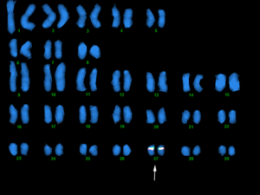
Fluorescence in situ hybridization (FISH), BAC clones, showing MHC genes location in two duplicated regions in Atlantic salmon: Location of MHC class IA region on chromosome 27, MHC class IB region on chromosome 14. Photo: Ruth Phillips

Through his research, Lukacs has shown that most of the MHC class I genes are to be found in two duplicated areas which have undergone an extensive reshuffling, compared to those of the . These two species of fish are very closely related in their development, but they react differently to, for example, various kinds of viruses.

By mapping the genes, Lukacs found 16 MHC genes, of which many may have new and interesting functions. The overall results of this doctoral research provide a solid platform for the understanding of MHC genes in salmon and for further studies of how these genes affect the fish's defence system against infectious agents.

Morten F. Lukacs defended his doctoral thesis on 29th September 2011 at The Norwegian School of Veterinary Science. The thesis is entitled: "Characterization of Major Histocompatibility Complex Class I and II Regions in ".

Provided by Norwegian School of Veterinary Science search and more info website


Rank 5 /5 (1 vote)
Relevant PhysicsForums posts

More news stories

Scientist: Evolution debate will soon be history

(AP) -- Richard Leakey predicts skepticism over evolution will soon be history. Not that the avowed atheist has any doubts himself.

Biology / Evolution

created 22 hours ago | popularity 3.5 / 5 (20) | comments 86

Manufacturing genes to attack flu virus

An international research team has manufactured a new protein that can combat deadly flu epidemics.

Biology / Biotechnology

created 4 hours ago | popularity not rated yet | comments 0 | with audio podcast

More plant species responding to global warming than previously thought

(Phys.org) -- Far more wild plant species may be responding to global warming than previous large-scale estimates have suggested.

Biology / Ecology

created May 22, 2012 | popularity 4.6 / 5 (14) | comments 18 | with audio podcast

Thousands of shellfish found dead in Peru

Thousands of crustaceans were found dead off the coast of Lima following the mystery mass death of dolphins and pelicans, the Peruvian Navy said Friday.

Biology / Ecology

created May 26, 2012 | popularity 4.7 / 5 (6) | comments 7

For monogamous sparrows, it doesn't pay to stray (but they do it anyway)

It's quite common for a female song sparrow to stray from her breeding partner and mate with the male next door, but a new study shows that sleeping around can be costly.

Biology / Plants & Animals

created May 22, 2012 | popularity 5 / 5 (2) | comments 8 | with audio podcast


Land and sea species differ in climate change response: study

(Phys.org) -- Marine and terrestrial species will likely differ in their responses to climate warming, new research by Simon Fraser University and Australia’s University of Tasmania has found.

'Unzipped' carbon nanotubes could help energize fuel cells, batteries

Multi-walled carbon nanotubes riddled with defects and impurities on the outside could replace some of the expensive platinum catalysts used in fuel cells and metal-air batteries, according to scientists at ...

T cells 'hunt' parasites like animal predators seek prey, study shows

By pairing an intimate knowledge of immune-system function with a deep understanding of statistical physics, a cross-disciplinary team at the University of Pennsylvania has arrived at a surprising finding: T cells use a movement ...

Computer model used to pinpoint prime materials for efficient carbon capture

When power plants begin capturing their carbon emissions to reduce greenhouse gases – and to most in the electric power industry, it's a question of when, not if – it will be an expensive undertaking.

Change in developmental timing was crucial in the evolutionary shift from dinosaurs to birds: study

At first glance, it's hard to see how a common house sparrow and a Tyrannosaurus Rex might have anything in common. After all, one is a bird that weighs less than an ounce, and the other is a dinosaur that ...

Nvidia trumpets Tegra 3 phone design wins for 2012

(Phys.org) -- Nvidia’s competitive war paint has a name, Tegra 3. On the heels of Nvidia announcements about lowering costs of its Tegra 3 processors and Nvidia-enabled tablets running Android Ice Cream ...