Long before Halloween became popular, ancient Greeks and Romans enjoyed good scary stories
October 17, 2011

Long Before Halloween Became Popular, Ancient Greeks and Romans Enjoyed Good Scary Stories, Says UMass Amherst Classics Professo

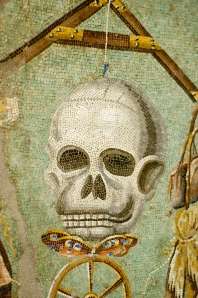
Centuries before movie and television audiences thrilled to tales of werewolves, vampires and wizards and Halloween became the second biggest celebration of the year, the ancient Greeks and Romans were spinning scary stories about monsters, ghosts and the afterlife, says University of Massachusetts Amherst Classics professor Debbie Felton, who studies the folklore of the supernatural.

Felton is the author of "Haunted and : Ghost Stories from Classical Antiquity," which relates stories of ghosts and hauntings from ancient times, many of which are similar to modern tales of the supernatural.

"I think these Roman stories are great, and most people don’t realize that ghost and werewolf stories like these were being told 2,000 years ago," says Felton. "There are many reasons why people enjoy them and enjoy being scared by them. There’s certainly a cathartic effect to hearing a ghost story and being scared out of your wits without ever being in any real danger. But, more essentially, ghost stories ultimately reflect religious beliefs concerning the importance of a proper burial and the survival of the spirit after death. The dead have a need to rest in peace, while the living have a need to believe in an afterlife; who really wants to think about eternal non-existence? And the humor in a lot of ghost stories is a good way to deal with the disturbing reality of death.

"For example, the Roman author Pliny the Younger tells a wonderful little ghost story about a haunted house in Athens," she says. "It’s a prototypical haunted house story: the horrific ghost of an old man scares everyone away, the house is deserted and falling into disrepair. Finally a brave man comes along who dares to spend the night in the house. He is not afraid of the ghost, and instead realizes the phantom wants to communicate. He follows the ghost to a spot where it disappears; he digs up the spot, finds bones, buries them with the proper rituals, and the ghost never appears again."

According to Felton, another great spooky story from antiquity isn’t about a ghost but a werewolf, told by the Roman author Petronius in his work "Satyricon." A man is going from Rome to a villa in the country to visit his mistress, and a soldier offers to accompany him. They stop to rest at the cemetery outside the city, and the soldier does something that terrifies his companion: he takes off his clothes and turns into a wolf. The man runs as fast as he can to the villa and finds that a wolf has ravaged the flocks there, but that one of the servants managed to wound the wolf. Hearing this, the man heads back to Rome, where he finds the soldier being treated by a doctor for wound. The man realizes the soldier is a shapeshifter. As with Pliny’s ghost story, this early werewolf story has many of the prototypical elements found in later such stories, including the presence of a full moon.

Along with classical writings, Felton studies literary ghost stories from the Gothic novel through British writers such as M.R. James down through American authors like Stephen King. She is currently the resident expert and coordinator for the "ghost" entry in the forthcoming Ashgate Encyclopedia of Literary and Cinematic Monsters, where she has been collecting entries from authors on ghosts in literature and cinema from all over the world, including Africa and the Caribbean, Japan, Southeast Asia, Europe and South America. Felton is also writing a number of entries for the encyclopedia, including "The Bell Witch," "Poltergeist" and "Ghosts in American literature and cinema."

Her most recent work is on monsters in Greek and Roman literature and thought, and she recently contributed a long chapter on that subject to the Ashgate Research Companion to Monsters and the Monstrous. She is currently working on a book about serial killers in the ancient world, the topic of a number of public lectures she has given around the country.

Provided by University of Massachusetts Amherst search and more info website

4.5 /5 (2 votes)  

Filter


Move the slider to adjust rank threshold, so that you can hide some of the comments.


Display comments: newest first

rwinners
Oct 17, 2011

Rank: not rated yet
Oh come on, people! Scary stories were told over camp fires 1000s or hundreds of thousands of years ago. It's how parents kept their children in check.
Rank 4.5 /5 (2 votes)
Relevant PhysicsForums posts

More news stories

Change in developmental timing was crucial in the evolutionary shift from dinosaurs to birds: study

At first glance, it's hard to see how a common house sparrow and a Tyrannosaurus Rex might have anything in common. After all, one is a bird that weighs less than an ounce, and the other is a dinosaur that ...

Other Sciences / Archaeology & Fossils

created 4 hours ago | popularity 5 / 5 (2) | comments 0 | with audio podcast

Social welfare cuts ultimately come with heavy price, researchers say

(Phys.org) -- Slashing government funding for Medicaid, food stamps and other programs that serve the poor – while politically popular with some lawmakers and many conservatives – may do more harm ...

Other Sciences / Social Sciences

created May 24, 2012 | popularity 4.3 / 5 (16) | comments 153

Ancient Bethlehem seal unearthed in Jerusalem

Israeli archaeologists have discovered a 2,700-year-old seal that bears the inscription "Bethlehem," the Israel Antiquities Authority announced Wednesday, in what experts believe to be the oldest artifact ...

Other Sciences / Archaeology & Fossils

created May 23, 2012 | popularity 3.5 / 5 (14) | comments 24

Dollars and sense: Why are some people morally against tax?

As the U.S. presidential election campaigns heat up, the economic debate is dominated by bailouts, austerity and, inevitably, taxation. Now a new study published in Symbolic Interaction asks why tax is such an important issue ...

Other Sciences / Social Sciences

created May 23, 2012 | popularity 3 / 5 (2) | comments 15

Oldest Jewish archaeological evidence on the Iberian Peninsula

German archaeologists of the Friedrich Schiller University Jena found one of the oldest archaeological evidence so far of Jewish Culture on the Iberian Peninsula at an excavation site in the south of Portugal, ...

Other Sciences / Archaeology & Fossils

created May 25, 2012 | popularity 4.2 / 5 (6) | comments 12


Land and sea species differ in climate change response: study

(Phys.org) -- Marine and terrestrial species will likely differ in their responses to climate warming, new research by Simon Fraser University and Australia’s University of Tasmania has found.

'Unzipped' carbon nanotubes could help energize fuel cells, batteries

Multi-walled carbon nanotubes riddled with defects and impurities on the outside could replace some of the expensive platinum catalysts used in fuel cells and metal-air batteries, according to scientists at ...

T cells 'hunt' parasites like animal predators seek prey, study shows

By pairing an intimate knowledge of immune-system function with a deep understanding of statistical physics, a cross-disciplinary team at the University of Pennsylvania has arrived at a surprising finding: T cells use a movement ...

Computer model used to pinpoint prime materials for efficient carbon capture

When power plants begin capturing their carbon emissions to reduce greenhouse gases – and to most in the electric power industry, it's a question of when, not if – it will be an expensive undertaking.

Nvidia trumpets Tegra 3 phone design wins for 2012

(Phys.org) -- Nvidia’s competitive war paint has a name, Tegra 3. On the heels of Nvidia announcements about lowering costs of its Tegra 3 processors and Nvidia-enabled tablets running Android Ice Cream ...

Yale study concludes public apathy over climate change unrelated to science literacy

Are members of the public divided about climate change because they don't understand the science behind it? If Americans knew more basic science and were more proficient in technical reasoning, would public consensus match ...