Fungus could wipe out Philippine bananas: growers
October 10, 2011

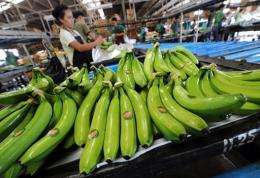
Workers pack freshly harvested bananas in the southern Philippine island of Mindanao in 200

Enlarge

Workers pack freshly harvested bananas in the southern Philippine island of Mindanao in 2008. A disease that has ravaged banana plantations across Southeast Asia could wipe out the Philippine industry in three years unless the government finds a cure, a growers' group warned Monday.

A disease that has ravaged banana plantations across Southeast Asia could wipe out the Philippine industry in three years unless the government finds a cure, a growers' group warned Monday.

The disease, called Fusarium wilt, is caused by a fast-spreading fungus that kills the plant, said Stephen Antig, executive director of the Pilipino Banana Growers and Exporters Association.

"So far, it has already infected 1,200 hectares (2,950 acres) of banana plantations locally, although that figure can go higher," Antig told AFP.

"If we can not contain this and it remains unchecked, then in less than three years our banana industry will die."

The is the second biggest exporter of in the world behind Ecuador with about 70,000 hectares of plantations, according to the association.

The banana sector is also the country's fifth largest export industry, directly employing 280,000 people, it said.

"Losing this industry will have a huge impact on our economy," Antig said.

The Philippines exports the Cavendish variety of banana, which is the most popular type around the world, according to Antig.

He said the disease wiped out the then-popular Gros Michel bananas in Central America and the Caribbean in the 1960s.

The disease also destroyed Cavendish plantations in Indonesia and Malaysia in the 1990s.

Traces of the fungus were found in controllable levels in the Philippines five years ago, Antig said.

But a more virulent type of the emerged last month and quickly began spreading through in the southern region of Mindanao, where most of the country's banana exports come from, he said.

Antig urged the government to fast-track the creation of a research institute to enable local growers to develop a fruit variety that is resistant to the disease.

(c) 2011 AFP

Filter


Move the slider to adjust rank threshold, so that you can hide some of the comments.


Display comments: newest first

Vendicar_Decarian
Oct 10, 2011

Rank: 5 / 5 (1)
Why should gubderment find a cure? Shouldn't it be industry's responsibility to do that?

Why are these capitalists in the banana industry failing to protect their own commercial interests?

According to failed Libertarian Ideology these banana production and export companies should have hired legions of biologists to find a cure for the disease that threatens the core of their existence.

Yet they have not done so, proving once again the abject failure of Libertarian/Randite ideology.
PhysOrgMe
Oct 10, 2011

Rank: not rated yet
The fact is that this problem is caused by the banana industry. The first reason is that the plants are almost all clones, which means that a disease that gets one will get all of them. The current variety that's falling victim to Fusarium is the one that was selected when the original, Gros Michel, succombed.

The probable reason that the Cavendish are now falling victim is that they're using glyphosate (RoundUp), which kills the bacteria in the soil that would normally keep the fungus at bay.

The solution is to stop this madness! Stop the monoculture. Stop the use of most pesticides. Completely ban glyphosate, which is at the heart of the current loss of bananas. The growers simply close up shop and move on to the next banana virgin area that can support the crop. The scorched earth method of farming must end - or we will end.
Astricus
Oct 10, 2011

Rank: not rated yet
http://en.wikiped...yphosate

"Glyphosate is the most used herbicide in the USA.[3] Exact figures are hard to come by because the U.S. Department of Agriculture stopped updating its pesticide use database in 2008."

Pirouette
Oct 10, 2011

Rank: not rated yet
I must agree that there is far too much use of these products that deliberately or inadvertently kill off the beneficial insect and microbial life, which is detrimental to continuous production of the fruit. Natural selection and survival of the fittest and strongest has been sacrificed for bigger and faster production for the sake of bigger profit. And that has its consequences which we are seeing more and more. . .and not just in bananas.
Pirouette
Oct 10, 2011

Rank: not rated yet
[qThe solution is to stop this madness! Stop the monoculture. Stop the use of most pesticides. Completely ban glyphosate, which is at the heart of the current loss of bananas. The scorched earth method of farming must end - or we will end.
PhysorgMe is right. Eventually, this foolish method of growing crops any place in the world will increase the risk of crops failing and causing famine on a regular basis. It's only a matter of time until diseases get the upper hand.
RayW
Oct 10, 2011

Rank: not rated yet
Pine Pitch Canker, causative agent an indiginous Fusarium sp., kills pine trees in the southern US. An indiginous Arthrobacter sp. secreting an antibiotic, taken up by the pibe tree roots, normally keeps this in check. They need to test virgin soil flora for sp. that inhibit the causative Fusarium. Testing those sp. against glyphosate might also be in order. The growers can use the data to adjust their chemicals, reseed flora, and/ot apply the cultured antibiotic.
Skepticus
Oct 11, 2011

Rank: not rated yet
I had the fortune of having eaten at least 6 different kinds of bananas, from finger to arm-sized ones. They are all refreshingly different. Sadly, most people don't know the bland crap they are buying from supermarkets are there solely due to the relative low cost of keeping them from spoilage during transportation and storing.
Rank 5 /5 (3 votes)
Relevant PhysicsForums posts

More news stories

Manufacturing genes to attack flu virus

An international research team has manufactured a new protein that can combat deadly flu epidemics.

Biology / Biotechnology

created 1 hour ago | popularity not rated yet | comments 0 | with audio podcast

Scientist: Evolution debate will soon be history

(AP) -- Richard Leakey predicts skepticism over evolution will soon be history. Not that the avowed atheist has any doubts himself.

Biology / Evolution

created 19 hours ago | popularity 3.3 / 5 (18) | comments 73

More plant species responding to global warming than previously thought

(Phys.org) -- Far more wild plant species may be responding to global warming than previous large-scale estimates have suggested.

Biology / Ecology

created May 22, 2012 | popularity 4.6 / 5 (14) | comments 18 | with audio podcast

Thousands of shellfish found dead in Peru

Thousands of crustaceans were found dead off the coast of Lima following the mystery mass death of dolphins and pelicans, the Peruvian Navy said Friday.

Biology / Ecology

created May 26, 2012 | popularity 4.8 / 5 (4) | comments 7

For monogamous sparrows, it doesn't pay to stray (but they do it anyway)

It's quite common for a female song sparrow to stray from her breeding partner and mate with the male next door, but a new study shows that sleeping around can be costly.

Biology / Plants & Animals

created May 22, 2012 | popularity 5 / 5 (2) | comments 8 | with audio podcast


Computer model used to pinpoint prime materials for efficient carbon capture

When power plants begin capturing their carbon emissions to reduce greenhouse gases – and to most in the electric power industry, it's a question of when, not if – it will be an expensive undertaking.

'Unzipped' carbon nanotubes could help energize fuel cells, batteries

Multi-walled carbon nanotubes riddled with defects and impurities on the outside could replace some of the expensive platinum catalysts used in fuel cells and metal-air batteries, according to scientists at ...

T cells 'hunt' parasites like animal predators seek prey, study shows

By pairing an intimate knowledge of immune-system function with a deep understanding of statistical physics, a cross-disciplinary team at the University of Pennsylvania has arrived at a surprising finding: T cells use a movement ...

Yale study concludes public apathy over climate change unrelated to science literacy

Are members of the public divided about climate change because they don't understand the science behind it? If Americans knew more basic science and were more proficient in technical reasoning, would public consensus match ...

Same gene that stunts infants' growth also makes them grow too big: research

UCLA geneticists have identified the mutation responsible for IMAGe* syndrome, a rare disorder that stunts infants' growth. The twist? The mutation occurs on the same gene that causes Beckwith-Wiedemann syndrome, which makes ...

Change in developmental timing was crucial in the evolutionary shift from dinosaurs to birds: study

At first glance, it's hard to see how a common house sparrow and a Tyrannosaurus Rex might have anything in common. After all, one is a bird that weighs less than an ounce, and the other is a dinosaur that ...