New research challenges evolutionary theory
(PhysOrg.com) -- New research from the University of Reading overturns conventional views on the nature of evolution, arguing that mammals did not develop into their many different forms in one early and rapid burst of evolution but rather found many different evolutionary routes.
It is widely assumed that species often diverge rapidly early in their evolution, and that this is followed by a longer, drawn-out period of slower evolutionary fine-tuning.
Explanations for this pattern suppose that mammals moved into a largely unoccupied niche and geographical space as they came to be the dominant vertebrate group on Earth. Then, as time went on, niche space and unexplored geographical regions became scarce, reducing opportunities for diversification.
However, the research led by Professor Mark Pagel, in conjunction with Dr Chris Venditti and Dr Andrew Meade, shows that there is no necessary connection between the rates at which new species emerge and the underlying rates of evolution of their features. Thus, the majority of mammal species, including two of the most prevalent orders of mammals (the rodents and bats), have no history of substantial and sustained increases in the rates at which they evolve.
Instead, these species achieved high rates of speciation' or the production of new species, even though their rates of evolution were close to normal for mammals.
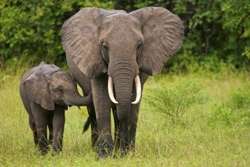
By comparison, some of the highest average rates of change occur in one of the least numerous groups. The Proboscidea, including elephants and sea cows, evolve on average 4.6-fold faster than the mammalian norm. The results highlight natural selection's role as a precise sculptor of mammalian size diversity, able to produce rapid body size changes seemingly at will.
Professor Pagel said: "It has long been believed mammals underwent a burst of body-size evolution that occurred early in their history and that this was followed by a gradual slowdown towards the present. However, we find that the processes that give rise to the morphological diversity of this class of animals are far more free to vary than previously considered. Niches do not seem to fill up, and diversity seems to arise whenever, wherever and at whatever rate it is advantageous. We find that natural selection has found multiple different routes to producing the current diversity of sizes."
Multiple routes to mammalian diversity', by Chris Venditti (now at University of Hull), Andrew Meade and Mark Pagel, is published in Nature on Wednesday October 19.
More information: DOI:10.1038/nature10516
Provided by University of Reading
-
From lemons to lemonade: Reaction uses carbon dioxide to make carbon-based semiconductor,
32 comments
-
Thioridazine kills cancer stem cells in human while avoiding toxic side-effects of conventional cancer treatments,
3 comments
-
SpaceX private rocket blasts off for space station (Update),
42 comments
-
Climate scientists say they have solved riddle of rising sea,
31 comments
-
SpaceX capsule has 'new car' smell, astronauts say (Update),
3 comments
-
What would stain as translucent on light-coloured fabric?
20 hours ago
-
How do I identify different bacteria on culture plates?
May 26, 2012
-
Why Do Dogs do Strange things...
May 25, 2012
-
What does exophillic and endophillic mean in terms of mosquito and their control?
May 24, 2012
-
Semen stains glows under black lights (uv light)?
May 23, 2012
-
Question on Human Chromosome 2
May 23, 2012
- More from Physics Forums - Biology
More news stories
Manufacturing genes to attack flu virus
An international research team has manufactured a new protein that can combat deadly flu epidemics.
1 hour ago |
not rated yet |
0
|
Scientist: Evolution debate will soon be history
(AP) -- Richard Leakey predicts skepticism over evolution will soon be history. Not that the avowed atheist has any doubts himself.
19 hours ago |
3.3 / 5 (18) |
73
More plant species responding to global warming than previously thought
(Phys.org) -- Far more wild plant species may be responding to global warming than previous large-scale estimates have suggested.
May 22, 2012 |
4.6 / 5 (14) |
18
|
Thousands of shellfish found dead in Peru
Thousands of crustaceans were found dead off the coast of Lima following the mystery mass death of dolphins and pelicans, the Peruvian Navy said Friday.
May 26, 2012 |
4.8 / 5 (4) |
7
For monogamous sparrows, it doesn't pay to stray (but they do it anyway)
It's quite common for a female song sparrow to stray from her breeding partner and mate with the male next door, but a new study shows that sleeping around can be costly.
May 22, 2012 |
5 / 5 (2) |
8
|
Computer model used to pinpoint prime materials for efficient carbon capture
When power plants begin capturing their carbon emissions to reduce greenhouse gases and to most in the electric power industry, it's a question of when, not if it will be an expensive undertaking.
'Unzipped' carbon nanotubes could help energize fuel cells, batteries
Multi-walled carbon nanotubes riddled with defects and impurities on the outside could replace some of the expensive platinum catalysts used in fuel cells and metal-air batteries, according to scientists at ...
T cells 'hunt' parasites like animal predators seek prey, study shows
By pairing an intimate knowledge of immune-system function with a deep understanding of statistical physics, a cross-disciplinary team at the University of Pennsylvania has arrived at a surprising finding: T cells use a movement ...
Yale study concludes public apathy over climate change unrelated to science literacy
Are members of the public divided about climate change because they don't understand the science behind it? If Americans knew more basic science and were more proficient in technical reasoning, would public consensus match ...
Same gene that stunts infants' growth also makes them grow too big: research
UCLA geneticists have identified the mutation responsible for IMAGe* syndrome, a rare disorder that stunts infants' growth. The twist? The mutation occurs on the same gene that causes Beckwith-Wiedemann syndrome, which makes ...
Change in developmental timing was crucial in the evolutionary shift from dinosaurs to birds: study
At first glance, it's hard to see how a common house sparrow and a Tyrannosaurus Rex might have anything in common. After all, one is a bird that weighs less than an ounce, and the other is a dinosaur that ...
Oct 20, 2011
Rank: 5 / 5 (21)
Oct 20, 2011
Rank: 4.9 / 5 (22)
Oct 20, 2011
Rank: 4.9 / 5 (14)
Oct 20, 2011
Rank: 5 / 5 (11)
Oct 20, 2011
Rank: 5 / 5 (12)
Sadly physorg article writers aren't that bright and seek sensational headlines. They probably hire freelance writers or something.
Oct 20, 2011
Rank: 4.6 / 5 (8)
Then again, who would read an article with such a boring heading?
Oct 20, 2011
Rank: 5 / 5 (8)
Oct 20, 2011
Rank: 1 / 5 (1)
Oct 20, 2011
Rank: 5 / 5 (5)
Oct 20, 2011
Rank: 2.6 / 5 (15)
Congrats everyone!
Oct 20, 2011
Rank: 3 / 5 (4)
That said, what if - evolution was the designed thing, not the actual evolving things that are a part of it? In an (quantum)infinite possibility system that everything in it is an evolutionary product of, you have to, at least, admit it is a POSSIBILITY (however remote)...
Hell, we humans do it all the time - "let's try this and see what happens...." - Like the time I threw a little gasoline on a bonfire - a completely unplanned action - to get it going. Let's call that MY mini big-bang event. It had a certain "designed-ness" to it(That was not very well thought out, it turned out), And I STILL run into innumerable, totally unintended, results of that act... "After-the-fact" analysis reveals the connection of a particular consequence to that event.
So... Just a "what if", mind you. NOT a statement of fact.
Oct 20, 2011
Rank: 5 / 5 (2)
Oct 20, 2011
Rank: not rated yet
And how did this being that designed "us" come to evolve?
Evolution perhaps? ;)
You can't have an intelligent being from 1 frame to another, intelligence has to evolve from something. In fact even something had to came to evolve from something smaller.
Oct 20, 2011
Rank: 4.3 / 5 (34)
They "could" just ascribe "creation" to first cause or underlying natural laws which lead to evolution, ...metaphysical questions outside the bounds of scientific applicability, rather than competing with scientific observation.
If they still want to question evolution or any other scientific theory, then they need to answer 'why it is that god has given us ability to understand the world and yet we are apparently misled in our observations'.
By their logic there would have to be a redundant and artificial seam to reality,.. existing between 'His Creation' and what appears to have occurred given inductive reasoning, which doesn't seem compatible with a perfect god.
Oct 20, 2011
Rank: 1.8 / 5 (12)
Oct 20, 2011
Rank: 3 / 5 (2)
That's all well and good and I certainly wouldn't say it's impossible, the question is what evidence is there to suggest it?
Oct 20, 2011
Rank: 5 / 5 (3)
Oct 20, 2011
Rank: 1 / 5 (1)
Oct 20, 2011
Rank: 4.3 / 5 (32)
What?
Oct 20, 2011
Rank: 1 / 5 (2)
Evidence is the result of observation. Observation comes from experimentation, which we design based on OTHER observations.
I suggest we haven't experienced enough observations to design the right experiment to test my postulate.
I read another article on here, last night, that seemed to suggest (from their observations of an experiment) that the actions of a "system" (thing, set, whatever)can be predicted by the repeated observation of an element OF that set.
Based on that premise, I also suggest that "evolution"(of life as we know it) is an element of a much larger set and therefore observable "evidence"
Of course, that set would have to be an element of an even LARGER set...
Therefore; Mandlebrot was a prophet...:-)
Oct 20, 2011
Rank: 1 / 5 (1)
Oct 20, 2011
Rank: 5 / 5 (4)
Oct 20, 2011
Rank: 5 / 5 (5)
terrible title. whoever wrote this needs to read the actual article.
Oct 20, 2011
Rank: 5 / 5 (6)
Why are you still making idiotic posts. I thought your stupidity was settled.
Oct 21, 2011
Rank: not rated yet
Oct 21, 2011
Rank: not rated yet
I do hope this helps to assuage (ameliorate) your consternation.
Oct 22, 2011
Rank: 3 / 5 (2)
Generational period is the measure of evolutionary rate... body size is probably tightly correlated to generational period though.
Oct 23, 2011
Rank: not rated yet
Oct 23, 2011
Rank: 1 / 5 (3)
We keep being told the climate science is settled and we are told evolution is settled so why do people keep wasting their time and money to study them?
OH, you mean the science is NOT settled?
Oct 23, 2011
Rank: 3 / 5 (2)
The details of how evolution occurs and has occurred in the past will never be fully known. That evolution occurs is as solid as gravity. More so really since both mutations occur and organisms die thus evolution is something that cannot not happen.
Now as for the climate. It changes. That is settled. Only someone that is a complete ignoramus or idiot would claim otherwise. Only ignoramuses and liars claim that CO2 isn't a greenhouse gas. The only questions how much effect the variability of the Sun is involved and if CO2 is causing global warming or staving off global cooling.
And ALL evidence shows that YOU are not the person with the skills or knowledge to discuss either of these in a rational manner.
Ethelred
Oct 25, 2011
Rank: not rated yet
Not very. It's more complicated than that, otherwise a 25-year-old queen honey ant might have a problem fitting into one of those tight little tunnels they build!
Oct 25, 2011
Rank: not rated yet
Oct 25, 2011
Rank: 5 / 5 (1)
Oct 25, 2011
Rank: 5 / 5 (2)