ESA centrifuge opens door to high-gravity worlds
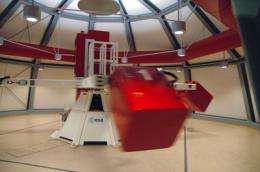
The LDC carrying one of the student's experiments. Credits: ESA
Astronauts' jobs sometimes weigh heavy on them: crews returning from space briefly endure g-loading more than four times Earth normal. Scientists interested in hypergravity need to create it for minutes, days or even weeks at a time. Fortunately, ESAs Large Diameter Centrifuge does just that.
Based at ESAs ESTEC technical centre in Noordwijk, the Netherlands, the centrifuge is designed not for astronaut training but for research. Jointly financed by ESA and the Dutch government, the centrifuge is available for a variety of applications.
People propose all kinds of experiments we assess them for scientific relevance, feasibility and safety, explained ESAs Jutta Krause.
We perform physical, biological, geological and even astrogeological tests one team investigated how crater impacts vary under higher gravity.
In addition, the centrifuge is open for industrial users to test and qualify hardware.
Last week, we hosted student teams from the latest round of Spin your Thesis, organised through ESAs Education Office.
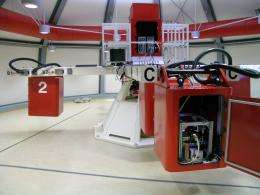
The 8 m-diameter centrifuge can create up to 20 g, with four gondolas holding up to 80 kg of experiments.
Enlarge
ESA Large Diameter Ceentrifuge facility at ESTEC. Credits: ESA
Two more gondolas can be attached half way along the arm to provide different g-levels at the same time.Experiments can be spun for up to six months at a time non-stop, at changing g-profiles if needed, Jutta added. After that, we have to stop for routine maintenance.
Students testing water drops and plant roots
The latest Spin your Thesis campaign took place in September, following an earlier campaign in June. Another team will run their experiment at the end of November.
Student teams are selected to take part by experts from ESA and the European Low Gravity Research Association.
The HyperDrop team from the Université Libre de Bruxelles in Belgium and Politecnico de Milano in Italy investigated how liquid droplets on a solid surface change shape as gravity shifts.
Were interested in measuring changes to the angle of the droplets where their outside edge meets air, explained Dmitry Zaitsev of HyperDrop.
Were performing 15-minute experiments across seven different g rates with liquids on various surfaces.
Its fairly fundamental research, but also has some practical applications. Spraying droplets onto surfaces is widely used in industry for cooling.
For instance, it is employed in some Formula One cars they are subjected to very high accelerations while racing.
A second team, HyperMEA from the University of Florence in Italy, employed sophisticated electrical devices normally used in neurological studies to detect how maize roots respond to gravity shifts.
Our samples begin with four hours spinning at 2 g, then move up to 5 g for one to two hours, commented Elisa Masi of HyperMEA.
The actual electrical effects involved are very small, so require around a day of analysis per single run.
Were interested in the pattern of plant response to stress although there might one day be practical uses, such as helping with plant cultivation in space.
Each team gets half a week when they are free to use the centrifuge as they wish, said Francesco Emma of ESAs Education Office.
This flexible access has already led to a number of studies submitted to scientific journals.
The call for proposals for 2012s Spin your Thesis campaign will close on 12 December. To find out more please check the right hand link.
Provided by
European Space Agency
-
From lemons to lemonade: Reaction uses carbon dioxide to make carbon-based semiconductor,
32 comments
-
Thioridazine kills cancer stem cells in human while avoiding toxic side-effects of conventional cancer treatments,
3 comments
-
SpaceX private rocket blasts off for space station (Update),
42 comments
-
Climate scientists say they have solved riddle of rising sea,
31 comments
-
SpaceX capsule has 'new car' smell, astronauts say (Update),
3 comments
-
Need a rigid insulation material???
16 hours ago
-
magnets or EMF in car bumpers to protect from fender bender
May 26, 2012
-
length of wire in a coil of known dimensions?
May 25, 2012
-
India Engineering Powerhouse
May 25, 2012
-
electromagnet core dereference between hard and soft iron
May 25, 2012
-
Measuring water pressure in an open tank
May 24, 2012
- More from Physics Forums - General Engineering
More news stories
Browser wars flare in mobile space
The browser wars are heating up again, but this time the fight is for dominance of the mobile Internet.
8 hours ago |
5 / 5 (1) |
3
Probability of contamination from severe nuclear reactor accidents is higher than expected: study
Catastrophic nuclear accidents such as the core meltdowns in Chernobyl and Fukushima are more likely to happen than previously assumed. Based on the operating hours of all civil nuclear reactors and the number ...
Technology / Energy & Green Tech
May 22, 2012 |
3.6 / 5 (22) |
56
|
SpotterRF debuts Radar Backpack Kit (w/ Video)
(Phys.org) -- SpotterRF has announced a special radar backpack kit designed to enhance situational awareness for soldiers on the ground. The company says its special radar is designed for warfighters as part ...
HyperSolar shows dirty water no barrier to power world
(Phys.org) -- The Santa Barbara, California, company, HyperSolar, is set to transparently share the ups and downs of its research experiences toward the companys ultimate vision, successfully producing ...
Tesla to launch electric sedan in US on June 22
Tesla Motors said Tuesday it would begin deliveries of "the world's first premium electric sedan" on June 22, slightly ahead of schedule.
Technology / Energy & Green Tech
May 22, 2012 |
4.5 / 5 (12) |
18
Computer model used to pinpoint prime materials for efficient carbon capture
When power plants begin capturing their carbon emissions to reduce greenhouse gases and to most in the electric power industry, it's a question of when, not if it will be an expensive undertaking.
'Unzipped' carbon nanotubes could help energize fuel cells, batteries
Multi-walled carbon nanotubes riddled with defects and impurities on the outside could replace some of the expensive platinum catalysts used in fuel cells and metal-air batteries, according to scientists at ...
T cells 'hunt' parasites like animal predators seek prey, study shows
By pairing an intimate knowledge of immune-system function with a deep understanding of statistical physics, a cross-disciplinary team at the University of Pennsylvania has arrived at a surprising finding: T cells use a movement ...
Yale study concludes public apathy over climate change unrelated to science literacy
Are members of the public divided about climate change because they don't understand the science behind it? If Americans knew more basic science and were more proficient in technical reasoning, would public consensus match ...
Same gene that stunts infants' growth also makes them grow too big: research
UCLA geneticists have identified the mutation responsible for IMAGe* syndrome, a rare disorder that stunts infants' growth. The twist? The mutation occurs on the same gene that causes Beckwith-Wiedemann syndrome, which makes ...
Change in developmental timing was crucial in the evolutionary shift from dinosaurs to birds: study
At first glance, it's hard to see how a common house sparrow and a Tyrannosaurus Rex might have anything in common. After all, one is a bird that weighs less than an ounce, and the other is a dinosaur that ...
Oct 23, 2011
Rank: 1 / 5 (1)