Child abuse in birds: Study documents 'cycle of violence' in nature
October 3, 2011

Child abuse in birds: Study documents 'cycle of violence' in nature

Enlarge

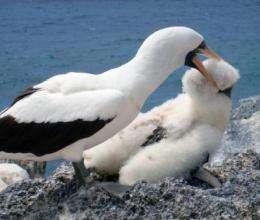
A Nazca booby adult begins an unwelcome visit with an unguarded nestling. Most such visits include aggressive bites by the adult to the nestling's head and neck. Credit: Jacquelyn Grace

For one species of seabird in the Galápagos, the child abuse "cycle of violence" found in humans plays out in the wild.

The new study of Nazca boobies by Wake Forest University researchers provides the first evidence from the animal world showing those who are abused when they are young often grow up to be abusers. The study appears in the October issue of the ornithology journal, The Auk.

"We were surprised by the intense interest that many adults show in unrelated young, involving really rough treatment," said Wake Forest Professor of Biology Dave Anderson, who led the study with Wake Forest graduate student Martina Müller. "A bird's history as a target of abuse proved to be a strong predictor of its adult behavior."

In Nazca boobies, traumatic abuse of developing young significantly increases the chances those maltreated individuals will exhibit the same maltreatment later in life as adults, Müller said. She is now at the University of Groeningen in the Netherlands.

The ocean-going seabirds live in colonies in the Galápagos Islands off the coast of Ecuador. Among Nazca boobies, victimization by adults on other birds' chicks is widespread. They raise solitary nestlings on the ground and frequently leave their offspring unattended while foraging at sea. So, there is much opportunity for adult birds to bully and beat up neighbor nestlings.
Child abuse in birds: Study documents 'cycle of violence' in nature
Enlarge

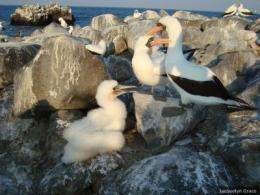
A Nazca booby family: male and female mated pair and their chick are on Isla Espaņola, Galápagos. Credit: Jacquelyn Grace

The abusive adults patrol the breeding colony, searching for unguarded chicks. They frequently bite and peck the chicks, and even make sexual advances, sometimes leaving the chicks bleeding and stressed. Female adults show more aggressive behavior than males do, on average.

The young birds nest years later in the colony where they were born, making them ideal models for studying the effects of "chick" abuse on lifelong behavior.

The researchers collected data during three breeding seasons documenting which nestlings suffered abuse or neglect, then several years later evaluated their behavior as adults in the same colony. They tracked the and identified them using leg bands.

The findings shed important light on animal behavior. "This is not some contrived experimental situation with freaked out captive animals. This is an animal in a natural situation experiencing natural stressors when young. And, the outcome is their behavior later is influenced by the social stress they experienced," Anderson said. "As we determine how similar the physiology of this response is to the human situation, we may find opportunities for research on this stress response that are not possible to do with humans."
Child abuse in birds: Study documents 'cycle of violence' in nature
Enlarge

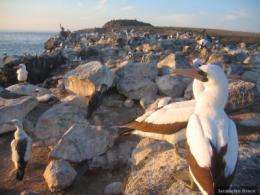
Nazca booby adults (foreground) and nestlings are part of a colony on Isla Espaņola, Galápagos. Credit: Jacquelyn Grace

Co-authors on the study included Wake Forest graduate students Elaine T. Porter, Jacquelyn K. Grace, Jill A. Awkerman, and Mark A. Westbrock and technicians Kevin T. Birchler, Alex R. Gunderson, and Eric G. Schneider.

The Wake Forest team of researchers is already exploring physiological responses to abuse and have found a dramatic increase in corticosterone, the primary avian stress hormone, after a chick has experienced abuse. The surge in stress hormone may influence adult bird behavior. The study, led by doctoral student Jacquelyn Grace, was published recently in the journal, Hormones and Behavior.

"It's fascinating that what many would consider an extremely complex human phenomenon is also occurring - perhaps through the same physiological mechanism — in Nazca boobies, which are more closely related to crocodiles than mammals," Grace said. "Both studies suggest Nazca boobies might be a good model system to begin understanding the mechanisms underlying the cycle of violence in humans."

Provided by Wake Forest University search and more info website

Filter


Move the slider to adjust rank threshold, so that you can hide some of the comments.


Display comments: newest first

Isaacsname
Oct 03, 2011

Rank: 5 / 5 (2)
I was surprised not to see this article titled " Boobies get slapped around on beach "
Rank 5 /5 (3 votes)
Relevant PhysicsForums posts

More news stories

Scientist: Evolution debate will soon be history

(AP) -- Richard Leakey predicts skepticism over evolution will soon be history. Not that the avowed atheist has any doubts himself.

Biology / Evolution

created 23 hours ago | popularity 3.5 / 5 (20) | comments 86

Manufacturing genes to attack flu virus

An international research team has manufactured a new protein that can combat deadly flu epidemics.

Biology / Biotechnology

created 4 hours ago | popularity not rated yet | comments 0 | with audio podcast

More plant species responding to global warming than previously thought

(Phys.org) -- Far more wild plant species may be responding to global warming than previous large-scale estimates have suggested.

Biology / Ecology

created May 22, 2012 | popularity 4.6 / 5 (14) | comments 18 | with audio podcast

For monogamous sparrows, it doesn't pay to stray (but they do it anyway)

It's quite common for a female song sparrow to stray from her breeding partner and mate with the male next door, but a new study shows that sleeping around can be costly.

Biology / Plants & Animals

created May 22, 2012 | popularity 5 / 5 (2) | comments 8 | with audio podcast

Thousands of shellfish found dead in Peru

Thousands of crustaceans were found dead off the coast of Lima following the mystery mass death of dolphins and pelicans, the Peruvian Navy said Friday.

Biology / Ecology

created May 26, 2012 | popularity 4.7 / 5 (6) | comments 7


Nvidia trumpets Tegra 3 phone design wins for 2012

(Phys.org) -- Nvidia’s competitive war paint has a name, Tegra 3. On the heels of Nvidia announcements about lowering costs of its Tegra 3 processors and Nvidia-enabled tablets running Android Ice Cream ...

'Unzipped' carbon nanotubes could help energize fuel cells, batteries

Multi-walled carbon nanotubes riddled with defects and impurities on the outside could replace some of the expensive platinum catalysts used in fuel cells and metal-air batteries, according to scientists at ...

T cells 'hunt' parasites like animal predators seek prey, study shows

By pairing an intimate knowledge of immune-system function with a deep understanding of statistical physics, a cross-disciplinary team at the University of Pennsylvania has arrived at a surprising finding: T cells use a movement ...

Computer model used to pinpoint prime materials for efficient carbon capture

When power plants begin capturing their carbon emissions to reduce greenhouse gases – and to most in the electric power industry, it's a question of when, not if – it will be an expensive undertaking.

Change in developmental timing was crucial in the evolutionary shift from dinosaurs to birds: study

At first glance, it's hard to see how a common house sparrow and a Tyrannosaurus Rex might have anything in common. After all, one is a bird that weighs less than an ounce, and the other is a dinosaur that ...

Land and sea species differ in climate change response: study

(Phys.org) -- Marine and terrestrial species will likely differ in their responses to climate warming, new research by Simon Fraser University and Australia’s University of Tasmania has found.