CGPM set to update international system of weights and measures
October 26, 2011 by Bob Yirka report

kilogram

Enlarge

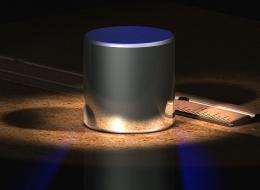
A computer-generated image of the International Prototype kilogram (IPK), which is made from an alloy of 90% platinum and 10% iridium (by weight) and machined into a right-circular cylinder (height = diameter) of 39.17 mm. The IPK is kept at the Bureau International des Poids et Mesures (International Bureau of Weights and Measures) in Sčvres on the outskirts of Paris.

(PhysOrg.com) -- The General Conference on Weights and Measures (CGPM) at its most recent meeting in Sčvres, France, has voted unanimously on a proposal to consider changes to at least some of the seven basic units (second, metre, kilogram, ampere, kelvin, mole and candela) of measurements used by most of the civilized world. This comes after years of debate concerning the kilogram, ampere, kelvin, and mole in particular. Of these, the kilogram has come under the most fire as it’s still based on a hunk of metal kept under lock and key in a vault in Paris. It’s been the subject of debate ever since it was discovered in 1948 that its mass had changed.

The seven basic units of measurements are used as standards all by themselves, but also as a means of deriving virtually all other measurements (grams, hours, etc.) As science has become more precise so too has the need for ever more precise measurements, and some of the old ways of doing so are just not holding up. The kilograms shortcomings are obvious, it’s the only one of the seven left still based on a manufactured object. A more accurate way to describe it would be to use a fundamental constant found in nature, such as the Planck constant. And this is exactly what a small group of meteorologists has recommended.

Peter Mohr, Terry Quinn, Barry Taylor and Edwin Williams recently banded together and published an article in the journal Metrologia that championed the switch to the Planck constant, and for changes to three other basic measurements as well: the ampere, kelvin, and mole. And it was this small group that lobbied for the proposed changes that have been addressed at the recent meeting of the CGPM.

At the meeting, it was stressed that any new changes to the way measurements are based, should not change the basic ways that they are now conventionally used, e.g. water would still freeze at 0° C, and boil at 100° and cooking recipes would still work and world records in Olympic events would still all hold, etc. What would change would be the degree of accuracy that could be used to describe a mass, distance, time, etc. that would be consistent regardless of where the measurements were being taken and by whom.

One good example is the metre (meter), a measurement not in need of change. It was originally based on an etching on a metal bar; now it’s based on the distance light travels in a vacuum.

This move by the CGPM means that proposals for the exact changes to be made will be considered and then voted on at the next meeting in 2014. If the changes pass, a timetable for their implementation will be set at that meeting as well.

The CGPM also known as the conférence générale des poids et mesures, is just one of three entities charged with maintaining the International System of Units (SI) by decree of an international convention held way back in 1875. It represents 52 member states and 26 other associates.

More information: http://www.bipm.or … ention/cgpm/

© 2011 PhysOrg.com

Filter


Move the slider to adjust rank threshold, so that you can hide some of the comments.


Display comments: newest first

Blakut
Oct 26, 2011

Rank: 5 / 5 (9)
A small group of METROLOGISTS, not METEOROLOGISTS!!!! COME ON!
Eikka
Oct 26, 2011

Rank: 2.8 / 5 (5)
They should also change the Pascal, which is so incredibly tiny that it's almost useless, and it doesn't really align to things that people actually encounter.

For example. Normal air pressure is roughly 100,000 Pa and the pressure in your bicycle tire is between 300,000 and 500,000 Pa

You have to stop and think to know how much is 1.2 Megapascals, because you have to remember to multiply it by ten to get a meaningful answers relative to everyday stuff. That's probably why nobody bothers to use the unit when we have Bars.
pauljpease
Oct 26, 2011

Rank: 4.4 / 5 (5)
They should also change the Pascal, which is so incredibly tiny that it's almost useless, and it doesn't really align to things that people actually encounter.

For example. Normal air pressure is roughly 100,000 Pa and the pressure in your bicycle tire is between 300,000 and 500,000 Pa

You have to stop and think to know how much is 1.2 Megapascals, because you have to remember to multiply it by ten to get a meaningful answers relative to everyday stuff. That's probably why nobody bothers to use the unit when we have Bars.


Pressure units are not fundamental. They are a complex unit combining force (mass, time and length) and area (length). So changing the Pascal would mean either changing the units of mass, time and/or length, or making the basic unit of pressure equal to some non-unitary ratio of Newtons and square meters (1 Pa = 1N/1m^2). The reason it is small is that a Newton is small and a square meter is large.
Rank 5 /5 (1 vote)
Relevant PhysicsForums posts
  • Why does light move?
    created1 hour ago
  • How to calculate the repulsion force between a permanent and an electromagnet?
    created3 hours ago
  • Why does light allow us to see things?
    created3 hours ago
  • Room temperature superconductivity
    created3 hours ago
  • Water flow question
    created6 hours ago
  • 16 year old solves 300 year old problem set by Isaac Newton
    created7 hours ago
  • More from Physics Forums - General Physics

More news stories

Is a classical electrodynamics law incompatible with special relativity?

(Phys.org) -- The laws of classical electromagnetism that were developed in the 19th century are the same laws that scientists use today. They include Maxwell’s four equations along with the Lorentz la ...

Physics / General Physics

created May 24, 2012 | popularity 4.7 / 5 (17) | comments 43 | with audio podcast feature

Landmark calculation clears the way to answering how matter is formed

(Phys.org) -- An international collaboration of scientists, including Thomas Blum, associate professor of physics, is reporting in landmark detail the decay process of a subatomic particle called a kaon – ...

Physics / General Physics

created May 25, 2012 | popularity 4.3 / 5 (22) | comments 51 | with audio podcast

Lying in wait for WIMPs: Researchers seek to dramatically increase sensitivity of Large Underground Xenon detector

Although it's invisible, dark matter accounts for at least 80 percent of the matter in the universe. No one knows what it is, but most scientists would bet on weakly interacting massive particles, or WIMPs.

Physics / General Physics

created May 23, 2012 | popularity 4 / 5 (7) | comments 16 | with audio podcast

Hawaii lab turns laser-powered bubbles into microrobots

(Phys.org) -- A team of scientists from the University of Hawaii are working on microrobots created from bubbles of air in a saline solution. The bubbles take on their title of “robots” as a laser ...

Physics / General Physics

created May 23, 2012 | popularity 5 / 5 (4) | comments 2 | with audio podcast weblog

Sound increases the efficiency of boiling

Scientists at the Georgia Institute of Technology achieved a 17-percent increase in boiling efficiency by using an acoustic field to enhance heat transfer. The acoustic field does this by efficiently removing vapor bubbles ...

Physics / Soft Matter

created May 24, 2012 | popularity 5 / 5 (2) | comments 2


Nvidia trumpets Tegra 3 phone design wins for 2012

(Phys.org) -- Nvidia’s competitive war paint has a name, Tegra 3. On the heels of Nvidia announcements about lowering costs of its Tegra 3 processors and Nvidia-enabled tablets running Android Ice Cream ...

'Unzipped' carbon nanotubes could help energize fuel cells, batteries

Multi-walled carbon nanotubes riddled with defects and impurities on the outside could replace some of the expensive platinum catalysts used in fuel cells and metal-air batteries, according to scientists at ...

T cells 'hunt' parasites like animal predators seek prey, study shows

By pairing an intimate knowledge of immune-system function with a deep understanding of statistical physics, a cross-disciplinary team at the University of Pennsylvania has arrived at a surprising finding: T cells use a movement ...

Computer model used to pinpoint prime materials for efficient carbon capture

When power plants begin capturing their carbon emissions to reduce greenhouse gases – and to most in the electric power industry, it's a question of when, not if – it will be an expensive undertaking.

Change in developmental timing was crucial in the evolutionary shift from dinosaurs to birds: study

At first glance, it's hard to see how a common house sparrow and a Tyrannosaurus Rex might have anything in common. After all, one is a bird that weighs less than an ounce, and the other is a dinosaur that ...

Land and sea species differ in climate change response: study

(Phys.org) -- Marine and terrestrial species will likely differ in their responses to climate warming, new research by Simon Fraser University and Australia’s University of Tasmania has found.