California physicist shares 2011 Nobel Prize
October 4, 2011

California physicist shares 2011 Nobel Prize (AP)

Enlarge

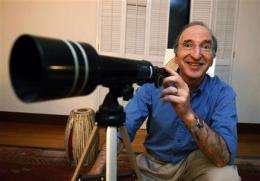
Nobel Prizes winner for physics Saul Perlmutter smiles as he poses with his daughter's telescope at his home in Berkeley, Calif., Tuesday, Oct. 4, 2011 after hearing he had won. The Royal Swedish Academy of Sciences said American Perlmutter would share the 10 million kronor ($1.5 million) award with U.S.-Australian Brian Schmidt and U.S. scientist Adam Riess. Working in two separate research teams during the 1990s, Perlmutter in one and Schmidt and Riess in the other, the scientists raced to map the universe's expansion by analyzing a particular type of supernovas, or exploding stars. (AP Photo/Paul Sakuma)

Saul Perlmutter won the Nobel Prize in physics Tuesday, but it wasn't until the California scientist was awakened by a telephone call from a reporter in Sweden that he learned of the distinction.

"How do I feel about what?" the 52-year-old Perlmutter remembered asking the reporter before dawn from his Berkeley home.

His wife looked online and told him it wasn't a hoax.

"Nobody really expects a Nobel Prize call," Perlmutter told The Associated Press by telephone shortly after the announcement in Stockholm.

Perlmutter was one of three U.S.-born scientists who won the prize for a study of that discovered that the is accelerating.

The finding overturned a fundamental assumption among that was slowing the rate of expansion, and that scientists might be able to predict when the would come to an end.

"The result was nothing that we expected," Perlmutter, who heads the Supernova Cosmology Project at the University of California, Berkeley, said during a morning with reporters.

Perlmutter's research relied on massive cosmic explosions called supernovas to serve both as interstellar distance markers and a way to gauge which direction the universe was moving and how fast.

Instead of gaining clues to when the universe would begin contracting rather than expanding, he discovered that the universe was still growing, and at a faster rate.

But Perlmutter said he didn't immediately trust his results. Instead, he thought continued data analysis would eventually bear out that the universe's rate of expansion was decreasing. But months later, it became clear that wasn't the case.

"That was the extended four months of `aha,'" he said. "That's got to be the slowest `aha (moment)' you've ever heard."

Perlmutter also explained that The , which awarded the prize, was slow to contact him because it was calling the wrong cellphone number. The academy got that number from a Swedish colleague of Perlmutter's, who didn't realize it was outdated, Perlmutter said.

"They tried to reach me for 45 minutes before going through another route," he said.

Perlmutter will share the $1.5 million award with U.S.-Australian Brian Schmidt and U.S. scientist Adam Riess, according to the acadmey, which credited their discoveries with helping to "unveil a universe that to a large extent is unknown to science."

Asked how he would spend the money, Perlmutter said he hadn't had time to think about that yet. He spent the morning on the phone and appeared at a news conference later in the day at Lawrence Berkeley National Laboratory.

"We knew Saul would win it one of these years," said Paul Preuss, a spokesman for the laboratory. "We just didn't know it would be this year. We are, of course, elated."

In addition to his prize money, Perlmutter will also get one of the coveted reserved parking spaces on campus that UC Berkeley gives to its Nobel winners.

"Which of course is the only reason to win a Nobel Prize, to be able to park on campus," Perlmutter joked.

The award was the 22nd received by a UC Berkeley faculty member. The first was nuclear physicist Ernest O. Lawrence, whose name graces the national lab where Perlmutter works.

©2011 The Associated Press. All rights reserved. This material may not be published, broadcast, rewritten or redistributed.

Filter


Move the slider to adjust rank threshold, so that you can hide some of the comments.


Display comments: newest first

omatumr
Oct 04, 2011

Rank: 1 / 5 (4)
accelerating expansion of the Universe


is worthy of a Nobel Prize, because . . .

It shows that Dark Energy is not needed; Neutron repulsion [1] causes neutrons to be emitted faster from smaller fragments of parent neutron stars - as water evaporates faster from smaller water droplets - in our infinite, cyclic cosmos [2].

1. "Neutron repulsion", APEIRON Journal, in press (2011)

http://arxiv.org/...2.1499v1

2. "Is the Universe Expanding?", Journal of Cosmology 13, 4187-4190 (2011)

http://journalofc...g102.htm

With kind regards,
Oliver K. Manuel
Former NASA Principal
Investigator for Apollo
http://myprofile....anuelo09
Ethelred
Oct 04, 2011

Rank: 5 / 5 (2)
Spam is not a reasoned response to my questions. Nor do the Nobel prize winners support you nor does their research support you.

Indeed it DISPROVES you. Can't have a cyclic universe that has ACCELERATING expansion.

So just how do Neutron Stars form when neutron repulsion is alleged by you to be so powerful that it stops Black Holes from forming no matter how large the mass?

Ignoring the question won't magically make you right Oliver. The ideas are contradictory and I bet even the Plasma Universe Cranks can see that now that it has been pointed out.

Join The Cause. Force Physorg To Enforce Their Own Rules On Oliver.

COUNTER SPAM OLIVER NOW.

Ethelred
Callippo
Oct 04, 2011

Rank: 1 / 5 (2)
There is apparently large controversy about this prize, as the scientists honored were members of larger team and a competent groups were there.

http://physicswor...con.html

From physical perspective the interpretation of dark energy as an accelerated expansion is problematic too. IMO it's the misinterpretation of the same category like the 1993 Nobel Prize for finding of gravitational waves at Hulse-Taylor binary system - i.e. the stuff which has not been confirmed anytime later.
jsdarkdestruction
Oct 04, 2011

Rank: 5 / 5 (1)
Oliver, do you not know of phase 2 of the plan? see kissinger and nixon knew about neutron repulsion and it being the main source of the suns and the universes power but chairman mao did not. as the world all followed their lead in the conspiracy they said it was to prevent nuclear war. however under the guise of that the united states had different reasons. as the climatoligists/scientists destroy our economy and power while funneling money to third world nations for supportung the scam the chinese will soon grow too strong and overpopulated for anyone but the us to even have a chance of stopping the chinese from taking over the world, at that moment neutron repulsion will be officially "discovered" and cheap easy neutron repulsion energy will be used both to power production of weapons and supplies and as weapons of mass destruction themselves in neutron repulsion bombs. saving the united states and allowing us to finally take over the whole world without looking like the bad guys...
Rank 5 /5 (1 vote)
Relevant PhysicsForums posts
  • Why does light move?
    created1 hour ago
  • How to calculate the repulsion force between a permanent and an electromagnet?
    created2 hours ago
  • Why does light allow us to see things?
    created2 hours ago
  • Room temperature superconductivity
    created2 hours ago
  • Water flow question
    created6 hours ago
  • 16 year old solves 300 year old problem set by Isaac Newton
    created7 hours ago
  • More from Physics Forums - General Physics

More news stories

Is a classical electrodynamics law incompatible with special relativity?

(Phys.org) -- The laws of classical electromagnetism that were developed in the 19th century are the same laws that scientists use today. They include Maxwell’s four equations along with the Lorentz la ...

Physics / General Physics

created May 24, 2012 | popularity 4.7 / 5 (17) | comments 43 | with audio podcast feature

Landmark calculation clears the way to answering how matter is formed

(Phys.org) -- An international collaboration of scientists, including Thomas Blum, associate professor of physics, is reporting in landmark detail the decay process of a subatomic particle called a kaon – ...

Physics / General Physics

created May 25, 2012 | popularity 4.3 / 5 (22) | comments 51 | with audio podcast

Lying in wait for WIMPs: Researchers seek to dramatically increase sensitivity of Large Underground Xenon detector

Although it's invisible, dark matter accounts for at least 80 percent of the matter in the universe. No one knows what it is, but most scientists would bet on weakly interacting massive particles, or WIMPs.

Physics / General Physics

created May 23, 2012 | popularity 4 / 5 (7) | comments 16 | with audio podcast

Hawaii lab turns laser-powered bubbles into microrobots

(Phys.org) -- A team of scientists from the University of Hawaii are working on microrobots created from bubbles of air in a saline solution. The bubbles take on their title of “robots” as a laser ...

Physics / General Physics

created May 23, 2012 | popularity 5 / 5 (4) | comments 2 | with audio podcast weblog

Sound increases the efficiency of boiling

Scientists at the Georgia Institute of Technology achieved a 17-percent increase in boiling efficiency by using an acoustic field to enhance heat transfer. The acoustic field does this by efficiently removing vapor bubbles ...

Physics / Soft Matter

created May 24, 2012 | popularity 5 / 5 (2) | comments 2


Land and sea species differ in climate change response: study

(Phys.org) -- Marine and terrestrial species will likely differ in their responses to climate warming, new research by Simon Fraser University and Australia’s University of Tasmania has found.

'Unzipped' carbon nanotubes could help energize fuel cells, batteries

Multi-walled carbon nanotubes riddled with defects and impurities on the outside could replace some of the expensive platinum catalysts used in fuel cells and metal-air batteries, according to scientists at ...

T cells 'hunt' parasites like animal predators seek prey, study shows

By pairing an intimate knowledge of immune-system function with a deep understanding of statistical physics, a cross-disciplinary team at the University of Pennsylvania has arrived at a surprising finding: T cells use a movement ...

Computer model used to pinpoint prime materials for efficient carbon capture

When power plants begin capturing their carbon emissions to reduce greenhouse gases – and to most in the electric power industry, it's a question of when, not if – it will be an expensive undertaking.

Change in developmental timing was crucial in the evolutionary shift from dinosaurs to birds: study

At first glance, it's hard to see how a common house sparrow and a Tyrannosaurus Rex might have anything in common. After all, one is a bird that weighs less than an ounce, and the other is a dinosaur that ...

Nvidia trumpets Tegra 3 phone design wins for 2012

(Phys.org) -- Nvidia’s competitive war paint has a name, Tegra 3. On the heels of Nvidia announcements about lowering costs of its Tegra 3 processors and Nvidia-enabled tablets running Android Ice Cream ...