In bubble-rafting snails, the eggs came first
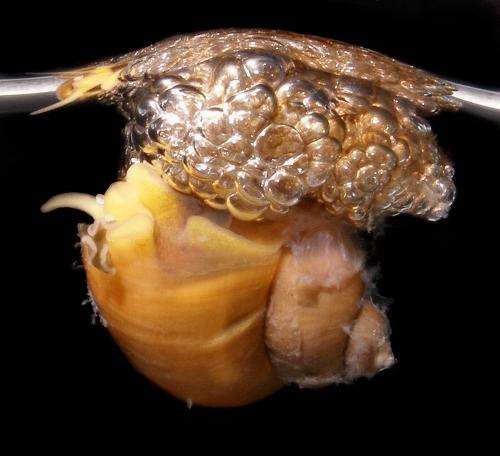
(PhysOrg.com) -- It's "Waterworld" snail style: Ocean-dwelling snails that spend most of their lives floating upside down, attached to rafts of mucus bubbles.
Scientists have known about the snails' peculiar lifestyle since the 1600s, but they've wondered how the rafting habit evolved. What, exactly, were the step-by-step adaptations along the way?
University of Michigan graduate student Celia Churchill and coauthors believe they've found the answer to that intriguing question. In a paper published in the Oct. 11 issue of Current Biology, they show that bubble rafting evolved by way of modified egg masses.
The bubble-rafting snails, members of the family Janthinidae, secrete mucus from their "foot," a broad, muscular organ at the base of the snail's body. But instead of using slime to get around or to communicate chemically, as other types of snails do, they trap air inside quick-setting mucus to make bubbles that glom together and form rafts on which the snails spend the rest of their lives.
"We had a pretty good idea that that janthinids evolved from snails that live on the sea floor," Churchill said. The question was, which specific group of snails gave rise to the janthinids, and how did the janthinid lineage make the transition from bottom dwellers to surface surfers?
To find the answer, Churchill and coauthors first sequenced DNA from janthinids and other snail families thought to be closely related to them and used techniques of molecular phylogenetics to identify the ancestral lineage. They discovered that the rafting snails are descendents of sea-floor snails called wentletraps that parasitize corals and sea anemones. The researchers then asked which specific habits of wentletraps might have morphed over time into raft-building.
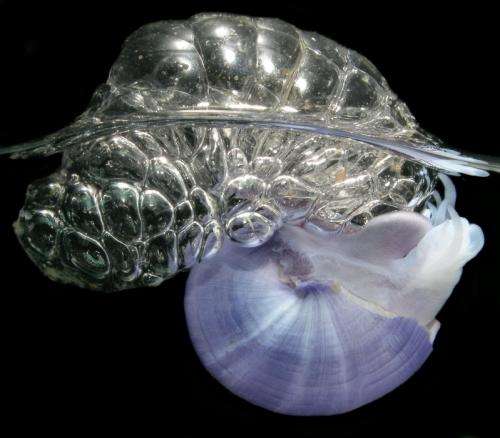
"We thought of two possibilities," said Churchill, who did the work under the direction of Diarmaid Ó Foighil, a professor of ecology and evolutionary biology and a curator of mollusks at the U-M Museum of Zoology. "The first was that bubble rafting evolved from juvenile droguing." In many species of marine snails, the juveniles produce a mucus thread called a drogue that helps them drift from place to place like a kite on a string. Adding air-filled mucus bubbles to the drogue thread could result in something resembling a bubble raft.
The other possibility was that rafts represent modified egg masses. In wentletraps, which belong to the family Epitoniidae, females remain on their hosts, attached by stretchy mucus threads to tethered egg masses. These egg masses typically have egg capsules in various stages of development, from newly encased embryos to empty husks, and the researchers reasoned that in an intertidal species, the empty husks might trap air, making the egg mass and attached female temporarily buoyant. As in the drogue scenario, adding mucus-filled bubbles to this ephemeral raft could lead to development of permanent bubble rafts. Either way, getting to the surface would give the snails access to a completion-free food source: floating jellyfish.
To know which scenario was correct, the researchers needed to find a transitional form---a janthinid with characteristics that fall somewhere between the bottom-dwelling epitoniids and the permanently-rafting janthinid known as the common purple snail (Janthina janthina). They got a break when they received a preserved specimen of the rare rafting snail Recluzia from Australia.
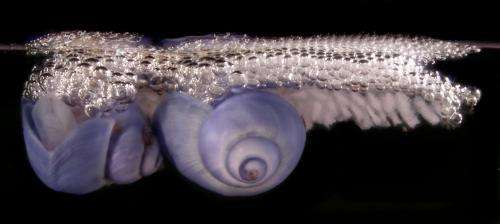
"I started to dissect it, and when I pulled the float away I noticed that there were tiny Recluzia on the float and egg capsules of the large female," Churchill said. These hitchhiking juveniles suggested a life history consistent with the egg mass hypothesis. They also suggested an explanation for how the rare Recluzia manages to survive.
"Immediately we started thinking about dwarf males, which are known from a variety of molluscan groups," Churchill said. "If Recluzia has a life history strategy where males remain with females, that might explain how Recluzia can persist at such low densities. When there aren't very many females, remaining with one of them may be the best mating strategy for a male."
The hitchhiking snails were so tiny it was impossible to confirm that they were male, but a recent photograph taken by another researcher clearly shows a larger snail, presumably male, associated with the float of a large female.
Was Recluzia truly the transitional form the researchers were seeking? Or might the transitional form be a species of Janthina, whose juveniles build their own floats, rather than hitchhiking on females' floats---a life history more in line with the juvenile droguing hypothesis? To answer that question, Churchill compared physical characteristics of Recluzia and Janthina with those of the ancestral epitoniids. Recluzia, she found, shares six characteristics with epitoniids; Janthina has none. This finding points to Recluzia as the transitional form, strongly supporting the egg mass hypothesis.
Churchill and colleagues went on to reconstruct the path that led from egg mass to bubble raft. In the scenario they propose, the ancestors of janthinids lived on the ocean floor, and females formed tethered egg masses with associated males, just as a number of present-day epitoniids do. The egg mass then became modified for buoyancy, resembling a typical Recluzia float, which serves as raft, egg-storage area and platform for juveniles. In the next step, all individuals began making their own floats, so the hitchhikers were lost, but the floats continued to serve as rafts and (in females) egg mass carriers. The present-day species Janthina cf. prolongata and Janthina exigua exemplify this lifestyle.
Finally, the rafts lost their egg-carrying function altogether and came to serve only as floatation devices, as they do in Janthina janthina, in which the female doesn't produce an egg mass at all, but broods the eggs inside her body until they're ready to hatch.
Churchill is working with the Woods Hole Oceanographic Institute's Sea Education Association to create student SEA Semester projects aimed at learning more about the ecology and behavior of rafting snails.
More information: Paper online www.cell.com/current-biology/abstract/S0960-9822%2811%2900886-4
Provided by University of Michigan


