Bismuth-based semiconducting material could enable control of electron spin
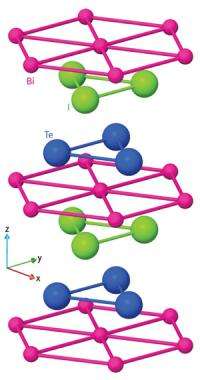
Figure 1: The layered atomic structure of BiTeI creates a three-dimensional version of the Rashba effect, normally seen at only two-dimensional surfaces and interfaces (pink, bismuth; blue, tellurium; iodine, green).
In the developing field of spintronics, physicists are designing devices to transmit data using the inherent axial rotation, or spin, of electrons rather than their charge as is used in electronics. Weak coupling of electron spin to electrical currents, however, makes gaining this level of control difficult. Yoshinori Tokura from the RIKEN Advanced Science Institute, Wako, working with colleagues from across Japan, has now shown that the semiconducting material BiTeI could provide the control needed because of its unusual atomic arrangement.
Spin can take one of two values, conventionally labeled up and down. Usually, an electron in a state with an up-spin has the same energy as an electron in the equivalent down-spin state. This so-called energy degeneracy makes it difficult to control up and down spins independently. A principle technique in spintronics is to manipulate spin by means of an electric current or voltage, says University of Tokyo scientist and co-author of the paper Kyoko Ishizaka. Lifting this degeneracy will enable a number of novel spin-to-current conversion techniques.
One way to split the energy of the two spin states is to destroy the symmetry of the atomic lattice; at a surface or at the interface between two materials for example. This is known as the Rashba effect. Physicists have observed this effect; however, splitting energy in these two-dimensional (2D) systems was, in general, too small for real applications. Tokura, Ishizaka and their team demonstrated experimentally a Rashba-type effect in three-dimensional, or bulk, BiTeI. In 2D Rashba systems, spintronic function is hindered by the electrons away from the surface, which remain degenerate, explains Ishizaka. In BiTeI, on the other hand, all the carrier electrons are spin-split.
The researchers studied BiTeI using a technique called angle-resolved photoemission spectroscopy, whereby electrons excited from the surface of a sample by incoming light provided details about the materials energy structure. The measurements showed that the spin splitting was large enough to make BiTeI a potential material for various spin-dependent electronic functions. The researchers took a first-principles approach to modeling their material system to obtain a better understanding of the origin of this effect. They showed that the large amount of spin-splitting was a result of the layered atomic structure of BiTeI (Fig. 1) in which the bismuth, tellurium and iodine atoms arranged into separate tiers, each with a triangular lattice.
Next we will study the spin-dependent transport and optical properties of BiTeI, with the aim of making a functional device, says Ishizaka.
More information: Ishizaka, K., Bahramy, M.S., Murakawa, H., Sakano, M., Shimojima, T., Sonobe, T., Koizumi, K., Shin, S., Miyahara, H., Kimura, A. et al. Giant Rashba-type spin splitting in bulk BiTeI. Nature Materials 10, 521526 (2011). http://www.nature. … mat3051.html
Provided by
RIKEN
-
From lemons to lemonade: Reaction uses carbon dioxide to make carbon-based semiconductor,
32 comments
-
Thioridazine kills cancer stem cells in human while avoiding toxic side-effects of conventional cancer treatments,
3 comments
-
SpaceX private rocket blasts off for space station (Update),
42 comments
-
Climate scientists say they have solved riddle of rising sea,
31 comments
-
SpaceX capsule has 'new car' smell, astronauts say (Update),
4 comments
-
Laser noise spectrum
4 hours ago
-
Transparency of molten substances?
May 25, 2012
-
saturated paramagnetic and ferromagnetic
May 24, 2012
-
How to calculate the bandstructure of Twisted Bilayer Graphene
May 23, 2012
-
vast computational richness from swapping one proton
May 22, 2012
-
Oscillator strength of mixed LH- and HH-excitons
May 22, 2012
- More from Physics Forums - Atomic, Solid State, Comp. Physics
More news stories
Is a classical electrodynamics law incompatible with special relativity?
(Phys.org) -- The laws of classical electromagnetism that were developed in the 19th century are the same laws that scientists use today. They include Maxwell’s four equations along with the Lorentz la ...
Landmark calculation clears the way to answering how matter is formed
(Phys.org) -- An international collaboration of scientists, including Thomas Blum, associate professor of physics, is reporting in landmark detail the decay process of a subatomic particle called a kaon ...
May 25, 2012 |
4.3 / 5 (22) |
51
|
Lying in wait for WIMPs: Researchers seek to dramatically increase sensitivity of Large Underground Xenon detector
Although it's invisible, dark matter accounts for at least 80 percent of the matter in the universe. No one knows what it is, but most scientists would bet on weakly interacting massive particles, or WIMPs.
May 23, 2012 |
4 / 5 (7) |
16
|
Hawaii lab turns laser-powered bubbles into microrobots
(Phys.org) -- A team of scientists from the University of Hawaii are working on microrobots created from bubbles of air in a saline solution. The bubbles take on their title of robots as a laser ...
Sound increases the efficiency of boiling
Scientists at the Georgia Institute of Technology achieved a 17-percent increase in boiling efficiency by using an acoustic field to enhance heat transfer. The acoustic field does this by efficiently removing vapor bubbles ...
May 24, 2012 |
5 / 5 (2) |
2
Land and sea species differ in climate change response: study
(Phys.org) -- Marine and terrestrial species will likely differ in their responses to climate warming, new research by Simon Fraser University and Australia’s University of Tasmania has found.
'Unzipped' carbon nanotubes could help energize fuel cells, batteries
Multi-walled carbon nanotubes riddled with defects and impurities on the outside could replace some of the expensive platinum catalysts used in fuel cells and metal-air batteries, according to scientists at ...
T cells 'hunt' parasites like animal predators seek prey, study shows
By pairing an intimate knowledge of immune-system function with a deep understanding of statistical physics, a cross-disciplinary team at the University of Pennsylvania has arrived at a surprising finding: T cells use a movement ...
Computer model used to pinpoint prime materials for efficient carbon capture
When power plants begin capturing their carbon emissions to reduce greenhouse gases and to most in the electric power industry, it's a question of when, not if it will be an expensive undertaking.
Change in developmental timing was crucial in the evolutionary shift from dinosaurs to birds: study
At first glance, it's hard to see how a common house sparrow and a Tyrannosaurus Rex might have anything in common. After all, one is a bird that weighs less than an ounce, and the other is a dinosaur that ...
Nvidia trumpets Tegra 3 phone design wins for 2012
(Phys.org) -- Nvidias competitive war paint has a name, Tegra 3. On the heels of Nvidia announcements about lowering costs of its Tegra 3 processors and Nvidia-enabled tablets running Android Ice Cream ...