A birthplace for primitive life on Earth?
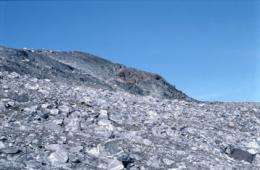
Serpentinites from Isua (Groenland. Credit: F. Albarčde
The mud volcanoes at Isua, in south-west Greenland, have been identified as a possible birthplace for life on Earth by an international team headed by researchers from the Laboratoire de Géologie de Lyon: Terre, Planètes et Environnement. Almost four billion years ago, these volcanoes released chemical elements indispensable to the formation of the first biomolecules, under conditions favorable to life. It is the first time that such an environment, meeting all the requirements for the emergence of life, has been identified by scientists in 3.8 billion year- old formations. This work is published this week in the PNAS.
Serpentinite is a dark green mineral used in decoration and jewelry. In nature, it is formed when sea water infiltrates into the Earth's upper mantle, at depths that can reach 200 km in subduction zones. According to the scientists, this mineral, often found in the walls of hydrothermal sources, could play a major role in the appearance of the first biomolecules.
It has often been presumed that life developed near to hydrothermal sources known as black smokers, such as those found at the bottom of the oceans along mid-ocean ridges. The abundance of hydrogen, methane and ammonia produced by these underwater geysers seemed favorable to the emergence of primitive life. Unfortunately, these black smokers are very acid, which prevents amino-acid stabilization, and thus the formation of organic molecules.
The team of scientists publishing this article focused their studies on serpentinites from Isua, in south-west Greenland, which date from the start of the Archean(2). Dating back some 3.8 billion years, the rocks of Isua are some of the oldest in the world. Using isotopes of zinc as indicators of the basic or acid nature of an environment, the researchers highlighted the basic character of the thermal fluids that permeated the Isua serpentinites, thus demonstrating that these minerals formed a favorable environment for amino-acid stabilization.
The researchers also compared these serpentinites with recent equivalents from the mid-oceanic ridge of the Artic Ocean, the Alps and Mexico: the Isua rocks are markedly depleted in heavy isotopes of zinc compared to the latter. On the other hand, their zinc is isotopically similar to that from mud volcanoes of the Marianas Trench. Nearly four billion years ago, at a time when the continents only occupied a very small part of the surface area of the globe, the oceanic crust of Isua was permeated by basic hydrothermal fluids, rich in carbonates, and at temperatures ranging from 100 to 300°C. Phosphorous, another indispensable element to life, is abundant in environments where serpentinization takes place(3). As this process generates mud volcanoes, all the necessary conditions were gathered at Isua for organic molecules to form and be stable. The mud volcanoes at Isua thus represent a particularly favorable setting for the emergence of primitive terrestrial life.
More information: Early Archean serpentine mud volcanoes at Isua, Greenland, as a niche for early life. Marie-Laure Pons, et al. PNAS. On line in the week of 17 October 2011.
Provided by
CNRS
-
From lemons to lemonade: Reaction uses carbon dioxide to make carbon-based semiconductor,
32 comments
-
Thioridazine kills cancer stem cells in human while avoiding toxic side-effects of conventional cancer treatments,
3 comments
-
SpaceX private rocket blasts off for space station (Update),
42 comments
-
Climate scientists say they have solved riddle of rising sea,
31 comments
-
SpaceX capsule has 'new car' smell, astronauts say (Update),
4 comments
-
Hypothetical desert earth
19 hours ago
-
More human population = greater mass?
May 25, 2012
-
Conversion from aircraft bearing to normal degrees
May 23, 2012
-
Interpretation/Analysis of the Lab results(HEPA filter)
May 22, 2012
-
Has anyone here attended the The Urbino Summer School in Paleoclimatology?
May 22, 2012
-
Earthquakes: Mag 6 N. Italy and Mag 5.6 W. Bulgaria
May 21, 2012
- More from Physics Forums - Earth
More news stories
Land and sea species differ in climate change response: study
(Phys.org) -- Marine and terrestrial species will likely differ in their responses to climate warming, new research by Simon Fraser University and Australia’s University of Tasmania has found.
2 hours ago |
not rated yet |
1
|
Yale study concludes public apathy over climate change unrelated to science literacy
Are members of the public divided about climate change because they don't understand the science behind it? If Americans knew more basic science and were more proficient in technical reasoning, would public consensus match ...
4 hours ago |
4 / 5 (1) |
10
|
10 million years needed to recover from mass extinction
It took some 10 million years for Earth to recover from the greatest mass extinction of all time, latest research has revealed.
Space & Earth / Earth Sciences
4 hours ago |
not rated yet |
1
|
Sophisticated simulations predict future warming
The chances of our planet being hit by a global warming of 3 degrees Celsius by 2050 is as likely as it being hit by an increase of 1.4 degrees, new research shows. Presented in the journal Nature Geoscience, the British study ...
Space & Earth / Earth Sciences
May 22, 2012 |
4.4 / 5 (9) |
51
Aliens don't want to eat us, says former SETI director
Alien life probably isnt interested in having us for dinner, enslaving us or laying eggs in our bellies, according to a recent statement by former SETI director Jill Tarter.
Space & Earth / Space Exploration
May 25, 2012 |
4.4 / 5 (14) |
40
'Unzipped' carbon nanotubes could help energize fuel cells, batteries
Multi-walled carbon nanotubes riddled with defects and impurities on the outside could replace some of the expensive platinum catalysts used in fuel cells and metal-air batteries, according to scientists at ...
T cells 'hunt' parasites like animal predators seek prey, study shows
By pairing an intimate knowledge of immune-system function with a deep understanding of statistical physics, a cross-disciplinary team at the University of Pennsylvania has arrived at a surprising finding: T cells use a movement ...
Computer model used to pinpoint prime materials for efficient carbon capture
When power plants begin capturing their carbon emissions to reduce greenhouse gases and to most in the electric power industry, it's a question of when, not if it will be an expensive undertaking.
Change in developmental timing was crucial in the evolutionary shift from dinosaurs to birds: study
At first glance, it's hard to see how a common house sparrow and a Tyrannosaurus Rex might have anything in common. After all, one is a bird that weighs less than an ounce, and the other is a dinosaur that ...
Nvidia trumpets Tegra 3 phone design wins for 2012
(Phys.org) -- Nvidias competitive war paint has a name, Tegra 3. On the heels of Nvidia announcements about lowering costs of its Tegra 3 processors and Nvidia-enabled tablets running Android Ice Cream ...
Scientist: Evolution debate will soon be history
(AP) -- Richard Leakey predicts skepticism over evolution will soon be history. Not that the avowed atheist has any doubts himself.