Airlift for drought-stricken Pacific island

File photo of the pristine waters surrounding on Funafuti Atoll in Tuvalu. New Zealand and Australia will Friday begin an airlift to help supply fresh water to the tiny drought-stricken Pacific nation of Tuvalu, which is under a state of emergency due to the crisis.
New Zealand and Australia will Friday begin an airlift to help supply fresh water to the tiny drought-stricken Pacific nation of Tuvalu, which is under a state of emergency due to the crisis.
New Zealand Foreign Minister Murray McCully said a series of flights by Australian and New Zealand military transport planes would bring a large New Zealand Army desalination unit to the main island of Funafuti.
It follows the deployment of smaller desalination units there this week.
"The advice is that more capacity is needed to relieve the acute water shortage and replenish stocks," McCully said.
"At present the two operating desalination plants at Funafuti are producing a combined volume of 43,000 litres a day. The minimum requirement for the 5,300 residents is 79,500 litres a day."
Tuvalu is reliant on rainwater collection for drinking water and has been severely affected by a weather pattern across the Pacific known as La Nina.
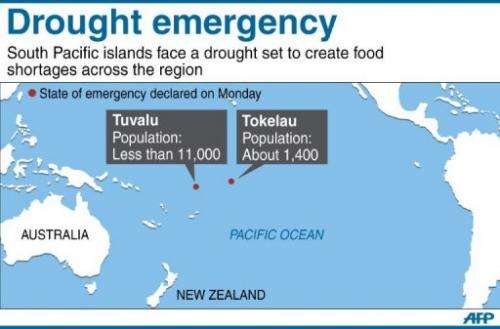
Map locating the South Pacific islands of Tuvalu and Tokelau, which have declared a state of emergency due to severe water shortages.
The neighbouring New Zealand-administered territory of Tokelau has also declared a state of emergency after the drought left its 1,400 people with less than a week's supply of water.Earlier this week McCully said the drought was not confined to Tokelau and Tuvalu, one of the world's smallest independent states with less than 11,000 people, and could cause food shortages across the South Pacific.
La Nina causes extreme weather, including both drought and floods, and was blamed for deluges and floods in Australia, Southeast Asia and South America late last year and earlier this year.
(c) 2011 AFP
-
From lemons to lemonade: Reaction uses carbon dioxide to make carbon-based semiconductor,
32 comments
-
Thioridazine kills cancer stem cells in human while avoiding toxic side-effects of conventional cancer treatments,
3 comments
-
SpaceX private rocket blasts off for space station (Update),
42 comments
-
Climate scientists say they have solved riddle of rising sea,
31 comments
-
SpaceX capsule has 'new car' smell, astronauts say (Update),
4 comments
-
Hypothetical desert earth
18 hours ago
-
More human population = greater mass?
May 25, 2012
-
Conversion from aircraft bearing to normal degrees
May 23, 2012
-
Interpretation/Analysis of the Lab results(HEPA filter)
May 22, 2012
-
Has anyone here attended the The Urbino Summer School in Paleoclimatology?
May 22, 2012
-
Earthquakes: Mag 6 N. Italy and Mag 5.6 W. Bulgaria
May 21, 2012
- More from Physics Forums - Earth
More news stories
Land and sea species differ in climate change response: study
(Phys.org) -- Marine and terrestrial species will likely differ in their responses to climate warming, new research by Simon Fraser University and Australia’s University of Tasmania has found.
2 hours ago |
not rated yet |
1
|
Yale study concludes public apathy over climate change unrelated to science literacy
Are members of the public divided about climate change because they don't understand the science behind it? If Americans knew more basic science and were more proficient in technical reasoning, would public consensus match ...
4 hours ago |
4 / 5 (1) |
10
|
10 million years needed to recover from mass extinction
It took some 10 million years for Earth to recover from the greatest mass extinction of all time, latest research has revealed.
Space & Earth / Earth Sciences
4 hours ago |
not rated yet |
1
|
Sophisticated simulations predict future warming
The chances of our planet being hit by a global warming of 3 degrees Celsius by 2050 is as likely as it being hit by an increase of 1.4 degrees, new research shows. Presented in the journal Nature Geoscience, the British study ...
Space & Earth / Earth Sciences
May 22, 2012 |
4.4 / 5 (9) |
51
Aliens don't want to eat us, says former SETI director
Alien life probably isnt interested in having us for dinner, enslaving us or laying eggs in our bellies, according to a recent statement by former SETI director Jill Tarter.
Space & Earth / Space Exploration
May 25, 2012 |
4.4 / 5 (14) |
40
'Unzipped' carbon nanotubes could help energize fuel cells, batteries
Multi-walled carbon nanotubes riddled with defects and impurities on the outside could replace some of the expensive platinum catalysts used in fuel cells and metal-air batteries, according to scientists at ...
T cells 'hunt' parasites like animal predators seek prey, study shows
By pairing an intimate knowledge of immune-system function with a deep understanding of statistical physics, a cross-disciplinary team at the University of Pennsylvania has arrived at a surprising finding: T cells use a movement ...
Computer model used to pinpoint prime materials for efficient carbon capture
When power plants begin capturing their carbon emissions to reduce greenhouse gases and to most in the electric power industry, it's a question of when, not if it will be an expensive undertaking.
Change in developmental timing was crucial in the evolutionary shift from dinosaurs to birds: study
At first glance, it's hard to see how a common house sparrow and a Tyrannosaurus Rex might have anything in common. After all, one is a bird that weighs less than an ounce, and the other is a dinosaur that ...
Nvidia trumpets Tegra 3 phone design wins for 2012
(Phys.org) -- Nvidias competitive war paint has a name, Tegra 3. On the heels of Nvidia announcements about lowering costs of its Tegra 3 processors and Nvidia-enabled tablets running Android Ice Cream ...
Scientist: Evolution debate will soon be history
(AP) -- Richard Leakey predicts skepticism over evolution will soon be history. Not that the avowed atheist has any doubts himself.
