The washable wearable antenna
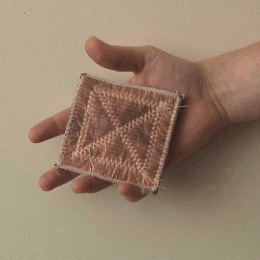
This wearable antenna is able to send a signal to satellites using the Cospas-Sarsat worldwide search and rescue satellite system. It is made from highly flexible, lightweight material that is robust against water exposure and moist conditions, and resistant to wear and tear. Credits: ESA - J. Makinen (CLICK 'ENLARGE' FOR ANIMATION, loading takes some time)
Wearing an antenna without anyone knowing is making a splash in the world of search and rescue.
ESA has provided research and development guidance to Finnish company Patria, with the help of Tampere University of Technology, in designing a search and rescue radio antenna that can be sewn into a life vest.
Made from highly flexible, lightweight material that is robust against water exposure and moist conditions, and resistant to wear and tear, this special antenna has been designed for use by the Cospas-Sarsat worldwide search and rescue satellite system.
Cospas-Sarsat has been operating for almost 30 years and has helped to rescue more than 26 000 victims in distress.
Sponsored by Canada, France, Russia and the United States, and started during the Cold War, the system operates 24 hours a day, 365 days a year, and aims to reduce the time required to alert rescue authorities in emergencies.
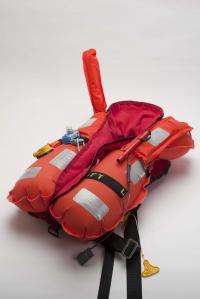
The life vest used to test the wearable search and rescue antenna. The vests were designed by Viking life saving equipment, based in Denmark. Credits: ESA - A. Le'Floch
Recent field trials with the antenna show that someone lost at sea wearing a life vest equipped with this new technology can be pinpointed within minutes.The Cospas-Sarsat system consists of emergency radio beacons carried by aircraft, ships or people, receivers on satellites, ground receiving stations, mission control centres and rescue coordination centres.
When a carrier is in distress, the emergency beacon is activated. As satellites orbit Earth, they listen for active beacons and report their position to rescue authorities.
This new antenna works as part of the Cospas-Sarsat distress transmitter.
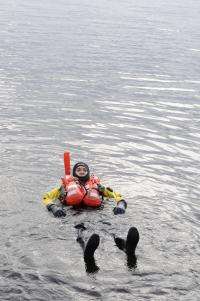
The life vest with an incorporated search and rescue antenna being tested in a field trial in Finland. Credits: ESA - P. de Maagt
Its high flexibility and small size make this antenna unique, given that the Cospas-Sarsat radio frequencies are so low. With such low frequencies, an antenna is usually much larger.The fact that an antenna of such a small size could be created that operates at such low frequencies is quite an accomplishment, explains Peter de Maagt, ESA engineer.
This, and that the antenna works in the extreme conditions at sea, make this technology quite useful.
The life vests were designed by Viking life saving equipment, based in Denmark.
In addition to integrating antennas into a life vest, a second attachable antenna is designed to be used with a diving vest.
Provided by
European Space Agency
-
From lemons to lemonade: Reaction uses carbon dioxide to make carbon-based semiconductor,
32 comments
-
Thioridazine kills cancer stem cells in human while avoiding toxic side-effects of conventional cancer treatments,
3 comments
-
SpaceX private rocket blasts off for space station (Update),
42 comments
-
Climate scientists say they have solved riddle of rising sea,
31 comments
-
SpaceX capsule has 'new car' smell, astronauts say (Update),
4 comments
-
Need a rigid insulation material???
18 hours ago
-
magnets or EMF in car bumpers to protect from fender bender
May 26, 2012
-
length of wire in a coil of known dimensions?
May 25, 2012
-
India Engineering Powerhouse
May 25, 2012
-
electromagnet core dereference between hard and soft iron
May 25, 2012
-
Measuring water pressure in an open tank
May 24, 2012
- More from Physics Forums - General Engineering
More news stories
Browser wars flare in mobile space
The browser wars are heating up again, but this time the fight is for dominance of the mobile Internet.
11 hours ago |
5 / 5 (1) |
3
Probability of contamination from severe nuclear reactor accidents is higher than expected: study
Catastrophic nuclear accidents such as the core meltdowns in Chernobyl and Fukushima are more likely to happen than previously assumed. Based on the operating hours of all civil nuclear reactors and the number ...
Technology / Energy & Green Tech
May 22, 2012 |
3.6 / 5 (22) |
56
|
HyperSolar shows dirty water no barrier to power world
(Phys.org) -- The Santa Barbara, California, company, HyperSolar, is set to transparently share the ups and downs of its research experiences toward the companys ultimate vision, successfully producing ...
SpotterRF debuts Radar Backpack Kit (w/ Video)
(Phys.org) -- SpotterRF has announced a special radar backpack kit designed to enhance situational awareness for soldiers on the ground. The company says its special radar is designed for warfighters as part ...
Tesla to launch electric sedan in US on June 22
Tesla Motors said Tuesday it would begin deliveries of "the world's first premium electric sedan" on June 22, slightly ahead of schedule.
Technology / Energy & Green Tech
May 22, 2012 |
4.5 / 5 (12) |
18
Land and sea species differ in climate change response: study
(Phys.org) -- Marine and terrestrial species will likely differ in their responses to climate warming, new research by Simon Fraser University and Australia’s University of Tasmania has found.
'Unzipped' carbon nanotubes could help energize fuel cells, batteries
Multi-walled carbon nanotubes riddled with defects and impurities on the outside could replace some of the expensive platinum catalysts used in fuel cells and metal-air batteries, according to scientists at ...
T cells 'hunt' parasites like animal predators seek prey, study shows
By pairing an intimate knowledge of immune-system function with a deep understanding of statistical physics, a cross-disciplinary team at the University of Pennsylvania has arrived at a surprising finding: T cells use a movement ...
Computer model used to pinpoint prime materials for efficient carbon capture
When power plants begin capturing their carbon emissions to reduce greenhouse gases and to most in the electric power industry, it's a question of when, not if it will be an expensive undertaking.
Change in developmental timing was crucial in the evolutionary shift from dinosaurs to birds: study
At first glance, it's hard to see how a common house sparrow and a Tyrannosaurus Rex might have anything in common. After all, one is a bird that weighs less than an ounce, and the other is a dinosaur that ...
Nvidia trumpets Tegra 3 phone design wins for 2012
(Phys.org) -- Nvidias competitive war paint has a name, Tegra 3. On the heels of Nvidia announcements about lowering costs of its Tegra 3 processors and Nvidia-enabled tablets running Android Ice Cream ...

