An upside-down cake throws a new light on photovoltaics

Credit: PV-LAB, EPFL/SNSF
Do better with less. That is the challenge the researchers of the Swiss Federal Institute of Technology in Lausanne (EPFL) have set for themselves, supported by the Swiss National Science Foundation and the Federal Office of Energy. Their specialty: manufacturing solar cells that are one thousand times thinner than conventional cells. In order to boost the output of the cells, they have developed a new nanopatterning technique.
Even though silicon is one of the most abundant elements, the energy required to make silicon from sand is immense. It is for this reason, but also to reduce manufacturing costs, that Professor Christophe Ballif and his team from the Photovoltaics and Thin-Film Electronics Laboratory at the EPFL have been working for several years on thin-film silicon solar cells that are a thousand times thinner than conventional cells.
Theres just one catch: the thinner the cells, the less they absorb the rays of the sun and the less electricity they produce. So researchers are trying to trap light in the thin silicon layers to increase their absorption. Traditionally, thin layers of zinc oxidea material that is very abundant, completely non-toxic, and that grows in the form of small pyramid-shaped crystalsare used for this purpose. These crystals scatter light efficiently into the underlying silicon layer. With such zinc oxide layers, even a new world record cell efficiency was achieved.
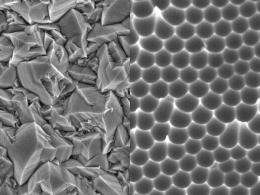
Layers of zinc oxide seen through an electronic microscope, on the left: natural pyramid structure, on the right: structure when grown on a mould (height of images 5 microns).
Reducing costsBut scientists are attempting to beat this record. It is difficult to modify the natural pyramidal shape of these crystals in order to obtain even better light scattering, explains researcher Corsin Battaglia, so we had the idea to force the crystals to grow on a different support, an inverted mould with the desired structure. The idea is as ingenious as it is simple. Once the thin layer of zinc oxide is deposited on the mould all that needs to be done is to demould itas you would a tarte tatin, for exampleto obtain a film with the desired structure.
This procedure, described in the September edition of the journal Nature Photonics, not only increases the amount of light that is trapped, thereby increasing output, but it also has the potential to reduce the cost of the cells because of its compatibility with mass production. These are interesting arguments at a time when photovoltaics is seeking to produce electricity at a lower price than the current grid price.
Provided by Ecole Polytechnique Federale de Lausanne
-
From lemons to lemonade: Reaction uses carbon dioxide to make carbon-based semiconductor,
32 comments
-
Thioridazine kills cancer stem cells in human while avoiding toxic side-effects of conventional cancer treatments,
3 comments
-
SpaceX private rocket blasts off for space station (Update),
42 comments
-
Climate scientists say they have solved riddle of rising sea,
31 comments
-
SpaceX capsule has 'new car' smell, astronauts say (Update),
4 comments
Nanopillars significantly boost the power conversion efficiency of thin-film solar cells
-
microstructure of titanium
May 26, 2012
-
Steam in My Espresso Machine
May 26, 2012
-
Density question
May 24, 2012
-
Mass transport originating from a point source at a solid gas interface
May 22, 2012
-
Ammonia dispersion in Air
May 22, 2012
-
Multi Choice Help
May 21, 2012
- More from Physics Forums - Materials & Chemical Engineering
More news stories
'Unzipped' carbon nanotubes could help energize fuel cells, batteries
Multi-walled carbon nanotubes riddled with defects and impurities on the outside could replace some of the expensive platinum catalysts used in fuel cells and metal-air batteries, according to scientists at ...
Nanotechnology / Nanomaterials
3 hours ago |
not rated yet |
0
|
Dopant gives graphene solar cells highest efficiency yet
(Phys.org) -- By taking advantage of graphenes favorable electrical and optical properties, and then adding an organic dopant, researchers have achieved the highest power conversion efficiency yet for ...
In nanorod crystal growth, nanoparticles seen as artificial atoms
In the growth of crystals, do nanoparticles act as "artificial atoms" forming molecular-type building blocks that can assemble into complex structures? This is the contention of a major but controversial theory ...
May 24, 2012 |
4.8 / 5 (6) |
0
|
First direct observation of oriented attachment in nanocrystal growth
Berkeley Lab researchers have reported the first direct observation of nanoparticles undergoing oriented attachment, the critical step in biomineralization and the growth of nanocrystals. A better understanding ...
May 24, 2012 |
4.7 / 5 (3) |
0
|
Synthetic nano-waste does not disappear
(Phys.org) -- Tiny particles of cerium oxide do not burn or change in the heat of a waste incineration plant. They remain intact on combustion residues or in the incineration system, as a new study by Swiss ...
Nanotechnology / Bio & Medicine
May 25, 2012 |
5 / 5 (2) |
1
|
Land and sea species differ in climate change response: study
(Phys.org) -- Marine and terrestrial species will likely differ in their responses to climate warming, new research by Simon Fraser University and Australia’s University of Tasmania has found.
T cells 'hunt' parasites like animal predators seek prey, study shows
By pairing an intimate knowledge of immune-system function with a deep understanding of statistical physics, a cross-disciplinary team at the University of Pennsylvania has arrived at a surprising finding: T cells use a movement ...
Computer model used to pinpoint prime materials for efficient carbon capture
When power plants begin capturing their carbon emissions to reduce greenhouse gases and to most in the electric power industry, it's a question of when, not if it will be an expensive undertaking.
Change in developmental timing was crucial in the evolutionary shift from dinosaurs to birds: study
At first glance, it's hard to see how a common house sparrow and a Tyrannosaurus Rex might have anything in common. After all, one is a bird that weighs less than an ounce, and the other is a dinosaur that ...
Nvidia trumpets Tegra 3 phone design wins for 2012
(Phys.org) -- Nvidias competitive war paint has a name, Tegra 3. On the heels of Nvidia announcements about lowering costs of its Tegra 3 processors and Nvidia-enabled tablets running Android Ice Cream ...
Yale study concludes public apathy over climate change unrelated to science literacy
Are members of the public divided about climate change because they don't understand the science behind it? If Americans knew more basic science and were more proficient in technical reasoning, would public consensus match ...

Sep 11, 2011
Rank: 5 / 5 (1)