Study uncovers predictable sequence toward coral reef collapse
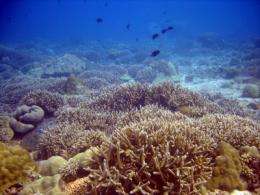
Coral reefs that have lots of corals and appear healthy may, in fact, be heading toward collapse, according to a study published by the Wildlife Conservation Society and other groups.
Using data from coral reef systems across the western Indian Ocean, an international team of researchers identified how overfishing creates a series of at least eight big changes on reefs that precipitate a final collapse. This information can help managers gauge the health of a reef and tell them when to restrict fishing in order to avoid a collapse of the ecosystem and fishery.
The study appears this week in the early online edition of the Proceedings of the National Academy of Sciences. The authors of the study include: Tim R. McClanahan and Nyawira A. Muthiga of the Wildlife Conservation Society; Nicholas A.J. Graham and Joshua E. Cinner of James Cook University, Queensland, Australia; M. Aaron MacNeil of the Australian Institute of Marine Science; J. Henrich Bruggemann of Laboratoire d'Ecologie Marine, Université de la Réunion, La Réunion, France; and Shaun K. Wilson of the Department of Environment and Conservation, Perth, Western Australia.
The authors say these changes are like a series of light switches, each of which make the reef more degraded and dims the chances of sustained fishery production and recovery.
"The study identifies eight changes before all of the ecological lights go off and the reef and fishery are gone" said Dr. McClanahan, the lead author on the study and the head of WCS's coral reef research and conservation program.
The study shows that in well-protected areas, there are typically 1000-1500 kilograms of reef fish of various species per hectare of coral reef. As the volume is fished down below 1000 kilograms, the early warning signs—like increased seaweed growth and urchin activity—begin to appear. The researchers found that between 300-600 kilograms per hectare, there appeared to be a "window" of what is known as maximum sustainable yield, but when the fish stock drops below 300 kilograms per hectare, the reef is in real trouble, they said.
"Below 300 kilograms per hectare we see a series of dramatic changes on reefs. This is where you get on a real slippery slope," McClanahan noted. "Strangely, the metric used by most managers to gauge the health of reef systems—coral cover—is the last threshold before ecosystem failure. Overfished reefs can appear healthy and then shift to algae dominated seascapes."
The authors recommend measuring the biomass of fish instead of coral cover to identify the early warning rather than the final sign of reef collapse.
"The good news is that a reef can likely provide sustainable fisheries even after the first three warning switches are turned off, but it becomes increasingly difficult to maintain a healthy fishery and restore reefs when the final five switches have been turned off," said Dr. McClanahan. "This study provides managers and policy makers with a tangible target of where to maintain their fishery."
Dr. Joshua Cinner from James Cook University in Australia added: "Of course, having a target is one thing, but achieving it is, well, another kettle of fish. So we also assessed how well different reef management schemes did at maintaining reefs."
Reef fisheries with no regulations tended to perform poorly, with some passing all the switches and completely collapsing. No-take marine reserves, where fishing was prohibited, were the best performers and tended to maintain key ecosystem processes such as predation.
"People depend on reefs for their livelihoods, so we can't prohibit fishing everywhere," noted Dr. Cinner. "A key finding from our study was that even easily enforceable regulations that restrict gear or the types of species that can be caught helped maintain biomass. These regulations are often more agreeable to fishermen than no-take closures and consequently receive higher levels of support and compliance."
"There is no one size fits all solution to save the world's coral reef ecosystems. To be politically and socially sustainable, tangible and objective management targets are critical to help managers make difficult near-term decisions of restricting or altering fishing practices for long-term social and ecological gain," said Dr. Caleb McClennen, Director of WCS's Marine Program. "This exhaustive research helps identify critical metrics and methods for sustainable management of coral reefs across the true gradient of ecological condition and management reality."
Provided by Wildlife Conservation Society


