Students building rocket for moon vehicle
September 14, 2011 By Emil Venere
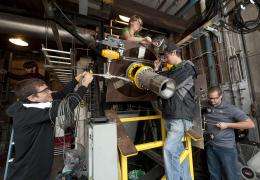
Purdue students are working on a rocket engine that might be used in a vehicle to land on the moon. From left are graduate students Michael Bedard, Emerald McKinney, Thomas Feldman and Andrew Rettenmaier. The work is part of the NASA-funded Project Morpheus, which includes research to develop new technologies for future trips to the moon, Mars or asteroids. Credit: Purdue University photo/Mark Simons
Purdue University students are designing and building a rocket engine that might be used in a vehicle to land on the moon.
Graduate students Thomas Feldman and Andrew Rettenmaier are part of a team developing a rocket motor through the NASA-funded Project Morpheus, which includes research to develop new technologies for future trips to the moon, Mars or asteroids.
Two other groups from Armadillo Aerospace in Texas and NASA's Johnson Space Center also are in the process of designing an engine under the same requirements. The most promising design will be chosen for the vehicle.
The rocket must meet stringent design and performance specifications related to factors including efficiency, size and weight limits, thrusting power, and the ability to dynamically throttle the rocket from 1,300-4,200 pounds of thrust, Feldman said.
"This thrusting range is needed because initially, when the lander is fully fueled, it will weigh significantly more than at the end of the mission when most of the propellant will be gone," he said.
The rocket, which will use liquid oxygen and liquid methane propellants, will be designed, built and tested using specialized facilities at Purdue's Maurice J. Zucrow Laboratories, including a new facility to liquefy the methane propellant.
The research, which began as a senior design project last fall, is entirely voluntary.
"It's commendable for students to take on a demanding project like this totally in their spare time," said William Anderson, an associate professor of aeronautics and astronautics and adviser to the students. "They are applying their advanced training for a truly important venture."
Feldman and Rettenmaier, who both have career aspirations to work in the aerospace industry, said the project is providing valuable experience and preparation for the job market.
"This is something you would never learn by reading a book or taking conventional classes," said Feldman, who is from Austin, Texas. "Most universities aren't going to provide the experience to do this."
Feldman recently was awarded a 2011 Liquid Propulsion Student Award from the American Institute of Aeronautics and Astronautics Liquid Propulsion Technical Committee.
Rettenmaier, who is from Fort Wayne, Ind., said Purdue's propulsion facilities influenced his decision to remain at the university for his graduate studies.
"It's such an interesting and unique place to work," he said. "If we design an engine that ends up landing on the moon, I think that would be a great accomplishment."
The engineers will first build a "battleship engine," or a heavily instrumented test engine that's far bulkier than the actual finished motor. The test engine will be needed to validate design concepts and will be fired up later this summer. Data from the experiments will be used to refine the engine design.
Provided by
Purdue University
-
From lemons to lemonade: Reaction uses carbon dioxide to make carbon-based semiconductor,
32 comments
-
Thioridazine kills cancer stem cells in human while avoiding toxic side-effects of conventional cancer treatments,
3 comments
-
SpaceX private rocket blasts off for space station (Update),
42 comments
-
Climate scientists say they have solved riddle of rising sea,
31 comments
-
SpaceX capsule has 'new car' smell, astronauts say (Update),
4 comments
-
Distance of planets from stars and revolution
4 hours ago
-
revamping general concept and cosmological principle
May 25, 2012
-
Transiting Exoplanet Light Curve
May 25, 2012
-
Math behind Theoretical Physics
May 24, 2012
-
Do we know whats at the center of galaxies yet?
May 23, 2012
-
Structure of the Milky Way?
May 20, 2012
- More from Physics Forums - General Astronomy
More news stories
Land and sea species differ in climate change response: study
(Phys.org) -- Marine and terrestrial species will likely differ in their responses to climate warming, new research by Simon Fraser University and Australia’s University of Tasmania has found.
2 hours ago |
5 / 5 (2) |
2
|
Yale study concludes public apathy over climate change unrelated to science literacy
Are members of the public divided about climate change because they don't understand the science behind it? If Americans knew more basic science and were more proficient in technical reasoning, would public consensus match ...
4 hours ago |
4 / 5 (1) |
11
|
10 million years needed to recover from mass extinction
It took some 10 million years for Earth to recover from the greatest mass extinction of all time, latest research has revealed.
Space & Earth / Earth Sciences
4 hours ago |
not rated yet |
1
|
Sophisticated simulations predict future warming
The chances of our planet being hit by a global warming of 3 degrees Celsius by 2050 is as likely as it being hit by an increase of 1.4 degrees, new research shows. Presented in the journal Nature Geoscience, the British study ...
Space & Earth / Earth Sciences
May 22, 2012 |
4.4 / 5 (9) |
51
Aliens don't want to eat us, says former SETI director
Alien life probably isnt interested in having us for dinner, enslaving us or laying eggs in our bellies, according to a recent statement by former SETI director Jill Tarter.
Space & Earth / Space Exploration
May 25, 2012 |
4.4 / 5 (14) |
40
Nvidia trumpets Tegra 3 phone design wins for 2012
(Phys.org) -- Nvidias competitive war paint has a name, Tegra 3. On the heels of Nvidia announcements about lowering costs of its Tegra 3 processors and Nvidia-enabled tablets running Android Ice Cream ...
'Unzipped' carbon nanotubes could help energize fuel cells, batteries
Multi-walled carbon nanotubes riddled with defects and impurities on the outside could replace some of the expensive platinum catalysts used in fuel cells and metal-air batteries, according to scientists at ...
T cells 'hunt' parasites like animal predators seek prey, study shows
By pairing an intimate knowledge of immune-system function with a deep understanding of statistical physics, a cross-disciplinary team at the University of Pennsylvania has arrived at a surprising finding: T cells use a movement ...
Computer model used to pinpoint prime materials for efficient carbon capture
When power plants begin capturing their carbon emissions to reduce greenhouse gases and to most in the electric power industry, it's a question of when, not if it will be an expensive undertaking.
Change in developmental timing was crucial in the evolutionary shift from dinosaurs to birds: study
At first glance, it's hard to see how a common house sparrow and a Tyrannosaurus Rex might have anything in common. After all, one is a bird that weighs less than an ounce, and the other is a dinosaur that ...
Scientist: Evolution debate will soon be history
(AP) -- Richard Leakey predicts skepticism over evolution will soon be history. Not that the avowed atheist has any doubts himself.