Student loan default rates jump
September 12, 2011 By JUSTIN POPE , AP Education Writer

Student loan default rates jump (AP)

Enlarge

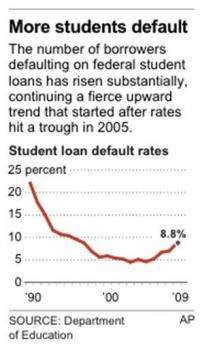
Graphic charts federal student loan default rates since 1990.

The number of borrowers defaulting on federal student loans has jumped sharply, the latest indication that rising college tuition costs, low graduation rates and poor job prospects are getting more and more students over their heads in debt.

The national two-year cohort default rate rose to 8.8 percent last year, from 7 percent in fiscal 2008, according to figures released Monday by the Department of Education.

Driving the overall increase was an especially sharp increase among students who borrow from the government to attend for-profit .

Of the approximately 1 million student borrowers at for-profit schools whose first payments came due in the year starting Oct. 1, 2008 - at the peak of the - 15 percent were already at least 270 days behind in their payments two years later. That was an increase from 11.6 percent last year.

At , the default rate increased from 6 percent to 7.2 percent and from 4 percent to 4.6 percent among students at private not-for-profit colleges.

"I think the jump over the last year has been pretty astonishing," said Debbi Cochrane, program director for the California-based Institute for College Access & Success.

Overall, 3.6 million borrowers entered repayment in fiscal 2009; more than 320,000 had already defaulted last fall, an increase of 80,000 over the previous year.

The federal default rate remains substantially below its peak of more than 20 percent in the early 1990s, before a series of reforms in government lending. But after years of steady declines it has now risen four straight years to its highest rate since 1997, and is nearly double its trough of 4.6 percent in 2005.

Troubling as the new figures are, they understate how many students will eventually default. Last year's two-year default rate increased to more than 12 percent when the government made preliminary calculations of how many defaulted within three years. Beginning next year, the department will begin using the figure for how many default within three years to determine which institutions will lose eligibility to enroll students receiving government financial aid.

The figures come as a stalled economy is hitting student borrowers from two sides - forcing cash-strapped state institutions to raise tuition, and making it harder for graduates to find jobs. The unemployment rate of 4.3 percent for college graduates remains substantially lower than for those without a degree. But many student borrowers don't finish the degree they borrow to pay for.

The Department of Education has begun an income-based repayment plan that caps federal loan payments at 15 percent of discretionary income. And new regulations the Obama administration has imposed on the for-profit sector have prompted those so-called proprietary colleges to close failing programs and tighten enrollment. Both developments could help lower default rates in the future.

Administration officials took pains to praise the for-profit sector for recent reforms, but also said flatly that those schools - along with the weak economy - are largely to blame for the current increases. Among some of the largest and better-known operators, the default rate at the University of Phoenix chain rose from 12.8 to 18.8 percent and at ITT Technical Institute it jumped from 10.9 percent to 22.6 percent.

"We are disappointed to see increases in the cohort default rates for our students, as well as students in other sectors of higher education," said Brian Moran, interim president and CEO of APSCU, the Association of Private Sector Colleges and Universities, which represents the for-profit sector. He said for-profit schools were taking remedial steps, including debt counseling for students, to bring down the rates.
"We believe that the default rates will go down when the economy improves and the unemployment rate drops," he said.

Officials for Phoenix, owned by Apollo Group, Inc., and ITT, owned by ITT Educational Services, did not immediately respond to requests for comment.

The department emphasized that it eventually manages to collect most of the money it's owed, even from defaulters. But that's part of the reason federal student loan defaults are so hard on borrowers - they can't be discharged in bankruptcy. Defaulting can also wreck students' credit and keep them from being able to return to school later with federal aid.

"There are very few avenues for escaping that," Cochrane said. Also, "many employers these days are starting to check credit so it can hurt your job prospects."

According to calculations by TICAS and using the latest available figures, in 2008 average debt for graduating seniors with student loans was $20,200 at public universities, $27,650 at private non-profits and $33,050 at private for-profits.

©2011 The Associated Press. All rights reserved. This material may not be published, broadcast, rewritten or redistributed.

Filter


Move the slider to adjust rank threshold, so that you can hide some of the comments.


Display comments: newest first

Nanobanano
Sep 12, 2011

Rank: not rated yet
Among some of the largest and better-known operators, the default rate at the University of Phoenix chain rose from 12.8 to 18.8 percent and at ITT Technical Institute it jumped from 10.9 percent to 22.6 percent.


Very little demand for "new" skills in technology. Mostly all they do is re-invent the wheel, or add or remove features or bells and whistles. Don't need droves of people with programming or networking degrees. Hell, networking is simpler than ever actually.

We've got too damn many operating systems and "competing" notepad clones as it is.

if not for 10 companies re-inventing the wheel, unemployment would be even worse, however, as there'd be only about 1/5th as many jobs or so, since you'd have even fewer engineers and programmers needed.

This just goes to show how the existing capitalism and currency scam known as the "free" market is actually one of the least efficient economic models possible.
Nanobanano
Sep 12, 2011

Rank: not rated yet
Look at all the time and money that was wasted training so many people in 2 year and 4 year degrees for majors in jobs that never existed, and will never exist.

Not only was it a waste of Federal resources in the form of money, it was a waste of collective and individual efforts, and the individuals come away from their "education" experience having gained nothing, and left with a net loss for their troubles.

Once you've established a brand and have a working product model, such as any given smart phone, the company doesn't need a complete re-design every time they update the product. This means fewer engineering jobs both in software and hardware. The smartphone companies buy most of their parts from china, japan, and taiwan anwyay. They just design the "system", but the components come from some place else, usually. Either way, the different brands are often useless middle-men copycats of one or two competing innovators.

The "jobs" crisis is unfixable for a GOOD reason...
Nanobanano
Sep 12, 2011

Rank: not rated yet
As stated, the jobs crisis is unfixable, because labor simply isn't needed any more, nor is engineering or software design needed any more.

Population has plateaued, so it's not like you need "new" houses, schools, or infrastructure, you just need to maintain what you have.

Technology is mostly the same old thing just miniaturized.

Software is the same as it has been. Add a feature here, remove one there, don't need a million gurus to do that, one or two guys on part time can handle it.

So where are teh "jobs"? Well, they are being done by robots and computers, of course, and about ten times more could be automated if the world was fair and rational, which is a good thing, or rather would be if we lived in a fair and rational world. Unfortunately, we don't. We live in a world where governments and the wealthy use personal income as a slavery mechanism, and so if you don't have a "job" you can't do anything anyway.

Nanobanano
Sep 12, 2011

Rank: not rated yet
Extremely advanced technology could and would eventually make "money" obsolete in a fair and rational world, because all work would be done either by machines or "volunteers", such as in Star Trek, where everyone shares everything, and they pretty much just work to maintain and advance their technology.

Why would money matter if everything is "free" in terms of human costs, and you only work at your own pace, or when there is a crisis anyway?

Nobody would need money, for example, if everything was made by solar powered robots, and resources were gathered by solar powered robots so the "costs" would all be zero.

While we aren't there yet, because of people's narrow mindedness, tradition, and control mechanisms, the fact is we are eventually transisioning to an automation-based society.

"Work" will not exist when computers do everything.
Burnerjack
Sep 12, 2011

Rank: not rated yet
Nano, when will automation diagnose and treat your ailments, build your housing, service your vehicle or fix your heating/cooling system? You need to get out of the office a little more and choose to be more observant.
The "nitty gritty" world is far less smartphone centric than you seem to be aware. But, back at the ranch... back on topic:
When I inquired about higher education I was deluged with high pressure sales tactics to sign up for Student Loans despite making it clear that I had absolutely no intention of applying for loans. The question that has been on my mind has always been " What is the kickback for these guys, anyway?". Higher Education has, IMNSHO, become more of a path to indentured servitude than gainfull employment while realization of personal potential. What good is making an extra 40 grand when you'll pay back 50-60 for what seems like half a lifetime?
While programmers and engeneers are losing their jobs to outsourcing or H1-B visas, carpenters etc. aren't.
Jeddy_Mctedder
Sep 13, 2011

Rank: not rated yet
bill clinton's fault. why you ask?

he made studen loans NON-dischargeable in bankruptcy when prior to him , they were just like credit card debt in a bankruptcy AND he backstopped private lenders risk with government guarantees of payment.

he set up a situation where debtors get screwed AND more importantly, where lenders' cannot lose.

the ONLY solution to this problem that will be effective within a 4 year time frame is to change the law and allow these loans to be discharged in bankruptcy.
simple truth. hard to swallow.
all other arguments are put forth in 'research papers' paid for by creditor's associations in america. or lawyers.
El_Nose
Sep 13, 2011

Rank: not rated yet
Okay now let's relook at y making student loans non-dischargeable might be a good thing ...

lets say you are a student - and you are at the end of your junior year -- you own nothing, you don;t really make much money, but you have borrowed 35k or you are finishing your MS or Ph.d next semester and you are 130k in the hole before getting a job -- you could that last semester file bankruptcy and get it all cleared and come out and then get a job with out ever paying back the society that put you through school.

I have a MS in computer science -- I love my education and I acknowledge the fact i would not have any degree with out our national student loan program ... I have to repay 90k but I have a great job and this will not be a problem -- but most people do not get degrees in science and their pay scale tops out far below their personal debt and bankruptcy would be the ideal way to get it gone ... new twenty somethings have time to rebuild credit and the law make them accountable
Nanobanano
Sep 13, 2011

Rank: not rated yet
Nano, when will automation diagnose and treat your ailments, build your housing, service your vehicle or fix your heating/cooling system.


Stick around.

I'd say conservatively that within 50 years ALL of that will be not only doable, but much cheaper and much more efficient than existing hands on methods. Some of that will be doable within 25 years, easily.

There is more research and development going into self-maintaining systems and self-repairing materials. Nanotechnology and self-maintaining systems will mean you won't need to service appliances. They will clean and maintain themselves, and in some cases even repair themselves.

You might think I'm nuts, but so what?

25 years ago camera phones and smartphones were the stuff of science fiction (forbidden planet, Star Trek, etc,) and then 15 years ago they were sort of a high school "What if" joke. Today they are real, and in some ways better than the science fiction imagined.
Rank 5 /5 (3 votes)
Relevant PhysicsForums posts

More news stories

Change in developmental timing was crucial in the evolutionary shift from dinosaurs to birds: study

At first glance, it's hard to see how a common house sparrow and a Tyrannosaurus Rex might have anything in common. After all, one is a bird that weighs less than an ounce, and the other is a dinosaur that ...

Other Sciences / Archaeology & Fossils

created 4 hours ago | popularity 5 / 5 (2) | comments 0 | with audio podcast

Social welfare cuts ultimately come with heavy price, researchers say

(Phys.org) -- Slashing government funding for Medicaid, food stamps and other programs that serve the poor – while politically popular with some lawmakers and many conservatives – may do more harm ...

Other Sciences / Social Sciences

created May 24, 2012 | popularity 4.3 / 5 (16) | comments 154

Ancient Bethlehem seal unearthed in Jerusalem

Israeli archaeologists have discovered a 2,700-year-old seal that bears the inscription "Bethlehem," the Israel Antiquities Authority announced Wednesday, in what experts believe to be the oldest artifact ...

Other Sciences / Archaeology & Fossils

created May 23, 2012 | popularity 3.5 / 5 (14) | comments 24

Dollars and sense: Why are some people morally against tax?

As the U.S. presidential election campaigns heat up, the economic debate is dominated by bailouts, austerity and, inevitably, taxation. Now a new study published in Symbolic Interaction asks why tax is such an important issue ...

Other Sciences / Social Sciences

created May 23, 2012 | popularity 3 / 5 (2) | comments 15

Oldest Jewish archaeological evidence on the Iberian Peninsula

German archaeologists of the Friedrich Schiller University Jena found one of the oldest archaeological evidence so far of Jewish Culture on the Iberian Peninsula at an excavation site in the south of Portugal, ...

Other Sciences / Archaeology & Fossils

created May 25, 2012 | popularity 4.2 / 5 (6) | comments 12


Nvidia trumpets Tegra 3 phone design wins for 2012

(Phys.org) -- Nvidia’s competitive war paint has a name, Tegra 3. On the heels of Nvidia announcements about lowering costs of its Tegra 3 processors and Nvidia-enabled tablets running Android Ice Cream ...

'Unzipped' carbon nanotubes could help energize fuel cells, batteries

Multi-walled carbon nanotubes riddled with defects and impurities on the outside could replace some of the expensive platinum catalysts used in fuel cells and metal-air batteries, according to scientists at ...

T cells 'hunt' parasites like animal predators seek prey, study shows

By pairing an intimate knowledge of immune-system function with a deep understanding of statistical physics, a cross-disciplinary team at the University of Pennsylvania has arrived at a surprising finding: T cells use a movement ...

Computer model used to pinpoint prime materials for efficient carbon capture

When power plants begin capturing their carbon emissions to reduce greenhouse gases – and to most in the electric power industry, it's a question of when, not if – it will be an expensive undertaking.

Land and sea species differ in climate change response: study

(Phys.org) -- Marine and terrestrial species will likely differ in their responses to climate warming, new research by Simon Fraser University and Australia’s University of Tasmania has found.

Scientist: Evolution debate will soon be history

(AP) -- Richard Leakey predicts skepticism over evolution will soon be history. Not that the avowed atheist has any doubts himself.