Small distant galaxies host supermassive black holes
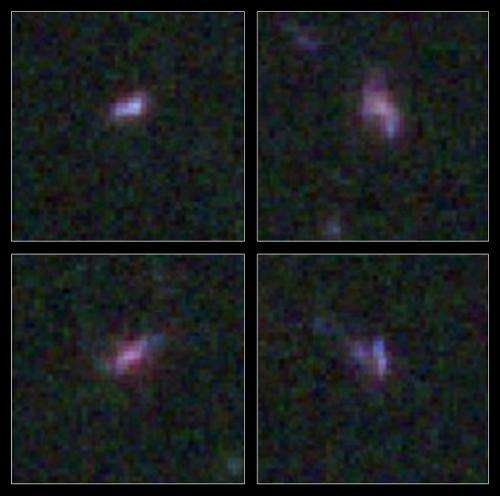
This is a montage of four small, young galaxies taken from a Hubble Space Telescope Wide Field Camera 3 slitless grism sample of 28 low-mass galaxies located 10 billion light-years away in the Hubble Ultra Deep Field region of the Cosmic Assembly Near-infrared Deep Extragalactic Legacy Survey (CANDELS). (Credit: NASA; ESA; A. Koekemoer, STScI; J. Trump and S. Faber, University of California, Santa Cruz; and the CANDELS Team)
(PhysOrg.com) -- Using the Hubble Space Telescope to probe the distant universe, astronomers have found supermassive black holes growing in surprisingly small galaxies. The findings suggest that central black holes formed at an early stage in galaxy evolution.
"It's kind of a chicken or egg problem: Which came first, the supermassive black hole or the massive galaxy? This study shows that even low-mass galaxies have supermassive black holes," said Jonathan Trump, a postdoctoral researcher at the University of California, Santa Cruz. Trump is first author of the study, which has been accepted for publication in the Astrophysical Journal and is currently available online.
All massive galaxies host a central supermassive black hole, which may shine brightly as an active galactic nucleus if the black hole is pulling in nearby gas clouds. In the local universe, however, active black holes are rarely seen in small "dwarf" galaxies. The galaxies studied by Trump and his coauthors are about 10 billion light-years away, giving astronomers a view of galaxies as they appeared when the universe was less than a quarter of its current age.
"When we look 10 billion years ago, we're looking at the teenage years of the universe. So these are very small, young galaxies," Trump said.
The study, part of the Cosmic Assembly Near-infrared Deep Extragalactic Legacy Survey (CANDELS), used a powerful new instrument on the Hubble Space Telescope. The "slitless grism" on Hubble's WFC3 infrared camera provided detailed information about different wavelengths of light coming from the galaxies. Spectroscopy allows researchers to spread out the light from an object into its component colors or wavelengths. With Hubble's high spatial resolution, the researchers were able to get separate spectra from the center and the outer part of each galaxy. This enabled them to identify the tell-tale emissions from a central black hole.
"This is the first study that is capable of probing for the existence of small, low-luminosity black holes back in time," said coauthor Sandra Faber, University Professor of astronomy and astrophysics at UC Santa Cruz and CANDELS principal investigator. "Up to now, observations of distant galaxies have consistently reinforced the local findings--distant black holes actively accreting in big galaxies only. We now have a big puzzle: What happened to these dwarf galaxies?"
One possibility is that at least some of them are the progenitors of present-day massive galaxies like the Milky Way. "Some may remain small, and some may grow into something like the Milky Way," Trump said.
But according to Faber, both possibilities raise further questions. To become big galaxies today, the dwarf galaxies would have to grow at a rate much faster than standard models predict, she said. If they remain small, then nearby dwarf galaxies should also have central black holes. "There might be a large population of small black holes in dwarf galaxies that no one has noticed before," Faber said.
Trump noted that the distant dwarf galaxies are actively forming new stars. "Their star formation rate is about ten times that of the Milky Way," he said. "There may be a connection between that and the active galactic nuclei. When gas is available to form new stars, it's also available to feed the black hole."
In addition to the Hubble observations, the researchers obtained further evidence of active black holes in the galaxies from x-ray data acquired by NASA's Chandra X-ray Observatory. The study focused on 28 galaxies in a small patch of sky known as the Hubble Ultra Deep Field. Because each object was so small and faint, Trump combined the data from all 28 galaxies to improve the signal-to-noise ratio.
"This is a powerful technique that we can use for similar studies in the future on larger samples of objects," Trump said.
Provided by
University of California - Santa Cruz
-
From lemons to lemonade: Reaction uses carbon dioxide to make carbon-based semiconductor,
32 comments
-
Thioridazine kills cancer stem cells in human while avoiding toxic side-effects of conventional cancer treatments,
3 comments
-
SpaceX private rocket blasts off for space station (Update),
42 comments
-
Climate scientists say they have solved riddle of rising sea,
31 comments
-
SpaceX capsule has 'new car' smell, astronauts say (Update),
4 comments
-
Distance of planets from stars and revolution
5 hours ago
-
revamping general concept and cosmological principle
May 25, 2012
-
Transiting Exoplanet Light Curve
May 25, 2012
-
Math behind Theoretical Physics
May 24, 2012
-
Do we know whats at the center of galaxies yet?
May 23, 2012
-
Structure of the Milky Way?
May 20, 2012
- More from Physics Forums - General Astronomy
More news stories
Land and sea species differ in climate change response: study
(Phys.org) -- Marine and terrestrial species will likely differ in their responses to climate warming, new research by Simon Fraser University and Australia’s University of Tasmania has found.
2 hours ago |
5 / 5 (2) |
2
|
Yale study concludes public apathy over climate change unrelated to science literacy
Are members of the public divided about climate change because they don't understand the science behind it? If Americans knew more basic science and were more proficient in technical reasoning, would public consensus match ...
4 hours ago |
4 / 5 (1) |
11
|
10 million years needed to recover from mass extinction
It took some 10 million years for Earth to recover from the greatest mass extinction of all time, latest research has revealed.
Space & Earth / Earth Sciences
4 hours ago |
not rated yet |
1
|
Sophisticated simulations predict future warming
The chances of our planet being hit by a global warming of 3 degrees Celsius by 2050 is as likely as it being hit by an increase of 1.4 degrees, new research shows. Presented in the journal Nature Geoscience, the British study ...
Space & Earth / Earth Sciences
May 22, 2012 |
4.4 / 5 (9) |
51
Aliens don't want to eat us, says former SETI director
Alien life probably isnt interested in having us for dinner, enslaving us or laying eggs in our bellies, according to a recent statement by former SETI director Jill Tarter.
Space & Earth / Space Exploration
May 25, 2012 |
4.4 / 5 (14) |
40
Nvidia trumpets Tegra 3 phone design wins for 2012
(Phys.org) -- Nvidias competitive war paint has a name, Tegra 3. On the heels of Nvidia announcements about lowering costs of its Tegra 3 processors and Nvidia-enabled tablets running Android Ice Cream ...
'Unzipped' carbon nanotubes could help energize fuel cells, batteries
Multi-walled carbon nanotubes riddled with defects and impurities on the outside could replace some of the expensive platinum catalysts used in fuel cells and metal-air batteries, according to scientists at ...
T cells 'hunt' parasites like animal predators seek prey, study shows
By pairing an intimate knowledge of immune-system function with a deep understanding of statistical physics, a cross-disciplinary team at the University of Pennsylvania has arrived at a surprising finding: T cells use a movement ...
Computer model used to pinpoint prime materials for efficient carbon capture
When power plants begin capturing their carbon emissions to reduce greenhouse gases and to most in the electric power industry, it's a question of when, not if it will be an expensive undertaking.
Change in developmental timing was crucial in the evolutionary shift from dinosaurs to birds: study
At first glance, it's hard to see how a common house sparrow and a Tyrannosaurus Rex might have anything in common. After all, one is a bird that weighs less than an ounce, and the other is a dinosaur that ...
Scientist: Evolution debate will soon be history
(AP) -- Richard Leakey predicts skepticism over evolution will soon be history. Not that the avowed atheist has any doubts himself.
Sep 15, 2011
Rank: 1 / 5 (7)
Yes, indeed, neutron repulsion caused massive neutron stars to fragment into galaxies of smaller neutron stars.
Neutron emission and decay from these stellar cores produced the glowing balls of hydrogen that surround them today.
With kind regards,
Oliver K. Manuel
Former NASA Principal
Investigator for Apollo
Sep 15, 2011
Rank: 5 / 5 (6)
But the theory of neutron repulsion is easily refuted in the following ways:
1) If neutron's repelled each other, this would add an add an additional force making neutron heavy isotopes more unstable than they are. This isn't supported by any evidence.
2) Neutron stars would not be able to form, because the repulsive force would disrupt them during formation. If it was very small, then the stars would form, but it would have to be tiny to be undetectable as an increase in the stars size vs measured mass.
3) VERY massive neutron stars would collapse into black holes.
Sep 15, 2011
Rank: 1.7 / 5 (6)
http://wellbalanc...7001.htm
If it's so, why we can still see the young galaxies in remote areas of Universe preferably? The first reason is observational. Because these galaxies are most luminous ones, they appear like brightly shining quasars - so they can be observed most easily in distant areas of Universe. The second reason could be statistical/anthropocentric. Our Milky Way is pretty old one (or we couldn't evolve in it) - so that our neighborhood appears similarly.
Sep 15, 2011
Rank: 1 / 5 (5)
Some astronomers like Mrs. Laura Mersini are believing, the Universe appears like giant quantum wave which travels from place to place and it ignites the nucleosynthesis at the places, where it appears - which should be perceived like the local Big Bang.
IMO the most probable scenario is the mixture of steady state and localized Big Bang model - because there is no reason for some particular model (note the Occam's razor again). Our Universe appears homogeneous, but not quite (Doppler shift of CMBR).
Sep 15, 2011
Rank: 1 / 5 (6)
Thanks for excellent points!
1. Neutron repulsion is observed as an increase in mass (stored energy) in every nucleus with two or more neutrons.
2. Gravity, the competing force, produces a gravitational barrier that must be penetrated for neutron emission or fission to occur. Like the Coulomb barrier that must be penetrated for alpha emission of fission of heavy nuclei.
3. Black holes were proposed BEFORE neutron repulsion was recognized.
See also:
www.physorg.com/n...ons.html
Sep 15, 2011
Rank: 2 / 5 (4)
Sep 15, 2011
Rank: 1 / 5 (6)
The standard cosmology puts the origin of Universe right there, because from wavelenght of CMBR follows, the Universe expands just 13.7 Gyrs. But there is no actual reason for it - our Universe could expand a well before the light escaped from its particle horizon. In accordance with it it seems, the Universe is much bigger, than it would correspond the product of speed of light and universe age.
http://www.techno...v/26333/
And now we have a question: if Universe is so much larger, why we should observe some inhomogeneity in the appearance of galaxies inside of it?
Sep 15, 2011
Rank: 2.8 / 5 (4)
You never checked your theories with hard numbers, right?
Sep 15, 2011
Rank: 2.3 / 5 (3)
And I'm not discussing the ways, in which the energy of neutrons should release later. It would require the emanation of protons, instead of consuming them with fusion reaction. In this way, the stars would produce lighter elements during their burning, instead of their fusion into heavier ones...
Sep 15, 2011
Rank: 1 / 5 (6)
That seems to be correct [Is the Universe Expanding?" The Journal of Cosmology 13, 4187-4190 (2011)]
http://journalofc...102.html
See related papers and experimental observations and data in manuscripts [Research profile}
http://myprofile....anuelo09
and videos [Research summary]
http://dl.dropbox...reer.doc
http://dl.dropbox...reer.pdf
Sep 15, 2011
Rank: 2 / 5 (8)
Sep 15, 2011
Rank: 1 / 5 (5)
Wrong. Neutron repulsion, based on nuclear rest mass data and the number of n-n, n-p and p-p interactions in each nucleus [1], was later shown to parallel Coulomb repulsion [2].
Here are the data and graphs used:
www.omatumr.com/D...Data.htm
Here are two early papers:
1. "Attraction and repulsion of nucleons: Sources of stellar energy"
Journal of Fusion Energy 19, 93-98 (2001)
www.omatumr.com/a...tnuc.pdf
2. "Neutron repulsion confirmed as energy source",
Journal of Fusion Energy 20, 197-201 (2002)
www.springerlink....6685079/
With kind regards,
Oliver K. Manuel
Sep 15, 2011
Rank: 1 / 5 (3)
Sep 15, 2011
Rank: 2.7 / 5 (7)
Sep 15, 2011
Rank: 2.3 / 5 (3)
The fact, goats are drinking watter and the watter is present at the distant planets doesn't imply, these goats are living just there... Check your line of reasoning and you would see, where your problem is.
Sep 15, 2011
Rank: 1 / 5 (1)
Sep 16, 2011
Rank: 1 / 5 (3)
http://www.physor...ack.html
That is why we must consider satellite galaxy formation.
Sep 16, 2011
Rank: 1 / 5 (4)
The ~3,0000 nuclear rest mass data points shown here
www.omatumr.com/D...Data.htm
Came from the Brookhaven National Laboratory, National Nuclear Data Center.
The data points include those two data points you copied from Wikipedia.
To see evidence of neutron repulsion in the nucleus, do not limit your study to 2/~3000 = ~0,06 % of the experimental data.
Sep 16, 2011
Rank: 1 / 5 (5)
You are right, Tuxford!
Sep 17, 2011
Rank: 3.7 / 5 (3)
Ethelred
Sep 17, 2011
Rank: 2.3 / 5 (4)
Before some time I proposed the model, in which central black holes were formed first and just after then the galaxies were evaporated from them - which is in good agreement with observation of young galaxies inside of remote areas of Universe, which have surprisingly large black holes inside of them.
http://aetherwave...ogy.html
I deduced this model from discovery of large galaxies that formed about 800M years from the beginning of the universe. This discovery implies that in less than a billions years from time=0, there were already a large galaxies, which couldn't be formed with gravity in LCDM model.
http://www.thereg...g_galaxy
Sep 17, 2011
Rank: 2 / 5 (5)
BTW In this connection it's interesting, that most of planets in solar system are supposed to have rocky & iron core of the roughly same size. It seems, they collected their hydrogen and lighter elements in secondary process, i.e. in similar way, like these small satellite galaxies, which makes the later model scale invariant (i.e. repeating even at smaller scales). We can consider primordial black holes as a remnants of previous universe generation from this POV..
http://www.wired....nasa.jpg
Sep 17, 2011
Rank: 1 / 5 (2)
You can imagine it easily with water surface analogy again. Up to certain distance from observer the appearance of water surface could be described quite exactly with model of water surface ripples, in which the surface ripples doesn't interfere with the underwater. But at very large distance all surface ripples will get dispersed into underwater with no mercy, so that the perspective mediated with surface ripples will get broken too.
Got it?
Sep 17, 2011
Rank: 1 / 5 (2)
In addition, the formal approach based on reductionism leads into fragmentation of our reality understanding and into increasing of number of formal theories. Which makes no problem for theorists, which will just get more jobs in such way - but the laymans will get into problem when trying to orient in increasing number of formal theories (which are exact by itself, but of limited validity scope).
Under such a situation the qualitative nonformal approach will help you to navigate through huge landscape of theories more easily.
Sep 17, 2011
Rank: 1 / 5 (2)
But from more distant historical perspective we could recognize, whole the Europe has been already a melting pet of Communism and Nazism, from which these extremists ideas expanded into outside. The low energy state of civilization after WWW I has lead into its spontaneous symmetry breaking and polarization of social movements.
At the case of historically distant events we can recognize their outer (global) sociopolitical context more easily - so we can even recognize them as a undeniable consequence of the external conditions, from which there was already no way to escape. I.e. like the sort of predestination or black hole, which would indeed disappear from the local perspective with respect to free will of individuals.
Sep 17, 2011
Rank: 1 / 5 (3)
http://en.wikiped...entarity
From inside you may not realize, you're in black hole already if you insist on the deterministic description of reality. For example, die-hard relativists will be convinced, that light still travels in constant speed through space-time around black hole, albeit it's already revolving it AT PLACE.
One of the consequences of this paradox is, the black holes appear the smaller, the more close you approach to them. Occasionally you could appear inside of them without even realizing, you already crossed their event horizon. In this way the distant galaxies would appear burrowed beneath the black holes, which are siting inside of them.
http://www.co-bw....izon.htm
Sep 17, 2011
Rank: 1 / 5 (2)
It applies both to cosmological scale, both the quantum scale - just in reversed way. For example, the clusters of heaviest particles like the top quarks appear like being formed with Higgs bosons nearly completely, because with increasing distance from human observer scale the boundary between density fluctuations forming the matter and density fluctuations forming the space vanishes mutually.
Sep 20, 2011
Rank: 5 / 5 (1)
Your long rambling posts tend to distract from your point and, tbh, I for one stop reading after a while as it's too much work trying to understand what you're actually saying.
It's probably a failing on my part though....