Silent nozzle extinguisher does not harm hard disks
September 26, 2011

Silent nozzle extinguisher does not harm hard disks

Enlarge

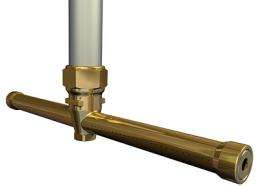
The Siemens Building Technologies Division has developed the Sinorix Silent Nozzle to avoid potential damage to hard disk drives when using a gas extinguishing system to extinguish a fire. The Sinorix Silent Nozzle is not only comparatively quiet, it also ensures fast and reliable extinguishing in data centers.

Siemens has developed a very quiet nozzle for gas extinguishing systems. The system is especially suitable for use in computer centers that store sensitive data. That’s because loud noise can cause hard disk drives to fail. However, the noise created by the Sinorix Silent Nozzle remains below the level that would endanger hard disk drives.

As is the case in many industrial facilities and archives, fires at computer centers are generally not extinguished with water but with . If a fire breaks out, the extinguishing systems flood the room with natural gases such as argon, nitrogen, or carbon dioxide within seconds, displacing oxygen in the process. Alternatively, chemical extinguishing agents can be used. These extinguish fires by extracting heat (energy) from the flames. The discharge of gas by conventional systems is very loud and can reach levels of 130 decibels or more, which is equivalent to a fighter jet taking off. In rare cases, computer center operators have noticed that such extinguishing systems have caused hard disk drives to fail temporarily. Studies have confirmed that this failure was the result of the hard disks’ sensitivity to noise. 

The new nozzle from Building Technologies is designed to keep the noise level below 100 decibels, as this comparatively low noise level doesn’t damage hard disks. The nozzle also makes it possible for the operator to choose the direction in which the gas will be discharged so that the sound waves will have a minimal impact on the hard disks. The nozzle can use the natural gases nitrogen or argon, and a similar nozzle concept is currently being developed for chemical extinguishing agents. The flooding times are identical to those for conventional nozzles. The new nozzle is fully compatible with the Sinorix gas extinguishing system and can also be retrofitted into existing facilities.

Provided by Siemens AG

4.3 /5 (4 votes)  

Rank 4.3 /5 (4 votes)
Relevant PhysicsForums posts

More news stories

Browser wars flare in mobile space

The browser wars are heating up again, but this time the fight is for dominance of the mobile Internet.

Technology / Software

created 12 hours ago | popularity 5 / 5 (1) | comments 3

Probability of contamination from severe nuclear reactor accidents is higher than expected: study

Catastrophic nuclear accidents such as the core meltdowns in Chernobyl and Fukushima are more likely to happen than previously assumed. Based on the operating hours of all civil nuclear reactors and the number ...

Technology / Energy & Green Tech

created May 22, 2012 | popularity 3.6 / 5 (22) | comments 56 | with audio podcast

HyperSolar shows dirty water no barrier to power world

(Phys.org) -- The Santa Barbara, California, company, HyperSolar, is set to transparently share the ups and downs of its research experiences toward the company’s ultimate vision, successfully producing ...

Technology / Energy & Green Tech

created May 24, 2012 | popularity 4.8 / 5 (16) | comments 17 | with audio podcast report

SpotterRF debuts Radar Backpack Kit (w/ Video)

(Phys.org) -- SpotterRF has announced a special radar backpack kit designed to enhance situational awareness for soldiers on the ground. The company says its special radar is designed for warfighters as part ...

Technology / Hi Tech & Innovation

created May 26, 2012 | popularity 5 / 5 (5) | comments 13 | with audio podcast report

Tesla to launch electric sedan in US on June 22

Tesla Motors said Tuesday it would begin deliveries of "the world's first premium electric sedan" on June 22, slightly ahead of schedule.

Technology / Energy & Green Tech

created May 22, 2012 | popularity 4.5 / 5 (12) | comments 18


Nvidia trumpets Tegra 3 phone design wins for 2012

(Phys.org) -- Nvidia’s competitive war paint has a name, Tegra 3. On the heels of Nvidia announcements about lowering costs of its Tegra 3 processors and Nvidia-enabled tablets running Android Ice Cream ...

'Unzipped' carbon nanotubes could help energize fuel cells, batteries

Multi-walled carbon nanotubes riddled with defects and impurities on the outside could replace some of the expensive platinum catalysts used in fuel cells and metal-air batteries, according to scientists at ...

T cells 'hunt' parasites like animal predators seek prey, study shows

By pairing an intimate knowledge of immune-system function with a deep understanding of statistical physics, a cross-disciplinary team at the University of Pennsylvania has arrived at a surprising finding: T cells use a movement ...

Computer model used to pinpoint prime materials for efficient carbon capture

When power plants begin capturing their carbon emissions to reduce greenhouse gases – and to most in the electric power industry, it's a question of when, not if – it will be an expensive undertaking.

Change in developmental timing was crucial in the evolutionary shift from dinosaurs to birds: study

At first glance, it's hard to see how a common house sparrow and a Tyrannosaurus Rex might have anything in common. After all, one is a bird that weighs less than an ounce, and the other is a dinosaur that ...

Land and sea species differ in climate change response: study

(Phys.org) -- Marine and terrestrial species will likely differ in their responses to climate warming, new research by Simon Fraser University and Australia’s University of Tasmania has found.