NRL launches TacSat-4 to augment communications needs
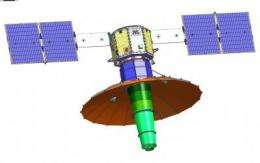
A less expensive, small-sat class system satellite with newer and more flexible technologies, TacSat-4's highly elliptical orbit augments existing geosynchronous satellites by providing near continuous communications to forward deployed forces in the high latitudes. Credit: US Naval Research Laboratory
The Navy's Tactical Satellite-IV (TacSat-4) successfully launched Sept. 27 aboard an Orbital Sciences Minotaur-IV+ launch vehicle from Alaska Aerospace Corporation's (AAC) Kodiak Launch Complex, Kodiak Island, Alaska.
The spacecraft augments current geosynchronous satellite communications, having an apogee of 12,050 kilometers in the high latitudes to deliver near, although not continuous, global communications on-the-move (COTM) to the battlefield and provide access to mountainous regions that have previously proved problematic.
TacSat-4 is a Navy-led joint mission that provides 10 Ultra High Frequency (UHF) channels and allows forward deployed troops to communicate from obscured regions using existing hand-held radios without the need to stop and point an antenna towards the satellite.
"TacSat-4 supports a critical warfighting requirement: communication," said Chief of Naval Research Rear Adm. Nevin Carr. "We've developed a technology that will supplement traditional satellites, giving military personnel on the ground another outlet for data transmission and facilitating 'comms on the move,'"
TacSat-4 provides flexible up and down channel assignments, which increase the ability to operate in busy radio-frequency environments and will cover the high latitudes and mountainous areas where users currently cannot access UHF satellite communications (SATCOMs). The NRL Blossom Point Ground Station provides the command and control for TacSat-4 and maintains its user Virtual Mission Operations Center (VMOC) tasking system, allowing dynamic reallocation to different theaters worldwide and enabling rapid SATCOM augmentation when unexpected operations or natural events occur.
TacSat-4 is an experimental spacecraft that will test advances in several technologies and SATCOM techniques. It will augment the existing fleet by giving the SATCOM Support Centers (SSC) an additional space asset to provide communications to otherwise under-served users and areas that either do not have high enough priority or do not have satellite visibility. The project will potentially provide the option for launching smaller highly elliptical orbit (HEO) satellites and enabling 24-hour coverage in multiple regions simultaneously, allowing the military to achieve the benefits of a combined HEO and geosynchronous orbit constellation.
The spacecraft bus was built by NRL and Johns Hopkins University Applied Physics Laboratory (APL) to mature ORS bus standards. It was developed by an Integrated (government and industry) System Engineering Team, the "ISET Team," with active representation from AeroAstro, Air Force Research Laboratory, Johns Hopkins Laboratory APL, ATK Space, Ball Aerospace and Technologies, Boeing, Design Net Engineering, General Dynamics AIS, Microcosm, Microsat Systems Inc., Massachusetts Institute of Technology Lincoln Laboratory, Orbital Sciences, NRL, SMC, Space System Loral, and Raytheon.
Provided by
Naval Research Laboratory
-
From lemons to lemonade: Reaction uses carbon dioxide to make carbon-based semiconductor,
32 comments
-
Thioridazine kills cancer stem cells in human while avoiding toxic side-effects of conventional cancer treatments,
3 comments
-
SpaceX private rocket blasts off for space station (Update),
42 comments
-
Climate scientists say they have solved riddle of rising sea,
31 comments
-
SpaceX capsule has 'new car' smell, astronauts say (Update),
4 comments
-
Distance of planets from stars and revolution
2 hours ago
-
revamping general concept and cosmological principle
May 25, 2012
-
Transiting Exoplanet Light Curve
May 25, 2012
-
Math behind Theoretical Physics
May 24, 2012
-
Do we know whats at the center of galaxies yet?
May 23, 2012
-
Structure of the Milky Way?
May 20, 2012
- More from Physics Forums - General Astronomy
More news stories
Land and sea species differ in climate change response: study
(Phys.org) -- Marine and terrestrial species will likely differ in their responses to climate warming, new research by Simon Fraser University and Australia’s University of Tasmania has found.
25 minutes ago |
not rated yet |
1
|
Yale study concludes public apathy over climate change unrelated to science literacy
Are members of the public divided about climate change because they don't understand the science behind it? If Americans knew more basic science and were more proficient in technical reasoning, would public consensus match ...
2 hours ago |
not rated yet |
10
|
10 million years needed to recover from mass extinction
It took some 10 million years for Earth to recover from the greatest mass extinction of all time, latest research has revealed.
Space & Earth / Earth Sciences
2 hours ago |
not rated yet |
1
|
Sophisticated simulations predict future warming
The chances of our planet being hit by a global warming of 3 degrees Celsius by 2050 is as likely as it being hit by an increase of 1.4 degrees, new research shows. Presented in the journal Nature Geoscience, the British study ...
Space & Earth / Earth Sciences
May 22, 2012 |
4.4 / 5 (9) |
51
Aliens don't want to eat us, says former SETI director
Alien life probably isnt interested in having us for dinner, enslaving us or laying eggs in our bellies, according to a recent statement by former SETI director Jill Tarter.
Space & Earth / Space Exploration
May 25, 2012 |
4.4 / 5 (14) |
39
Almost half of new vets seek disability
(AP) -- America's newest veterans are filing for disability benefits at a historic rate, claiming to be the most medically and mentally troubled generation of former troops the nation has ever seen.
'Unzipped' carbon nanotubes could help energize fuel cells, batteries
Multi-walled carbon nanotubes riddled with defects and impurities on the outside could replace some of the expensive platinum catalysts used in fuel cells and metal-air batteries, according to scientists at ...
T cells 'hunt' parasites like animal predators seek prey, study shows
By pairing an intimate knowledge of immune-system function with a deep understanding of statistical physics, a cross-disciplinary team at the University of Pennsylvania has arrived at a surprising finding: T cells use a movement ...
Computer model used to pinpoint prime materials for efficient carbon capture
When power plants begin capturing their carbon emissions to reduce greenhouse gases and to most in the electric power industry, it's a question of when, not if it will be an expensive undertaking.
Change in developmental timing was crucial in the evolutionary shift from dinosaurs to birds: study
At first glance, it's hard to see how a common house sparrow and a Tyrannosaurus Rex might have anything in common. After all, one is a bird that weighs less than an ounce, and the other is a dinosaur that ...
Same gene that stunts infants' growth also makes them grow too big: research
UCLA geneticists have identified the mutation responsible for IMAGe* syndrome, a rare disorder that stunts infants' growth. The twist? The mutation occurs on the same gene that causes Beckwith-Wiedemann syndrome, which makes ...
Sep 27, 2011
Rank: not rated yet
Is it really augmenting the NEEDS? Or is it augmenting the capabilities? It would be a great big waste of money if it made the needs greater, but I have a feeling that's just a product of the infamous three headed headline monster again. Some of the headline around here deserve to be on the wrapper of Laffy Taffy.
That's an odd place for a launch facility, isn't it? At about 58 degrees north?