Nanoscale spin waves can replace microwaves
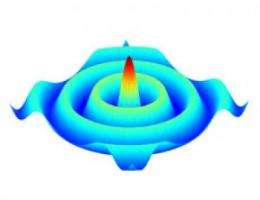
Spin waves spread from a magnetic nanocontact like rings on water. Credit: University of Gothenburg
A group of scientists from the University of Gothenburg and the Royal Institute of Technology (KTH), Sweden, have become the first group in the world to demonstrate that theories about nanoscale spin waves agree with observations. This opens the way to replacing microwave technology in many applications, such as mobile phones and wireless networks, by components that are much smaller, cheaper, and that require less resources. The study has been published in the scientific journal Nature Nanotechnology, the most prestigious journal in nanoscience.
"We have been in competition with two other research groups to be the first to confirm experimentally theoretical predictions that were first made nearly 10 years ago. We have been successful due to our method for constructing magnetic nanocontacts and due to the special microscope at our collaborators' laboratory at the University of Perugia in Italy", says Professor Johan Åkerman of the Department of Physics, University of Gothenburg, where he is head of the Applied Spintronics group.
The aim of the research project, which started two years ago, has been to demonstrate the propagation of spin waves from magnetic nanocontacts. Last autumn, the group was able to demonstrate the existence of spin waves with the aid of electrical measurements, and the results were published in the scientific journal Physical Review Letters. The new results have been published in Nature Nanotechnology, the most prestigious journal in nanoscience.
This video is not supported by your browser at this time.
The simulation of magnetic nanocontacts shows how spin waves spread like rings on water. The nanocontact has a diameter of 40 nanometre and the spin waves are created in a thin film of nickel-iron alloy, 3 nanometre thick.
The research group has used one of the three advanced spin wave microscopes in the world, at the university in the Italian town of Perugia, to visualise the motion. The microscope makes it possible to see the dynamic properties of components with a resolution of approximately 250 nanometre.The results have opened the way for a new field of research known as "magnonics", using nanoscale magnetic waves.
"I believe that our results will signal the start of a rapid development of magnonic components and circuits. What is particularly exciting is that these components are powered by simple direct current, which is then converted into spin waves in the microwave region. The frequency of these waves can be directly controlled by the current. This will make completely new functions possible", says Johan Åkerman, who is looking forward to exciting developments in the next few years.
This video is not supported by your browser at this time.
A simulation of six magnetic nanocontacts placed in a circle to illustrate how the nanocontacts can be placed in freely chosen patterns. All the signals synchronise in this case through the spin waves that propagate through the magnetic film.
Its magneto-optical and metallic properties mean that magnonic technology can be integrated with traditional microwave-based electronic circuits, and this will make completely untried combinations of the technologies possible. Magnonic components are much more suitable for miniaturisation than traditional microwave technology.Provided by
University of Gothenburg
-
From lemons to lemonade: Reaction uses carbon dioxide to make carbon-based semiconductor,
32 comments
-
Thioridazine kills cancer stem cells in human while avoiding toxic side-effects of conventional cancer treatments,
3 comments
-
SpaceX private rocket blasts off for space station (Update),
42 comments
-
Climate scientists say they have solved riddle of rising sea,
31 comments
-
SpaceX capsule has 'new car' smell, astronauts say (Update),
4 comments
-
Why does light move?
45 minutes ago
-
How to calculate the repulsion force between a permanent and an electromagnet?
1 hour ago
-
Why does light allow us to see things?
1 hour ago
-
Room temperature superconductivity
2 hours ago
-
Water flow question
5 hours ago
-
16 year old solves 300 year old problem set by Isaac Newton
6 hours ago
- More from Physics Forums - General Physics
More news stories
'Unzipped' carbon nanotubes could help energize fuel cells, batteries
Multi-walled carbon nanotubes riddled with defects and impurities on the outside could replace some of the expensive platinum catalysts used in fuel cells and metal-air batteries, according to scientists at ...
Nanotechnology / Nanomaterials
3 hours ago |
not rated yet |
0
|
In nanorod crystal growth, nanoparticles seen as artificial atoms
In the growth of crystals, do nanoparticles act as "artificial atoms" forming molecular-type building blocks that can assemble into complex structures? This is the contention of a major but controversial theory ...
May 24, 2012 |
4.8 / 5 (6) |
0
|
Dopant gives graphene solar cells highest efficiency yet
(Phys.org) -- By taking advantage of graphenes favorable electrical and optical properties, and then adding an organic dopant, researchers have achieved the highest power conversion efficiency yet for ...
First direct observation of oriented attachment in nanocrystal growth
Berkeley Lab researchers have reported the first direct observation of nanoparticles undergoing oriented attachment, the critical step in biomineralization and the growth of nanocrystals. A better understanding ...
May 24, 2012 |
4.7 / 5 (3) |
0
|
Synthetic nano-waste does not disappear
(Phys.org) -- Tiny particles of cerium oxide do not burn or change in the heat of a waste incineration plant. They remain intact on combustion residues or in the incineration system, as a new study by Swiss ...
Nanotechnology / Bio & Medicine
May 25, 2012 |
5 / 5 (2) |
1
|
Land and sea species differ in climate change response: study
(Phys.org) -- Marine and terrestrial species will likely differ in their responses to climate warming, new research by Simon Fraser University and Australia’s University of Tasmania has found.
T cells 'hunt' parasites like animal predators seek prey, study shows
By pairing an intimate knowledge of immune-system function with a deep understanding of statistical physics, a cross-disciplinary team at the University of Pennsylvania has arrived at a surprising finding: T cells use a movement ...
Computer model used to pinpoint prime materials for efficient carbon capture
When power plants begin capturing their carbon emissions to reduce greenhouse gases and to most in the electric power industry, it's a question of when, not if it will be an expensive undertaking.
Change in developmental timing was crucial in the evolutionary shift from dinosaurs to birds: study
At first glance, it's hard to see how a common house sparrow and a Tyrannosaurus Rex might have anything in common. After all, one is a bird that weighs less than an ounce, and the other is a dinosaur that ...
Almost half of new vets seek disability
(AP) -- America's newest veterans are filing for disability benefits at a historic rate, claiming to be the most medically and mentally troubled generation of former troops the nation has ever seen.
Nvidia trumpets Tegra 3 phone design wins for 2012
(Phys.org) -- Nvidias competitive war paint has a name, Tegra 3. On the heels of Nvidia announcements about lowering costs of its Tegra 3 processors and Nvidia-enabled tablets running Android Ice Cream ...
Sep 07, 2011
Rank: 2 / 5 (5)
Sep 07, 2011
Rank: 5 / 5 (1)
Along those lines, I don't like how they start this article, because it leads us in the wrong direction of thought. Only midway through the article does it become clear that this is an advance in microwave modulation/communications. and basically nothing else at all.
I'm sure it comes none too soon, as it will definitely help with bandwidth and higher speed connections, but really, whoever wrote this article needs to call a spade a spade.
Sep 07, 2011
Rank: 5 / 5 (2)
Sep 07, 2011
Rank: 5 / 5 (1)
Sep 08, 2011
Rank: 5 / 5 (1)
Sep 08, 2011
Rank: 5 / 5 (1)
[blink]
Woah! What happened?! I think I kinda blanked out there a bit while watching the videos.
Sep 08, 2011
Rank: not rated yet
Sep 08, 2011
Rank: 4 / 5 (1)
Sep 08, 2011
Rank: not rated yet
Another net plus is that you can directly detect, and immediately amplify, any in-band femtowatt microwave signal. Another huge savings in scale, cost, and accuracy. [It may even obviate a coming collision between 4G signals and GPS, due to FCC stupidity, using sharper bandpass filter circuitry.] Heck, almost makes me want to get back into the EE world. This is fun!
Sep 13, 2011
Rank: not rated yet