Two radiation generators mark major milestones
September 8, 2011 By Neal Singer
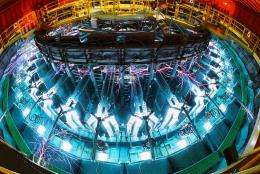
Saturn, Sandia’s workhorse pulsed-power machine, delivers hard radiation during one of its milestone shots. The scarcity of jagged, lightning-like arcing between different water/metal interfaces means that the machine’s water insulation is effective, and that relatively much of its electrical pulse is traveling on its intended path from the machine’s circular exterior to its central target. Credit: Randy Montoya
Two remarkable pulsed-power machines used to test the nations defenses against atomic weapons have surpassed milestones at Sandia National Laboratories: 4,000 firings, called shots, on the Saturn accelerator and 9,000 shots on the HERMES III accelerator.
Saturn originally projected to last 5 to 10 years began operating in 1987. Its major function has been to produce X-rays to test the effectiveness of countermeasures used to protect electronics and other materials against X-ray radiation from nuclear weapons. The machine, used broadly as a physics research testbed , provides data that can be used either directly or as input for computer simulations. The machine can fire twice a day. All these characteristics make it a spry source for data.
HERMES (High-Energy Radiation Megavolt Electron Source) III, which can fire six to eight times daily, is used primarily to demonstrate the effect of gamma ray radiation -- another component of a nuclear weapon burst -- on electronics and larger military hardware. First fired in 1988, it is still the worlds most powerful gamma ray generator.
The continued operation of these facilities is a testament to the ingenuity and dedication of personnel and management, said Sandia manager Ray Thomas.
Saturn is a predecessor to Sandias more awesome Z machine, but still fills a significant niche. Though it operates at roughly one-third the power of Z, Saturn can accelerate electrons at voltages and amperages that allow materials to be tested for so-called hard X-ray effects; the Z facility is not configured to produce X-rays in this critical range of frequencies.
Twenty-one years ago, in what proved to be one of Saturns most high-profile endeavors, it hosted its first wire-array tests, which pulsed millions of amperes in nanoseconds through a number of wires each thinner than a human hair. The success of these tests led to installation of wire-array hardware on the larger Z machine, with gains in X-ray output that astonished the world and led to Zs consideration as a potentially reliable way to create electricity essentially from seawater, the worlds largest natural resource.
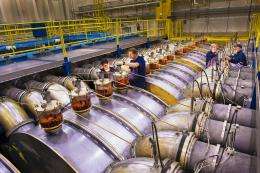
Technicians service the linear HERMES pulsed-power machine — the most powerful gamma ray producer in the world — for its next shot. Because of Sandia’s nuclear responsibilities, HERMES and Saturn are kept in “warm, standby mode” for immediate testing of components. Credit: Randy Montoya
In those early tests, the wires of course disintegrated like overstressed fuses from the great flood of electricity. But the powerful magnetic field always associated with a powerful electric current grabbed the floating ions created from the shorted-out wires and pulled them together at great speeds. When the ions ran out of room to travel, they stopped suddenly, confronting each other along a relatively vertical axis that was the hub of the magnetic field. Their sudden braking led them to release X-ray energy, similar to the release of heat from a cars tires when the driver jams on the brakes. The scientific process, called a z-pinch by geometrical reference, caused an extraordinary increase of X-ray energy output over previous methods. Such intense X-rays can be used to compress a BB-sized hydrogen capsule, fusing its contents to release enormous energies that eventually could be used to drive an electrical power plant on very little fuel.
Unlike Saturn and Z, whose modules are each arranged in a circular pattern that resembles a wagon wheel, with electrical transmission lines like spokes leading to the target at the axle, HERMES uses 20 inductively isolated modules coupled to a linear transmission line that resembles a short subway train in size, shape and amount of metal. The output voltage from each module is added in series, the reason for the very high voltage achieved. Saturns outdoor test facility is large enough to accommodate military tanks.
Continued improvements on both machines have enhanced their capabilities to map portions of the X-ray spectra previously unattainable, and to reach radiation dose rates never before achieved by an accelerator.
Provided by
Sandia National Laboratories
-
From lemons to lemonade: Reaction uses carbon dioxide to make carbon-based semiconductor,
32 comments
-
Thioridazine kills cancer stem cells in human while avoiding toxic side-effects of conventional cancer treatments,
3 comments
-
SpaceX private rocket blasts off for space station (Update),
42 comments
-
Climate scientists say they have solved riddle of rising sea,
31 comments
-
SpaceX capsule has 'new car' smell, astronauts say (Update),
4 comments
-
Why does light move?
26 minutes ago
-
How to calculate the repulsion force between a permanent and an electromagnet?
1 hour ago
-
Why does light allow us to see things?
1 hour ago
-
Room temperature superconductivity
1 hour ago
-
Water flow question
5 hours ago
-
16 year old solves 300 year old problem set by Isaac Newton
6 hours ago
- More from Physics Forums - General Physics
More news stories
Is a classical electrodynamics law incompatible with special relativity?
(Phys.org) -- The laws of classical electromagnetism that were developed in the 19th century are the same laws that scientists use today. They include Maxwell’s four equations along with the Lorentz la ...
Landmark calculation clears the way to answering how matter is formed
(Phys.org) -- An international collaboration of scientists, including Thomas Blum, associate professor of physics, is reporting in landmark detail the decay process of a subatomic particle called a kaon ...
May 25, 2012 |
4.3 / 5 (22) |
51
|
Lying in wait for WIMPs: Researchers seek to dramatically increase sensitivity of Large Underground Xenon detector
Although it's invisible, dark matter accounts for at least 80 percent of the matter in the universe. No one knows what it is, but most scientists would bet on weakly interacting massive particles, or WIMPs.
May 23, 2012 |
4 / 5 (7) |
16
|
Hawaii lab turns laser-powered bubbles into microrobots
(Phys.org) -- A team of scientists from the University of Hawaii are working on microrobots created from bubbles of air in a saline solution. The bubbles take on their title of robots as a laser ...
Sound increases the efficiency of boiling
Scientists at the Georgia Institute of Technology achieved a 17-percent increase in boiling efficiency by using an acoustic field to enhance heat transfer. The acoustic field does this by efficiently removing vapor bubbles ...
May 24, 2012 |
5 / 5 (2) |
2
Land and sea species differ in climate change response: study
(Phys.org) -- Marine and terrestrial species will likely differ in their responses to climate warming, new research by Simon Fraser University and Australia’s University of Tasmania has found.
'Unzipped' carbon nanotubes could help energize fuel cells, batteries
Multi-walled carbon nanotubes riddled with defects and impurities on the outside could replace some of the expensive platinum catalysts used in fuel cells and metal-air batteries, according to scientists at ...
T cells 'hunt' parasites like animal predators seek prey, study shows
By pairing an intimate knowledge of immune-system function with a deep understanding of statistical physics, a cross-disciplinary team at the University of Pennsylvania has arrived at a surprising finding: T cells use a movement ...
Computer model used to pinpoint prime materials for efficient carbon capture
When power plants begin capturing their carbon emissions to reduce greenhouse gases and to most in the electric power industry, it's a question of when, not if it will be an expensive undertaking.
Change in developmental timing was crucial in the evolutionary shift from dinosaurs to birds: study
At first glance, it's hard to see how a common house sparrow and a Tyrannosaurus Rex might have anything in common. After all, one is a bird that weighs less than an ounce, and the other is a dinosaur that ...
Almost half of new vets seek disability
(AP) -- America's newest veterans are filing for disability benefits at a historic rate, claiming to be the most medically and mentally troubled generation of former troops the nation has ever seen.

Sep 08, 2011
Rank: 5 / 5 (1)
Looks like a real Doomsdaydevice :)
Sep 08, 2011
Rank: 5 / 5 (5)
Good article Neal.
Sep 08, 2011
Rank: not rated yet
It does my heart good to see that phrase in print.
Another article posted yesterday on physorg.com, "Something new on the Sun: Spacecraft observes new characteristics of solar flares", never mentions electric currents and instead says:
I think the JPL/NASA and Sandia people should spend more time together - somebody seems to be possibly overlooking a few key elements, and I don't think it is the Sandia crew.
Sep 08, 2011
Rank: 5 / 5 (4)
I don't think the science/engineering crews are the ones overlooking the things you mention - it is the 'journalists' who write the articles who generally miss important phrasings or points.
Speaking of missed, you missed the best technical statement ever to grace physorg.
Sep 08, 2011
Rank: 5 / 5 (1)
You are probably right about your first point, and definitely right about the second one.
I was all set to blame the 'journalists' in the first place, when I noticed that over on that other article it says (at the very bottom)"Provided by JPL/NASA".
Now granted, it may be JPL's/NASA's journalists, which would bring it full circle, but since that's all the citation I noticed, that's who I chose to throw bricks at.
Still, you're probably correct.
Sep 08, 2011
Rank: 5 / 5 (1)
Sep 08, 2011
Rank: 5 / 5 (2)
Good call, and thanks for the clarification.
(Any other day I'd take exception to the word "objective", but let's just let that slide... Overall, you're correct.)
Sep 08, 2011
Rank: 5 / 5 (1)
Sep 09, 2011
Rank: not rated yet
http://en.wikiped...iva_Star
Sep 11, 2011
Rank: 1 / 5 (1)
"Giuliani, who was mayor during the terrorist attack, chose Ecclesiastes 3:4 to read at the 10th anniversary ceremony.
"It's the one that begins, "To everything there is a season, and a time to every purpose under the heaven."
-The specific verse:
"4 a time to weep and a time to laugh,
a time to mourn and a time to dance,"Ecc3:4
-Meaning that there is a Proper Time for these and every activity listed in this passage, a Description of why Empire has been so successful. These Things are all INEVITABLE.
But should we weep or laugh, mourn or dance? Depends wholly on which Side you're on. Irregardless, Empire determines When, Where, How and Why.
Read the whole thing:
http://www.bibleg...sion=NIV
-Er sorry, wrong thread-
Sep 11, 2011
Rank: not rated yet
On 911, a giant tent fell and many goats were killed.
Sep 12, 2011
Rank: not rated yet
Sep 12, 2011
Rank: not rated yet
"OTTOWA - Memorial for animals killed in war
"We need the monument because our casualty list of close to 60,000 in the First World War and some 48,000 in the Second World War would have been much higher had it not been for the support of our animals," he said. "The animals managed to bring the guns forward, the animals that managed to bring the provisions forward, the animals that evacuated our wounded. We owe a great debt to them."
If you'd like to contribute to Swick's fundraising campaign, donations can be made to the Animals in War Dedication Fund at any TD Canada Trust via account #___-______.
-Thats sweet.