How key genes cooperate to make healthy skin
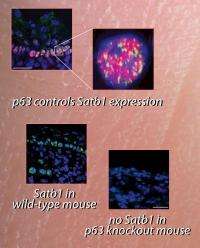
Skin is the body's armor, protecting us from disease agents, injury, excessive water loss, and cold and heat. Yet mutations in a single gene, the gene for the protein p63, cause numerous diseases and malformations of the uppermost layer of skin – the epidermis – and other tissues. In the epidermis, these range from skin cancers to dysplasias that cause cracking, bleeding, infection, and discoloration.
A research team from the U.S. Department of Energy's Lawrence Berkeley National Laboratory (Berkeley Lab) and spearheaded by colleagues from the University of Bradford in the United Kingdom, including members from Boston University, has learned that p63 acts by directly regulating another protein, Satb1, which is a "genome organizer" – it controls gene expression in progenitor cells by temporarily remodeling chromatin, the structure that makes up the chromosomes and contains tightly wound DNA.
The p63 protein is the "master regulator" of epidermal development as a mammalian embryo grows, working with other proteins to closely coordinate the expression and timing of groups of genes that control cell growth and differentiation. Just how p63 performs its complex role has been a mystery, however.
A significant part of the answer lies with Satb1. Discovered a decade ago by a team led by Terumi Kohwi-Shigematsu of Berkeley Lab's Life Sciences Division, Satb1 acts as a molecular machine to regulate gene expression by binding to chromosomal DNA at specific sites, rearranging it to bring essential genes into proximity, and recruiting the additional proteins needed to transcribe those genes. Satb1 has been shown to be crucial in the development of the immune system's T-cells, in T-cell function, and in breast cancer metastasis. Yet the mechanisms that control the expression of the Satb1 gene in different cell types have been as much a mystery as how p63 regulates skin development. (Gene names, as distinct from protein names, are italicized.)
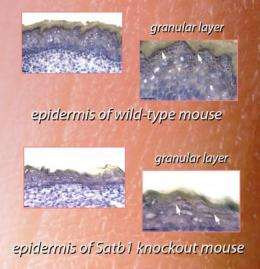
Vladimir Botchkarev, Professor of Cutaneous Biology and Associate Director of the Centre for Skin Sciences at the University of Bradford, suspected that the key to p63's role lay with chromatin remodeling factors such as Satb1. The skin of mice bred with no p63 gene is slow to develop and markedly thinner than that of normal mice. From these "knockout" mice, Botchkarev was able to learn which other genes were under-expressed and which were over-expressed when p63 was lacking.
Finding that Satb1 was at the head of the list of missing chromatin-remodeling genes, Botchkarev contacted Kohwi-Shigematsu to bring their labs together with colleagues from Boston University to jointly study the potential connection of p63 and Satb1 in skin development.
Says Kohwi-Shigematsu, "The expertise of our teams in skin and Satb1 biology led to two important firsts: we established Satb1's key role in the development of skin and also, for the first time, we identified a protein, p63, that regulates Satb1 itself."
The teams have published their results in the Journal of Cell Biology.
Getting under the skin
The epidermis is the barrier than separates the body from the outer world. The deepest of its five sublayers consists of progenitor cells that form keratinocytes, the most common type of skin cells. These gradually migrate upward, differentiating into cells with distinct properties in the upper layers of the epidermis, and eventually flake off – a continuous process that in humans take two weeks or more.
At each new level the keratinocytes accumulate more and more tough, connective keratin proteins. The keratins and other proteins form filaments that begin to interlink. The cells stiffen, lose their nuclei and other internal structures, and finally program themselves to die. The top layers of skin form a tough barrier, made of dead cells that fit together like tiles. At every stage of the process, the appropriate genes must be turned on and off to regulate cell signaling, cell adhesion, metabolism, and gene transcription.
In mice, many of these genes are clustered together in chromosomal regions specific to the expression of keratin and related proteins, and in a site called the "epidermal differentiation complex." The proteins coded for by the genes in the clusters are necessary to the process of toughening, or cornifying (the word means "making horn"), the cell envelopes essential to the skin barrier. These gene assemblies are just the sort that Satb1 controls in other systems by chromatin remodeling.
Satb1 doesn't always bind to DNA close to where a gene's transcription starts, however. It typically bends and folds the chromatin to bring the right groups of genes together. Thus, when Satb1 binds to a specific site, genes as far as 200,000 base pairs away may be activated.
Two kinds of knockout mice, lacking either the p63 or the Satb1 gene, exhibited similar impacts on expression of their skin-related genes, and they had decreased amounts of the same proteins involved in cell cornifying. Both kinds of knockout mice had the thinner skins.
The effects of missing p63 on expression of many genes were so close to those of missing Satb1 as to suggest to the researchers that Satb1 plays an important function in skin development as a gene "downstream" of the p63 protein – a primary target of its activity. Indeed, a series of tests showed that p63 directly regulates the Satb1 gene.
A final test was the most suggestive of them all. If the lack of p63 causes a thin epidermis, a lack of cell growth, and a decrease in such critical proteins as loricrin (necessary to form the tough envelope of the outermost skin cells), can Satb1 reverse this degenerative process?
The researchers used a virus to transport the Satb1 gene into samples of skin from p63 knockout mice. The result was a significant increase in epidermal thickness, cell proliferation, and loricrin levels. The research team concluded that Satb1 is capable of partially restoring the normal epidermis in p63-deficient mice.
Says Kohwi-Shigematsu, "Our collaboration on skin development with Botchkarev's lab, which made the major contribution to this study, and our other colleagues was exciting because we learned both a new key player and a novel strategy that cells use to make skin: the master regulator p63 uses Satb1's skills to do much of its work."
Knowledge of how these essential genes and proteins work together holds promise for better understanding and eventual progress in addressing a wide range of skin disorders.
More information: "p63 regulates Satb1 to control tissue-specific chromatin remodeling during development of the epidermis," by Michael Y. Fessing, et al., Journal of Cell Biology jcb.rupress.org/content/194/6/825.abstract
Provided by Lawrence Berkeley National Laboratory


