Industry and neutron science: Working to make a match
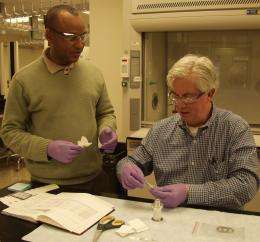
Industrial users are starting to eye the potential of neutron science for solving problems that can't be solved in any other way. At the same time, the Spallation Neutron Source and High Flux Isotope Reactor neutron science facilities at Oak Ridge National Laboratory are exploring ways to woo such users and to make a match of it, to the benefit of both.
Michael Crawford, a member of the research staff in Central Research and Development at DuPont in Wilmington, Del., foresees that neutron science will lead to significant developments in new materials for multiple applications. DuPont is a giant, science-based products and services company that operates in 90 countries.
Crawford has studied polymer nanocomposites at both HFIR and SNS for several years. "Nanocomposites, in which nanoparticles of many varieties are uniformly dispersed in a polymer matrix, have been reported to have significantly improved properties over the pure polymer," he said. "But these claims are often not substantiated, or placed in the context of the effect on other materials properties.
"We are trying to provide a detailed scientific understanding of if, when, how and why nanoparticles can improve the properties of polymers by using small-angle neutron scattering at HFIR to study a series of model systems. We also hope to use the Extended Q-Range Small Angle Neutron Scattering Diffractometer at the SNS in the future."
As a complement to the HFIR diffractometer, Crawford also takes advantage of inelastic neutron scattering at SNS's Backscattering Spectrometer to explore the effects nanoparticles have on polymer dynamics. "We hope to extend the backscattering work to longer timescales, using neutron spin spectroscopy."
And the materials researchers look to SNS's Cold Neutron Chopper Spectrometer to understand phonons in what are called negative thermal expansion materials. Most materials expand when heated. However, some systems are known to do the opposite. "Combining materials with negative thermal expansion with materials with positive thermal expansion can provide composites with zero, or very small, thermal expansion," Crawford said. Such materials can be used as substrates in electronics or optics, or as materials for common high temperature applications (a well-known example is Corning cookware).
Then there is the new Powder Diffractometer, POWGEN, at SNS: Industrial users are intrigued by its ability to determine the crystal structures of several negative thermal expansion materials, or materials related to these, as a function of temperature. "In some cases the fact that neutron diffraction can differentiate elements that X-ray scattering cannot—such as germanium and zinc—is an important factor," Crawford said.
One of DOE's goals for the two neutron science facilities is to boost the competitiveness of American industries by ensuring them access to the best materials science research tools. ORNL is looking for ways to make SNS and HFIR more user friendly to a sector of researchers who aren't familiar with what neutrons can accomplish in their fields.
"The advantages of neutrons to study materials are the same for industrial researchers and academic researchers: they can see light elements, study magnetic structures, penetrate big samples," said Thomas Proffen, a group leader in ORNL's Neutron Sciences Directorate.
Time is money in industry, and Proffen says industrial users are acutely aware of this concept. They may first come to the facility with a nonproprietary sample to quickly see what type of data they get. "They work with the instrument team, see what analysis is required, and they can do this just by investing their staff time. Then if they see the results are such that they can learn something from it, they may come back to do proprietary work."
One of the challenges for industrial users is that many lack the expertise to handle their data. "One of the opportunities for ORNL is to provide tools or a mechanism to help in those cases beyond the experiment itself, that might open the door to more industrial users," Proffen said.
"Ultimately, the impact on industry is driven by how well the tools are established, how well the research staff understand what options are there, and how important the question is that neutrons can answer. In fundamental research, we want to know everything. Industry wants to know enough to answer a question.
"Industry hates inconclusive results. The pressure is on them to obtain results they can report," Proffen added. That's why instruments such as the Engineering Diffractometer at SNS and the Neutron Residual Stress Mapping Facility at HFIR are at the forefront of industrial interest, he noted. "A lot of industrial samples are big, and neutrons have the advantage that they can penetrate them. You don't have to cut it up into little pieces-you can take the whole thing you want to look at and put it in the beam line.
"The experimental technique and the results you'll get are established and straightforward enough that there isn't a strong need to be an expert on neutron scattering to analyze the data," Proffen said. "Once the data are properly reduced, what they get from the instrument is a stress/strain curve of the sort they get with other methods, and they know what to do with that. So it's not surprising that's an area where there's a lot of industry interest—it's quick, and the results are straightforward." Proffen says that to grow the number of industrial users, SNS and HFIR need to present industrially relevant speakers at user meetings and workshops. "It's a question of being exposed to the specific questions that industry has, that go beyond fundamental research," he said. "The effort starts with sitting in a room or having a special session at a meeting and connecting the people who know the technique with the people who have the problems."
Neutron scattering can play a significant role in refining the accuracy of the computer models that industry uses to do much of its predictive work, Proffen noted. Buried in those codes are parameters usually derived from experiment. If those are not accurate, the model predictions will be inaccurate. "As we ask more detailed questions of these models," he said, "we find that our assumptions may not be good enough. So there is a lot of experimental work that needs to be done to test and validate the computational codes. And some of that is done with neutrons."
Ease of use, ease of access, knowing what neutron scattering data will add to the knowledge base—all those are factors in attracting users from industry, Proffen noted. "Neutron scattering needs to be easy. Industrial users cannot spend a year on a project. If we made it more accessible, having workshops, making access to the facilities easier, providing tools that help with interpreting the data, it would make things better across the board."
Industrial users like Crawford see the research as important both for fundamental and applied science. "Most of my work at SNS and HFIR is fundamental research that we intend to publish in the open literature," Crawford said. "Our hope is that the fundamental understanding we obtain from this work will guide our development of new materials with designed properties that are better suited to their intended applications."
Other neutron scattering techniques available at ORNL could also be particularly useful to industry, including reflectometry, neutron spin echo, high-pressure diffraction, and the new vibrational spectrometer scheduled to be available at SNS in 2012, he said.
Crawford agrees with Proffen that for American industry to realize the potential of neutron scattering, ORNL needs to help industry researchers get started. The neutron scattering facilities should make sure that there is a well-defined route for those users to get information, and expertise available to help them plan their experiments, write proposals, and analyze the data after the experiment.
Industry researchers also need to know that they don't have to pay to use SNS and HFIR and other DOE user facilities to conduct nonproprietary experiments, he pointed out. "You just have to write a proposal, and if it is accepted, you are granted the time."
Provided by Oak Ridge National Laboratory


