Graphene can be strengthened by folding
September 20, 2011 by Lisa Zyga feature

Graphene can be strengthened by folding

Enlarge

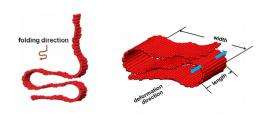
(Left) Illustration of the folding process that forms grafold. (Right) A double-folded piece of grafold with a width of 70 angstroms and length of 60 angstroms. Image credit: Zheng, at al. ©2011 IOP Publishing Ltd

(PhysOrg.com) -- With a strength 200 times greater than that of steel, graphene is the strongest known material to exist. But now scientists have found that folding graphene nanoribbons into structures they call “grafold” can enable it to bear even greater compressive loads.

The researchers, Yongping Zheng and Zhigao Huang of Fujian Normal University in China; Ning Wei and Zheyong Fan of Xiamen University in China; and Lanqing Xu of both universities, have published their study in a recent issue of .

“The results of this work provide a new route for tailoring the properties of graphene-based nanomaterials,” Zheng told PhysOrg.com. “Currently, many researchers and engineers are concerned with doping, alchemy, etc. We have demonstrated here that structure re-construction could also lead to interesting results.”

In their study, the researchers used molecular dynamics simulations to investigate grafold. They compared with grafold in two areas: tension (the force that pulls the material apart) and (the force that pushes the material together). The ability to be both elongated and squeezed without damage is very helpful for engineering applications. However, as the researchers explain, graphene only has a high tensile ; because of its two-dimensional nature, it is “soft” under compression and can’t be squeezed.

In contrast, the researchers’ simulations showed that grafold is “harder” than graphene and can withstand much larger amounts of compression (10-25 GPa depending on the structure of grafold compared with less than 2 GPa for graphene). While its compressive strength is significantly higher than that of graphene, grafold’s tensile strength approaches that of graphene. The Young’s modulus (a measure of elasticity) and fracture strain of grafold are a little lower than those of graphene. The scientists noted that several other materials can withstand greater compression than grafold, including carbon nanotubes, which can be both elongated and squeezed like grafold.

“As is well known, graphene can’t withstand any compression,” Zheng said. “Via folding, graphene transforms into grafold and can be compressed to a certain amount. Even when highly compressed, it won’t break down, just be squeezed into a shorter folded belt. Furthermore, the deformation is elastic. As we know, if the strength exceeds carbon nanotubes’ breaking point, it will crash and never return to its original form.”

Among grafold’s advantages is that folding a graphene nanoribbon to create grafold will be much easier than rolling it up to create a carbon nanotube. Plus, grafold’s mechanical properties can be tuned by the modifying the design, such as changing the size, shape, and number of folds.

Overall, the results of the simulations provide a new route for tailoring the properties of graphene-based nanomaterials, which could lead to advanced mechanical applications. The researchers hope to experimentally fabricate grafold in the near future.

“There could be versatile applications,” Zheng said. “Say, one could utilize the elastic and low-to-mid stiffness of grafold in applications where a large damping is required.”

More information: Yongping Zheng, et al. “Mechanical properties of grafold: a demonstration of strengthened graphene.” Nanotechnology 22 (2011) 405701 (9pp). DOI:10.1088/0957-4484/22/40/405701

Copyright 2011 PhysOrg.com.
All rights reserved. This material may not be published, broadcast, rewritten or redistributed in whole or part without the express written permission of PhysOrg.com.

4.5 /5 (17 votes)  

Filter


Move the slider to adjust rank threshold, so that you can hide some of the comments.


Display comments: newest first

TrustTheONE
Sep 20, 2011

Rank: 2 / 5 (4)
its a big step for the space elevator ribbon!
Isaacsname
Sep 20, 2011

Rank: 5 / 5 (2)
They should take a tip from airbag designers and look to origami folds for inspirations. I bet orbifolds will exhibit some interesting properties. How complex will they get with the construction of shapes ? Will they ever be able to make something like:

http://en.wikiped...tex_tube

that_guy
Sep 20, 2011

Rank: 4.3 / 5 (3)
@Trust
This does absolutely nothing for any proposed space elevator. As soon as I read the title, I knew someone was going to go there without trying to comprehend the science in a SCIENCE article.

Please wikipedia space elevator, and mechanical loads.

You will find that the main obstacle to a space elevator is finding a manufacturable material with enough tensile strength to handle the strain of the centrifugal forces. We have plenty of materials that have enough compressive strength needed.

Since folded graphene has the same tensile strength as regular graphene, it doesn't do a whole lot to help us, now does it?

I think that the researchers did an excellent job. Since the sheets are folded, it will keep them from slipping as much as they do. This is an elegant and conceptually simple solution to help graphine become an even more useful material.
TheGhostofOtto1923
Sep 20, 2011

Rank: 3.3 / 5 (3)
We have plenty of materials that have enough compressive strength needed.

Since folded graphene has the same tensile strength as regular graphene, it doesn't do a whole lot to help us, now does it?
A space elevator will experience very complex loads due to oscillation, vibration, movement and impact of live loads, differential expansion and contraction from thermal changes, torque, etc.

A single material which is superior in both tension and compression would be a distinct advantage as a composite would potentially not be needed to address these issues.
mikenoelbilly
Sep 20, 2011

Rank: 5 / 5 (3)
The first time through I missed: 'researchers used molecular dynamics simulations'. So I assume no graphene has actually been folded and squashed yet to verify the computer modelling.
loreak
Sep 20, 2011

Rank: 5 / 5 (1)
Graphene and nano tubes both have a strong enough tensile strength for an elevator ribbon but we have no way of manufacturing it, our best trys are barely 1% of the strength of individual nano tubes since you use other materials to hold it all together. Unless we figure out how to make individual nano tubes that are 62k miles long and string them all together its not looking plausible.
210
Sep 20, 2011

Rank: 5 / 5 (1)
We have plenty of materials that have enough compressive strength needed.
Since folded graphene has the same tensile strength as regular graphene, it doesn't do a whole lot to help us, now does it?
A space elevator will experience very complex loads due to oscillation, vibration, movement and impact of live loads, differential expansion and contraction from thermal changes, torque, etc.
A single material which is superior in both tension and compression would be a distinct advantage as a composite would potentially not be needed to address these issues.

Hold it, please, everyone, HOLD what you got! The diagram in the article may, just may be showing us the way forward. Everyone's point is well taken, even the space elevator point that most disagree with it, but, BUT graphene's limits may be mitigated by both doping for added bond strength and by varying the geometry of the folds, INTO A WEAVE with varying bond angles. That is, the WAY it is manufactured...
210
Sep 20, 2011

Rank: not rated yet
It appears, I say appears, that if we could 'grow' multiple folds across differing axis's and have them aligned around ligature atoms to help with thermal issues and an excess of something that helped mitigate or control carbons tendency to falter under high EMF;( Like a three dimensional weave with knots in it that are dopants that change the bond angles.) My first thought is something like Hepta-or-Hexa valent Flourine (or do I need an electron donor)?
Sorta, like the old triple stack defense in american football; we lose a little strength but gain omnidirectional flexibility and ACTIVE adaptability without breaking even if a piece fails. It's just a thought, but, the diagram does suggest that we gain the might we are seeking by building in more than two dimensions...what do you all think?
word-to-ya-muthas
TheGhostofOtto1923
Sep 20, 2011

Rank: 4 / 5 (2)
Unless we figure out how to make individual nano tubes that are 62k miles long and string them all together its not looking plausible.
But we will, of course. Why not?? Humans have a successful history of developing the technologies they need at exactly the times they need them. Not before, and not after.

Wonder why that is.
RealScience
Sep 20, 2011

Rank: 5 / 5 (1)
Ioreak - While a CNT cable with individual nanotubes reaching to geostationary and beyond would be ideal, it is not essential.
Even nanotubes a couple of meters long (~100x longer than current longest carbon nanotubes would have 100 times as much contact with the 'other materials' along each nanotube as today's CNT cables.
Thus they should be a good fraction as strong as cables with full-length CNTs, and that is enough for a space elevator.
Of course it would still be good to get rid of the binder and its weight altogether.
Parsec
Sep 21, 2011

Rank: not rated yet
Unless we figure out how to make individual nano tubes that are 62k miles long and string them all together its not looking plausible.
But we will, of course. Why not?? Humans have a successful history of developing the technologies they need at exactly the times they need them. Not before, and not after.

Wonder why that is.

Not true. A lot of inventions happen a LONG time before they are useful and fall by the wayside as a consequence. Take Telsa's invention of the wireless transmission of power in the early 1900's. Its taken a century before that discovery was re-invented.
vidar_lund
Sep 21, 2011

Rank: not rated yet
Imagine using this stuff in aircraft bodies and cars, should be possible to make paper thin body work.
Graeme
Sep 22, 2011

Rank: not rated yet
The technology to make stiffer structures out of flexible fibres and strips has actually been around for 10,000s of years. Look at the basket, net, and cloth. So this research has extra potential if basketweaving can be introduced.
binghamjames
Sep 25, 2011

Rank: 3 / 5 (2)
Title seems kind of silly. I mean, hell even toilet paper can be strengthened by folding. Lol
Rank 4.5 /5 (17 votes)
Relevant PhysicsForums posts
  • microstructure of titanium
    createdMay 26, 2012
  • Steam in My Espresso Machine
    createdMay 26, 2012
  • Density question
    createdMay 24, 2012
  • Mass transport originating from a point source at a solid gas interface
    createdMay 22, 2012
  • Ammonia dispersion in Air
    createdMay 22, 2012
  • Multi Choice Help
    createdMay 21, 2012
  • More from Physics Forums - Materials & Chemical Engineering

More news stories

'Unzipped' carbon nanotubes could help energize fuel cells, batteries

Multi-walled carbon nanotubes riddled with defects and impurities on the outside could replace some of the expensive platinum catalysts used in fuel cells and metal-air batteries, according to scientists at ...

Nanotechnology / Nanomaterials

created 3 hours ago | popularity not rated yet | comments 0 | with audio podcast

In nanorod crystal growth, nanoparticles seen as artificial atoms

In the growth of crystals, do nanoparticles act as "artificial atoms" forming molecular-type building blocks that can assemble into complex structures? This is the contention of a major but controversial theory ...

Nanotechnology / Nanophysics

created May 24, 2012 | popularity 4.8 / 5 (6) | comments 0 | with audio podcast

Dopant gives graphene solar cells highest efficiency yet

(Phys.org) -- By taking advantage of graphene’s favorable electrical and optical properties, and then adding an organic dopant, researchers have achieved the highest power conversion efficiency yet for ...

Nanotechnology / Nanophysics

created May 21, 2012 | popularity 5 / 5 (10) | comments 14 | with audio podcast feature

First direct observation of oriented attachment in nanocrystal growth

Berkeley Lab researchers have reported the first direct observation of nanoparticles undergoing oriented attachment, the critical step in biomineralization and the growth of nanocrystals. A better understanding ...

Nanotechnology / Nanophysics

created May 24, 2012 | popularity 4.7 / 5 (3) | comments 0 | with audio podcast

Synthetic nano-waste does not disappear

(Phys.org) -- Tiny particles of cerium oxide do not burn or change in the heat of a waste incineration plant. They remain intact on combustion residues or in the incineration system, as a new study by Swiss ...

Nanotechnology / Bio & Medicine

created May 25, 2012 | popularity 5 / 5 (2) | comments 1 | with audio podcast


Land and sea species differ in climate change response: study

(Phys.org) -- Marine and terrestrial species will likely differ in their responses to climate warming, new research by Simon Fraser University and Australia’s University of Tasmania has found.

T cells 'hunt' parasites like animal predators seek prey, study shows

By pairing an intimate knowledge of immune-system function with a deep understanding of statistical physics, a cross-disciplinary team at the University of Pennsylvania has arrived at a surprising finding: T cells use a movement ...

Computer model used to pinpoint prime materials for efficient carbon capture

When power plants begin capturing their carbon emissions to reduce greenhouse gases – and to most in the electric power industry, it's a question of when, not if – it will be an expensive undertaking.

Change in developmental timing was crucial in the evolutionary shift from dinosaurs to birds: study

At first glance, it's hard to see how a common house sparrow and a Tyrannosaurus Rex might have anything in common. After all, one is a bird that weighs less than an ounce, and the other is a dinosaur that ...

Almost half of new vets seek disability

(AP) -- America's newest veterans are filing for disability benefits at a historic rate, claiming to be the most medically and mentally troubled generation of former troops the nation has ever seen.

Nvidia trumpets Tegra 3 phone design wins for 2012

(Phys.org) -- Nvidia’s competitive war paint has a name, Tegra 3. On the heels of Nvidia announcements about lowering costs of its Tegra 3 processors and Nvidia-enabled tablets running Android Ice Cream ...