Are genes our destiny? 'Hidden' code in DNA evolves more rapidly than genetic code, scientists discover
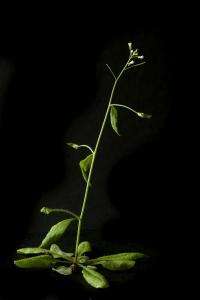
A photo of an Arabidposis plant. Credit: Joe Belcovson, Salk Institute for Biological Studies
A "hidden" code linked to the DNA of plants allows them to develop and pass down new biological traits far more rapidly than previously thought, according to the findings of a groundbreaking study by researchers at the Salk Institute for Biological Studies.
The study, published today in the journal Science, provides the first evidence that an organism's "epigenetic" code - an extra layer of biochemical instructions in DNA - can evolve more quickly than the genetic code and can strongly influence biological traits.
While the study was limited to a single plant species called Arabidopsis thaliana, the equivalent of the laboratory rat of the plant world, the findings hint that the traits of other organisms, including humans, might also be dramatically influenced by biological mechanisms that scientists are just beginning to understand.
"Our study shows that it's not all in the genes," said Joseph Ecker, a professor in Salk's Plant Molecular and Cellular Biology Laboratory, who led the research team. "We found that these plants have an epigenetic code that's more flexible and influential than we imagined. There is clearly a component of heritability that we don't fully understand. It's possible that we humans have a similarly active epigenetic mechanism that controls our biological characteristics and gets passed down to our children. "
With the advent of techniques for rapidly mapping the DNA of organisms, scientists have found that the genes stored in the four-letter DNA code don't always determine how an organism develops and responds to its environment. The more biologists map the genomes of various organisms (their entire genetic code), the more they are discovering discrepancies between what the genetic code dictates and how organisms actually look and function.
In fact, many of the major discoveries that led to these conclusions were based upon studies in plants. There are traits such as flower shape and fruit pigmentation in some plants that are under the control of this epigenetic code. Such traits, which defy the predictions of classical Mendelian genetics, are also found in mammals. In some strains of mice, for instance, a tendency for obesity can pass from generation to generation, but no difference between the genetic code of fat mice and thin mice explains this weight difference.
Scientists have even found that identical human twins exhibit different biological traits, despite their matching DNA sequences. They have theorized that such unexplained disparities could be the work of epigenetic variation.
"Since none of these patterns of variation and inheritance match what the genetic sequence says should happen, there is a clearly a component of the 'genetic' heritability that is missing," Ecker said.
Ecker and other scientists have traced these mysterious patterns to chemical markers that serve as a layer of genetic control on top of the DNA sequence. Just as genetic mutations can arise spontaneously and be inherited by subsequent generations, epigenetic mutations can emerge in individuals and spread into the broader population.
Although scientists have identified a number of epigenetic traits, very little was known about how often they arose spontaneously, how quickly they could spread through a population and how significant an influence they could have on biological development and function.
"Perception of the extent of epigenetic variation in plants from generation to generation varies widely within our scientific community," said Robert Schmitz, a post-doctoral research in Eckers' laboratory and the lead author on the paper. "We actually did the experiment, and found that overall there is very little change between each generation, but spontaneous epimutations do exist in populations and arise at a rate much higher than the DNA mutation rate, and at times they had a powerful influence over how certain genes were expressed."
In their study, the Salk researchers and collaborators at Scripps Research Institute mapped the epigenome of a population of Arabidopsis plants then observed how this biochemical landscape had changed after 30 generations. This mapping consisted of recording the state of all locations on the DNA molecule that could undergo a chemical modification known as methylation, a key epigenetic change that can alter how certain underlying genes are expressed. They then watched how methylation states of these sites evolved over the generations.
The plants were all clones of a single ancestor, so their DNA sequences were essentially identical across the generations. Thus any changes in how the plants expressed certain genetic traits were likely to be a result of spontaneous changes in their epigenetic code - variations in the methylation of the DNA sites- not the result of variations in the underlying DNA sequences.
"You couldn't do this kind of study in humans, because our DNA gets shuffled each generation," Ecker said. "Unlike people, some plants are easily cloned, so we can see the epigenetic signature without all the genetic noise."
The researchers discovered that as many as a few thousand methylation sites on the plants' DNA were altered each generation. Although this represents a small proportion of the potentially six million methylation sites estimated to exist on Arabidopsis DNA, it dwarfs the rate of spontaneous change seen at the DNA sequence level by about five orders of magnitude.
This suggests that the epigenetic code of plants - and other organisms, by extension - is far more fluid than their genetic code.
Even more surprising was the extent to which some of these changes turned genes on or off. A number of plant genes that underwent heritable changes in methylation also experienced substantial alterations in their expression - the process by which genes control cellular function through protein production.
This meant that not only was the epigenome of the plants morphing rapidly despite the absence of any strong environmental pressure, but that these changes could have a powerful influence on the plants' form and function.
Ecker said the results of the study provide some of the first evidence that the epigenetic code can be rewritten quickly and to dramatic effect. "This means that genes are not destiny," he said. "If we are anything like these plants, our epigenome may also undergo relatively rapid spontaneous change that could have a powerful influence on our biological traits."
Now that they have shown the extent to which spontaneous epigenetic mutations occur, the Salk researchers plan to unravel the biochemical mechanisms that allow these changes to arise and get passed from one generation to the next.
They also hope to explore how different environmental conditions, such as differences in temperature, might drive epigenetic change in the plants, or, conversely, whether epigenetic traits provide the plants with more flexibility in coping with environmental change.
"We think these epigenetic events might silence genes when they aren't needed, then turned them back on when external conditions warrant," Ecker said. "We won't know how important these epimutations are until we measure the effect on plant traits, and we're just now to the point where we can do these experiments. It's very exciting."
Provided by
Salk Institute
-
From lemons to lemonade: Reaction uses carbon dioxide to make carbon-based semiconductor,
32 comments
-
Thioridazine kills cancer stem cells in human while avoiding toxic side-effects of conventional cancer treatments,
3 comments
-
SpaceX private rocket blasts off for space station (Update),
42 comments
-
Climate scientists say they have solved riddle of rising sea,
31 comments
-
SpaceX capsule has 'new car' smell, astronauts say (Update),
4 comments
-
What would stain as translucent on light-coloured fabric?
22 hours ago
-
How do I identify different bacteria on culture plates?
May 26, 2012
-
Why Do Dogs do Strange things...
May 25, 2012
-
What does exophillic and endophillic mean in terms of mosquito and their control?
May 24, 2012
-
Semen stains glows under black lights (uv light)?
May 23, 2012
-
Question on Human Chromosome 2
May 23, 2012
- More from Physics Forums - Biology
More news stories
Manufacturing genes to attack flu virus
An international research team has manufactured a new protein that can combat deadly flu epidemics.
3 hours ago |
not rated yet |
0
|
Scientist: Evolution debate will soon be history
(AP) -- Richard Leakey predicts skepticism over evolution will soon be history. Not that the avowed atheist has any doubts himself.
21 hours ago |
3.5 / 5 (20) |
83
More plant species responding to global warming than previously thought
(Phys.org) -- Far more wild plant species may be responding to global warming than previous large-scale estimates have suggested.
May 22, 2012 |
4.6 / 5 (14) |
18
|
Thousands of shellfish found dead in Peru
Thousands of crustaceans were found dead off the coast of Lima following the mystery mass death of dolphins and pelicans, the Peruvian Navy said Friday.
May 26, 2012 |
4.8 / 5 (5) |
7
For monogamous sparrows, it doesn't pay to stray (but they do it anyway)
It's quite common for a female song sparrow to stray from her breeding partner and mate with the male next door, but a new study shows that sleeping around can be costly.
May 22, 2012 |
5 / 5 (2) |
8
|
Land and sea species differ in climate change response: study
(Phys.org) -- Marine and terrestrial species will likely differ in their responses to climate warming, new research by Simon Fraser University and Australia’s University of Tasmania has found.
'Unzipped' carbon nanotubes could help energize fuel cells, batteries
Multi-walled carbon nanotubes riddled with defects and impurities on the outside could replace some of the expensive platinum catalysts used in fuel cells and metal-air batteries, according to scientists at ...
T cells 'hunt' parasites like animal predators seek prey, study shows
By pairing an intimate knowledge of immune-system function with a deep understanding of statistical physics, a cross-disciplinary team at the University of Pennsylvania has arrived at a surprising finding: T cells use a movement ...
Computer model used to pinpoint prime materials for efficient carbon capture
When power plants begin capturing their carbon emissions to reduce greenhouse gases and to most in the electric power industry, it's a question of when, not if it will be an expensive undertaking.
Change in developmental timing was crucial in the evolutionary shift from dinosaurs to birds: study
At first glance, it's hard to see how a common house sparrow and a Tyrannosaurus Rex might have anything in common. After all, one is a bird that weighs less than an ounce, and the other is a dinosaur that ...
Almost half of new vets seek disability
(AP) -- America's newest veterans are filing for disability benefits at a historic rate, claiming to be the most medically and mentally troubled generation of former troops the nation has ever seen.
Sep 16, 2011
Rank: 1.8 / 5 (9)
2.)"...match what the genetic sequence says should happen,..."
3.)"...how quickly they could spread ..."
4.)"...how significant an influence they could have on..."
5.)"...were likely to be..."
6.)"...but that these changes could have..."
7.)"If we are anything like ..."
8.)"...change that could have ..."
9.)"...might silence genes..."
10.)"...might also be dramatically influenced..."
A flawless article and research except for one fact:
Any words after 'if', 'should', 'could', 'would', 'might', 'maybe' and 'but' are non factual.
Even all commentators/writers will benefit from this realization - not just the research papers published.
And the best part of this English linguistic language marker is there are no exceptions to this.
Not all languages have this downfall. Some make honest use of non factual statements.
Sep 16, 2011
Rank: 5 / 5 (9)
Sep 16, 2011
Rank: 3.2 / 5 (10)
Ah, you've found the beauty of science: there are no facts. If more writers took note of this nuance, maybe the sensationalist politicization of science would slow down a little.
Sep 16, 2011
Rank: 1 / 5 (4)
Sep 16, 2011
Rank: 4 / 5 (2)
After all if chimps share apx 98% the same genetic code as humans, surely 2% doesn't encode directly for the difference.
Also embryos all seem to start the same way, then differentiate.
I'm purely guessing here, but it wouldn't surprise me if MANY creatures are pretty much the same geneticly, and the difference is HOW the genes are expressed.
Just look at how a caterpillar transforms into a butterfly!! It's like two seperate creatures, but we know it's the same one with a different morphology, and thus different gene expression.
I wonder if a butterfly had any sort or memory, whether it could remember anything from the caterpillar stage???? Or is it simpy melt into a chemical soup, rearrange and start again.
So I suspect many creatures are the same, just with different "epigenetic" code.
Sep 16, 2011
Rank: not rated yet
Indeed: Something is either "missing" or relevant but yet unknown. It has occurred to me and to others that demanding that genetics or just 'mutation' account for all the variability/adaptability in the living is just not founded. There IS more because what we have cannot do it all! We know there is change, but insufficient, not absent, insufficient mutation to account for all change. D 'adaptive trigger' has been my point all along & current science is closing N on it, more precisely, this article aims at that piece of nature that says '..time to change/adapt..' we cannot just pooh pooh the work because it did not reach a given point or say what we wanted 2 hear. We cannot discard the journey, D growing body of knowledge & ever get 2 D better land of understanding.
word-to-ya-muthas
Sep 16, 2011
Rank: 2 / 5 (3)
Absolute celerity IS a fact.
The Law of Gravity is a fact.
Stoichiometry is a body of fact; The mathematic integral is a fact; Hydrogen fusion is a fact, splitting the atom is made possible by a world...a universe, of facts...etc, etc, etc... The fact that people have made mistakes SEEKING facts IS a fact & not a fact that should excuse error or denounce the pursuit of FACT. We are MORTAL we progress by FAULT: When you were 14, you climbed on your parents house with a cape on, jumped off & broke your arm.Facts dont stop being just because we don't like them!
Thereore, the error of your statement and your belief IS A FACT!
word-to-ya-muthas
Sep 16, 2011
Rank: 3.6 / 5 (9)
Sep 17, 2011
Rank: not rated yet
If we don't speculate about facts, then we can remove at least two words from our vocabulary: obsolete and supersede.
Wealthychef and LeChatlier statements are consistent with each other. The ratings must reflect other factors other than consistency.
Facts are like DNA and cosmology. Changing over time. Sometimes the rate of change is exponential.
Sep 17, 2011
Rank: 5 / 5 (1)
This article is all over the place, with claims of mysterious effects on the one hand, followed by the explanation of epigenetics. It's very poor form to try to manufacture some kind of mystery to, supposedly keep people interested, when the effect has been known about for some time.
Epigenetics, in its modern meaning, has been known since the 1990s, while the etymology of the term (with slightly different meaning) can be traced to the 50s and 60s. For example, epigenetics plays a role in fur coloration/markings in cats and other mammals, so even if you were to clone your dead pet, it may end up looking totally different (markings wise) than the original.
Sep 17, 2011
Rank: 5 / 5 (3)
Sep 17, 2011
Rank: 2.3 / 5 (3)
...which...does NOT, NOT make it any less A FACT...you...and your argument...stilll have the scar tissue to prove it..!
word...
Sep 17, 2011
Rank: 5 / 5 (1)
Sep 17, 2011
Rank: 1 / 5 (1)
Sep 17, 2011
Rank: 3 / 5 (2)
It was sloppy thinking that caused people to claim DNA coded for proteins and that sloppy thinking resulted in a lack of understanding till recently that the RNA often has biological properties without being transcribed into amino acids.
And yes that Wiki should be changed.
Ethelred
Sep 17, 2011
Rank: not rated yet
Sep 17, 2011
Rank: not rated yet
That's referring to the 4 bases, not that fact that codons are 3 nucleotides long...
Sep 17, 2011
Rank: not rated yet
Sep 18, 2011
Rank: 3 / 5 (4)
Sep 18, 2011
Rank: 3 / 5 (2)
The RNA is what can code for an amino acid but RNA is not limited to being a messenger molecule. Which is why I say it is sloppy to say DNA codes for amino acids since it only codes for the RNA.
Ethelred
Sep 18, 2011
Rank: not rated yet
In wikipedia:
http://en.wikiped...tic_code
...doesn't the first sentence only suggest the "sloppiness" (possible source of misinterpretation) you are referring to?
I can not find in the rest of the Wikipedia text a path that leads away from a straight and narrow interpretation.
Just curious.
Sep 19, 2011
Rank: 3 / 5 (2)
I wrote on Apolyton.com around 2002 about RNA being largely ignored. I did that independently because not being a biologist I was not aware that a few people had recently started to look into the biological activity of RNA besides mRNA. My thinking was that the parts of DNA that coded just fine for RNA but not for functioning proteins might still be biologically active. After all it WAS active in ribosomes so why not elsewhere? And SOMETHING had to code for the ribosomes. What the hell were people thinking being so fixated on proteins?
This turns out to be true. Junk DNA is NOT all junk.
This is why all the stuff that treats DNA as coding directly for proteins needs to be replaced. The point of view is wrong.
Ethelred
Sep 19, 2011
Rank: 3 / 5 (2)
Ethelred
Sep 20, 2011
Rank: not rated yet
As full-genom sequencing is getting cheaper, the realisation is coming through, that the DNA in one cell of an organism is never exactly the same as in the cell spawned off.
In spite of these differences, they are not enough to explain different behaviour between "identical" cells. Even IF the cells would have exactly the same DNA, the cell-surrounding is never the same. A cell isn't symmetrical down to atom level, and even IF it was, the likelihood that it would be split exactly in the middle is minuscule. Thus the "epigenetics" - all from methyl-groups attached directly to the DNA to molecules acting from more far away in the cell.- is what makes every "identical" cell unique.
Sep 20, 2011
Rank: not rated yet
Small hints are arriving that some cancer might be caused by "epigenetic" changes outside of the DNA molecule but inside the cell. The term epigenetics has to be put in between citation marks, as no one knows how much of such factors are transfered almost unchanged (almost unchanged as near perfect DNA-re/duplication) to the next cell.
Sep 25, 2011
Rank: not rated yet
Where are you pulling "four letter words" from? That does not exist and is not implied anywhere in this article. What you're looking for is "four letter code", which has been previously quoted and is accurate. DNA consists of 4 bases. Nowhere does that imply that codons are 4 bases long.