Gene controlling flowering boosts energy production from sorghum
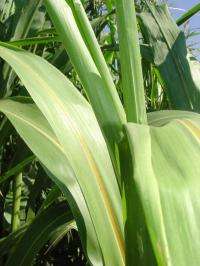
A sorghum hybrid that does not flower and accumulates as much as three times the amount of stem and leaf matter may help the bioenergy industry, according to a study appearing today in the Proceedings of the National Academy of Sciences.
A team at Texas AgriLife Research has discovered a gene that regulates sorghum flowering, according to the proceedings.
"For energy crops, we want to prevent plants from flowering so they accumulate as much biomass as possible for bioenergy/biofuels production," said Dr. John Mullet, AgriLife Research biochemist. sorghum leaves
Sorghum is a grass, native to Africa, that provides an indispensable food source for more than 300 million people in countries where food supplies are insecure, according to the paper's authors. They noted that though primarily grown for its grain and forage, high biomass sorghum is also an excellent drought-tolerant energy crop for sustainable production of lignocellulosic-based biofuels.
"We were able to identify a gene in sorghum that controls flowering in response to day length, and we discovered that the gene is regulated by the plant's internal 'clock' and light enabling the plant to flower at approximately the same date each growing season," Mullet said.
Research team member Rebecca Murphy described "walking along the chromosome" of sorghum using genetic mapping techniques until landing on what she calls Maturity Locus 1, an historically important genetic determinant of flowering time originally discovered by AgriLife Research scientists in 1945.
"Flowering time is important for sorghum no matter what type of sorghum is grown," said Murphy, a biochemistry doctoral student at Texas A&M University. "In the case of bioenergy sorghum, you want to delay flowering because the more you delay flowering, the more biomass sorghum will accumulate.
"Before this discovery, a sorghum breeder would have to wait for a plant to flower to see what type of flowering time genes were in the sorghum," she said. "Now we will be able at a very early stage to look at the molecular level and determine a plant's flowering type genotype. Then, a breeder can pretty accurately predict flowering time without having to wait for the plant to mature."
"Work on understanding how and when sorghum flowers has been studied for decades, Mullet explained. Initially, many sorghum varieties brought to the U.S. from Africa would not flower or flowered too late to develop grain, he said. That made the crop useless for grain production until scientists began breeding plants to flower early enough to avoid drought in the southern states or in time to mature before frost in the north.
Early researchers identified four genes – called Ma1 through Ma4 – that control flowering time in sorghum, Mullet said. Until recently, flowering time regulation was important primarily for grain production. However, the more recent search for alternatives to fossil fuels has led to the development of sorghum as a dedicated bioenergy crop.
"In this study, we identified the gene in sorghum that corresponds to Ma4-1. There are mutations in that gene in some sorghum genotypes that inactivate the gene causing plants to flower early," Mullet said. "But when the gene is active, the plants flower late. It was a variation in the activity of the gene corresponding to Ma1 that sorghum breeders have been using in breeding programs for years to fine-tune when their hybrids would flower.
"Our work connected the initial discovery of Ma1 in the 1940s to the identification of the gene that was regulating when plants would flower."
But whether a sorghum plant will flower is not the only catch for using sorghum as a bioenergy crop. Mullet said scientists have long been interested in understanding the fundamental biochemical mechanisms that plants use to determine when to flower.
Researchers in the 1920s and 30s began piecing together the impact of day length, calling it photoperiodism, to describe how a plant decides to turn on its flowering mechanism, Mullet said. More recent research demonstrated that plants use an internal clock to keep track of 24-hour time and light sensory to measure the length of the day and night.
"The interaction of those two types of information is used by the plant to determine when in a growing season to flower," Mullet said.
"We figured out how the plant's internal clock and day length in sorghum co-regulate the expression of the Ma1gene called PRR37 to fine-tune exactly when the plant will induce flowering under different circumstances," Mullet said. "So in a practical sense, we now understand how this gene regulates flowering and this insight is helping us fill in an entire pathway which regulates flowering time in sorghum."
Murphy indicated that a planting test of sorghum phenotypes with an active form of Ma1 and other genes in this pathway could be delayed in flowering for up to 200 days compared to the usual 60 days for a grain-type sorghum.
"That is a striking difference," she said, showing two 90-day-old plants, one a non-flowering sorghum plant reaching a 10-foot ceiling and the other a typical 3-foot sorghum variety that would yield grain.
Mullet explained that breeders "can now use molecular markers to assist in the design of sorghum hybrids that flower at optimal times accelerating the process of breeding high-yielding grain, sweet and energy sorghum hybrids."
Provided by Texas A&M AgriLife Communications


