New plant ecology study challenges conventional wisdom
September 26, 2011

New plant ecology study challenges conventional wisdom

Enlarge

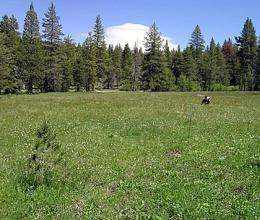
Ecologists monitored diverse grassland sites on five continents to challenge the prevailing belief about habitat productivity. (Dan Gruner/University of Maryland photo)

(PhysOrg.com) -- An international team of 58 ecologists, including UC Davis researcher Louie Yang, has found that habitat productivity does not predict the quantity or diversity of plant species, as has been assumed for several decades.

The groundbreaking research, published today in the journal Science, shows "no clear relationship between productivity and the number of plant species in small study plots," said Utah State University plant Peter Adler, lead author of the paper.

Productivity refers to the amount of biomass, or , that a habitat yields.

The findings challenge a prevailing model, developed in the early 1970s by British ecologist J. Philip Grime, which proposed that the number of rises and then declines with increasing productivity.

Not generally so, says the new study. The ecologists sampled 48 diverse grassland sites on five continents in a novel project, partially supported by the National Science Foundation.

The Science paper is one of the first to emerge from the research launched five years ago with the formation of Nutrient Network, http://nutnet.science.oregonstate.edu, a cooperative research initiative dedicated to investigating biodiversity and in global grasslands.

“It’s a really innovative approach to ecology,” said Yang, an assistant professor in the Department of Entomology. “We conducted a coordinated study in diverse at the 48 sites and we pooled our data together to address some persistent issues in the field.

“In this paper, we show that plant diversity is not predicted by productivity in any general or simple way; instead, it looks like patterns of plant diversity result from more complex processes, which are variable at local, regional and global scales.”

Yang’s research contributions to the network came from a field site at UC Berkeley’s Sagehen Creek Field Station, located near Truckee in Nevada County. He and University of Maryland researcher Dan Gruner have managed a montane, or highland meadows, research site there since 2007.

Future research may target factors regulating biodiversity, such as evolutionary history, disturbance and resource supply, the researchers said.

Provided by UC Davis search and more info website

Filter


Move the slider to adjust rank threshold, so that you can hide some of the comments.


Display comments: newest first

Who_Wants_to_Know
Sep 26, 2011

Rank: not rated yet
Silly me. And here I thought that conducting scientific research was all about things like knowing the merits and defects of all the other research out there about the subject of interest, being skeptical of claims and ensuring that they're well verified before buying into them, building on other scientists work, designing a falsifiable experiment able to prove your hypothesis had merit, collecting real world data during that experiment, analysing it, then if meaningful, putting your results and conclusions out there for others to then replicate, verify and validate - or refute. Upon which the cycle begins again.

Apparently that's innovative to the science of ecology, however.

At least these folks DID apparently use a scientific approach, thus overturning what from the sounds of it was unsubstantiated dogma for the last few decades - at least wrt this issue.
Rank 3 /5 (2 votes)
Relevant PhysicsForums posts

More news stories

Scientist: Evolution debate will soon be history

(AP) -- Richard Leakey predicts skepticism over evolution will soon be history. Not that the avowed atheist has any doubts himself.

Biology / Evolution

created 16 hours ago | popularity 3.3 / 5 (17) | comments 51

More plant species responding to global warming than previously thought

(Phys.org) -- Far more wild plant species may be responding to global warming than previous large-scale estimates have suggested.

Biology / Ecology

created May 22, 2012 | popularity 4.6 / 5 (14) | comments 18 | with audio podcast

Thousands of shellfish found dead in Peru

Thousands of crustaceans were found dead off the coast of Lima following the mystery mass death of dolphins and pelicans, the Peruvian Navy said Friday.

Biology / Ecology

created May 26, 2012 | popularity 4.8 / 5 (4) | comments 7

For monogamous sparrows, it doesn't pay to stray (but they do it anyway)

It's quite common for a female song sparrow to stray from her breeding partner and mate with the male next door, but a new study shows that sleeping around can be costly.

Biology / Plants & Animals

created May 22, 2012 | popularity 5 / 5 (2) | comments 7 | with audio podcast

Study uncovers secret to speedy burrowing by razor clams

(Phys.org) -- If you look at a razor burrowing clam sitting in a bucket, you’d never guess that it could burrow itself down into the soil, much less do it with any speed. Razor clams look like fat straws, ...

Biology / Plants & Animals

created May 25, 2012 | popularity 1 / 5 (1) | comments 3 | with audio podcast report


Nvidia trumpets Tegra 3 phone design wins for 2012

(Phys.org) -- Nvidia’s competitive war paint has a name, Tegra 3. On the heels of Nvidia announcements about lowering costs of its Tegra 3 processors and Nvidia-enabled tablets running Android Ice Cream ...

Browser wars flare in mobile space

The browser wars are heating up again, but this time the fight is for dominance of the mobile Internet.

Dell tablet leak: 10.1-inch display, two-battery choice

(Phys.org) -- Headline after headline talks about vendors’ tablets in the wings as likely number-one contenders for the iPad. Such claims have justifiably been taken with a grain of salt, considering ...

Keep food safety in mind this memorial day weekend

(HealthDay) -- Picnics, parades and cookouts are as much a part of Memorial Day weekend as tributes to the United States' war veterans.

Social welfare cuts ultimately come with heavy price, researchers say

(Phys.org) -- Slashing government funding for Medicaid, food stamps and other programs that serve the poor – while politically popular with some lawmakers and many conservatives – may do more harm ...

Is a classical electrodynamics law incompatible with special relativity?

(Phys.org) -- The laws of classical electromagnetism that were developed in the 19th century are the same laws that scientists use today. They include Maxwell’s four equations along with the Lorentz la ...