Engineers 'cook' promising new heat-harvesting nanomaterials in microwave oven
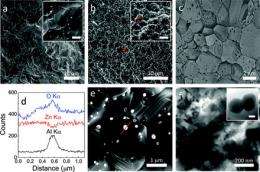
Engineering researchers at Rensselaer Polytechnic Institute have developed new thermoelectric nanomaterials, pictured above, that could lead to techniques for better capturing and putting this waste heat to work. The key ingredients for making marble-sized pellets of the new material are aluminum and a common, everyday microwave oven.
(PhysOrg.com) -- Waste heat is a byproduct of nearly all electrical devices and industrial processes, from driving a car to flying an aircraft or operating a power plant. Engineering researchers at Rensselaer Polytechnic Institute have developed new nanomaterials that could lead to techniques for better capturing and putting this waste heat to work. The key ingredients for making marble-sized pellets of the new material are aluminum and a common, everyday microwave oven.
Harvesting electricity from waste heat requires a material that is good at conducting electricity but poor at conducting heat. One of the most promising candidates for this job is zinc oxide, a nontoxic, inexpensive material with a high melting point. While nanoengineering techniques exist for boosting the electrical conductivity of zinc oxide, the materials high thermal conductivity is a roadblock to its effectiveness in collecting and converting waste heat. Because thermal and electrical conductivity are related properties, its very difficult to decrease one without also diminishing the other.
However, a team of researchers led by Ganpati Ramanath, professor in the Materials Science and Engineering Department at Rensselaer, in collaboration with the University of Wollongong, Australia, have demonstrated a new way to decrease zinc oxides thermal conductivity without reducing its electrical conductivity. The innovation involves adding minute amounts of aluminum to zinc oxide, and processing the materials in a microwave oven. The process is adapted from a technique invented at Rensselaer by Ramanath, graduate student Rutvik Mehta, and Theo Borca-Tasciuc, associate professor in the Department of Mechanical, Aerospace, and Nuclear Engineering (MANE). This work could open the door to new technologies for harvesting waste heat and creating highly energy efficient cars, aircraft, power plants, and other systems.
Harvesting waste heat is a very attractive proposition, since we can convert the heat into electricity and use it to power devices like in a car or a jet that is creating the heat in the first place. This would lead to greater efficiency in nearly everything we do and, ultimately, reduce our dependence on fossil fuels, Ramanath said. We are the first to demonstrate such favorable thermoelectric properties in bulk-sized high-temperature materials, and we feel that our discovery will pave the way to new power harvesting devices from waste heat.
Results of the study are detailed in the paper Al-Doped Zinc Oxide Nanocomposites with Enhanced Thermoelectric Properties, published recently by the journal Nano Letters. View the paper online at: http://pubs.acs.or … 21/nl202439h
To create the new nanomaterial, researchers added minute quantities of aluminum to shape-controlled zinc oxide nanocrystals, and heated them in a $40 microwave oven. Ramanaths team is able to produce several grams of the nanomaterial in a matter of few minutes, which is enough to make a device measuring a few centimeters long. The process is less expensive and more scalable than conventional methods and is environmentally friendly, Ramanath said. Unlike many nanomaterials that are fabricated directly onto a substrate or surface, this new microwave method can produce pellets of nanomaterials that can be applied to different surfaces. These attributes, together with low thermal conductivity and high electrical conductivity, are highly suitable for heat harvesting applications.
Our discovery could be key to overcoming major fundamental challenges related to working with thermoelectric materials, said project collaborator Borca-Tasciuc. Moreover, our process is amenable to scaling for large-scale production. Its really amazing that a few atoms of aluminum can conspire to give us thermoelectric properties were interested in.
Provided by
Rensselaer Polytechnic Institute
-
From lemons to lemonade: Reaction uses carbon dioxide to make carbon-based semiconductor,
32 comments
-
Thioridazine kills cancer stem cells in human while avoiding toxic side-effects of conventional cancer treatments,
3 comments
-
SpaceX private rocket blasts off for space station (Update),
42 comments
-
Climate scientists say they have solved riddle of rising sea,
31 comments
-
SpaceX capsule has 'new car' smell, astronauts say (Update),
2 comments
-
microstructure of titanium
19 hours ago
-
Steam in My Espresso Machine
May 26, 2012
-
Density question
May 24, 2012
-
Mass transport originating from a point source at a solid gas interface
May 22, 2012
-
Ammonia dispersion in Air
May 22, 2012
-
Multi Choice Help
May 21, 2012
- More from Physics Forums - Materials & Chemical Engineering
More news stories
In nanorod crystal growth, nanoparticles seen as artificial atoms
In the growth of crystals, do nanoparticles act as "artificial atoms" forming molecular-type building blocks that can assemble into complex structures? This is the contention of a major but controversial theory ...
May 24, 2012 |
4.8 / 5 (6) |
0
|
First direct observation of oriented attachment in nanocrystal growth
Berkeley Lab researchers have reported the first direct observation of nanoparticles undergoing oriented attachment, the critical step in biomineralization and the growth of nanocrystals. A better understanding ...
May 24, 2012 |
4.7 / 5 (3) |
0
|
Dopant gives graphene solar cells highest efficiency yet
(Phys.org) -- By taking advantage of graphenes favorable electrical and optical properties, and then adding an organic dopant, researchers have achieved the highest power conversion efficiency yet for ...
Synthetic nano-waste does not disappear
(Phys.org) -- Tiny particles of cerium oxide do not burn or change in the heat of a waste incineration plant. They remain intact on combustion residues or in the incineration system, as a new study by Swiss ...
Nanotechnology / Bio & Medicine
May 25, 2012 |
5 / 5 (2) |
1
|
'Metamaterials,' quantum dots show promise for new technologies
(Phys.org) -- Researchers are edging toward the creation of new optical technologies using "nanostructured metamaterials" capable of ultra-efficient transmission of light, with potential applications including ...
May 24, 2012 |
5 / 5 (7) |
1
|
Nvidia trumpets Tegra 3 phone design wins for 2012
(Phys.org) -- Nvidias competitive war paint has a name, Tegra 3. On the heels of Nvidia announcements about lowering costs of its Tegra 3 processors and Nvidia-enabled tablets running Android Ice Cream ...
Browser wars flare in mobile space
The browser wars are heating up again, but this time the fight is for dominance of the mobile Internet.
Scientist: Evolution debate will soon be history
(AP) -- Richard Leakey predicts skepticism over evolution will soon be history. Not that the avowed atheist has any doubts himself.
Dell tablet leak: 10.1-inch display, two-battery choice
(Phys.org) -- Headline after headline talks about vendors tablets in the wings as likely number-one contenders for the iPad. Such claims have justifiably been taken with a grain of salt, considering ...
Keep food safety in mind this memorial day weekend
(HealthDay) -- Picnics, parades and cookouts are as much a part of Memorial Day weekend as tributes to the United States' war veterans.
Social welfare cuts ultimately come with heavy price, researchers say
(Phys.org) -- Slashing government funding for Medicaid, food stamps and other programs that serve the poor while politically popular with some lawmakers and many conservatives may do more harm ...
Sep 29, 2011
Rank: 5 / 5 (1)
An excerpt from the future spinoff device's instruction manual...
"To create your own nanomaterial, just place the zinc oxide crystals and aluminum material onto the rotating plater, close the door, and press the [Nano} button on the front control panel."
Sep 29, 2011
Rank: not rated yet
Sep 29, 2011
Rank: not rated yet
That's nothing, you should see what the 100$ model can do.
In all seriousness, this is some cool work. It could lead to thermoelectric generators with customized Seebeck coefficients of the materials. Designed to fit the problem directly, it could really increase the efficiency with which they are utilized.
On one note, if most design didn't rely on overkill, we'd not have so much waste to deal with capturing.
..jus' sayin'
Sep 29, 2011
Rank: not rated yet
Sep 29, 2011
Rank: not rated yet
Both is working. Imaging of taking a high ZT material, and than
make a nano-structure of that... One thing to keep in mind
is that nano-structured stuff is extremely expensive, while
instrintically high ZT materials could be literally cooked up
in a microwave :-)
Speaking of ZT for this material, it is not that great
in general: ZT 0.44 But it is at 1000 K but it is great for because the other high ZT materials do not survive at such temperatures.
I need not to mention that high temperature of the heater
is great for the efficiency due to the Karnot equation (assuming that cooler is at the air temperature).